



Relevant for Exams
Research links ancient Vaigai flood 1,155 years ago to Keezhadi's abandonment.
Summary
New research suggests that urban-like structures at Keezhadi, an archaeological site, were buried approximately 1,155 years ago due to a high-energy flood event in the Vaigai river. This discovery offers a potential explanation for the abandonment of the ancient settlement, providing crucial insights into the historical geography and environmental factors influencing ancient Indian civilizations, which is highly relevant for history and culture sections in competitive exams.
Key Points
- 1New research indicates urban-like structures at Keezhadi were buried around 1,155 years before present.
- 2The burial event is attributed to a high-energy flood from the Vaigai river.
- 3The flood deposited sands, then finer silts and clays on the floodplain, covering the structures.
- 4Keezhadi is a significant archaeological site in Tamil Nadu, India, known for its Sangam-era findings.
- 5The research suggests this flood event may have contributed to the abandonment of the ancient Keezhadi settlement.
In-Depth Analysis
The recent research suggesting that urban-like structures at Keezhadi were buried around 1,155 years ago due to a high-energy flood from the Vaigai river offers profound insights into ancient Indian history, environmental archaeology, and the resilience of early civilizations. This discovery not only provides a potential explanation for the abandonment of a significant ancient settlement but also enriches our understanding of the Sangam Age and its aftermath in South India.
**Background Context: Unearthing Keezhadi's Significance**
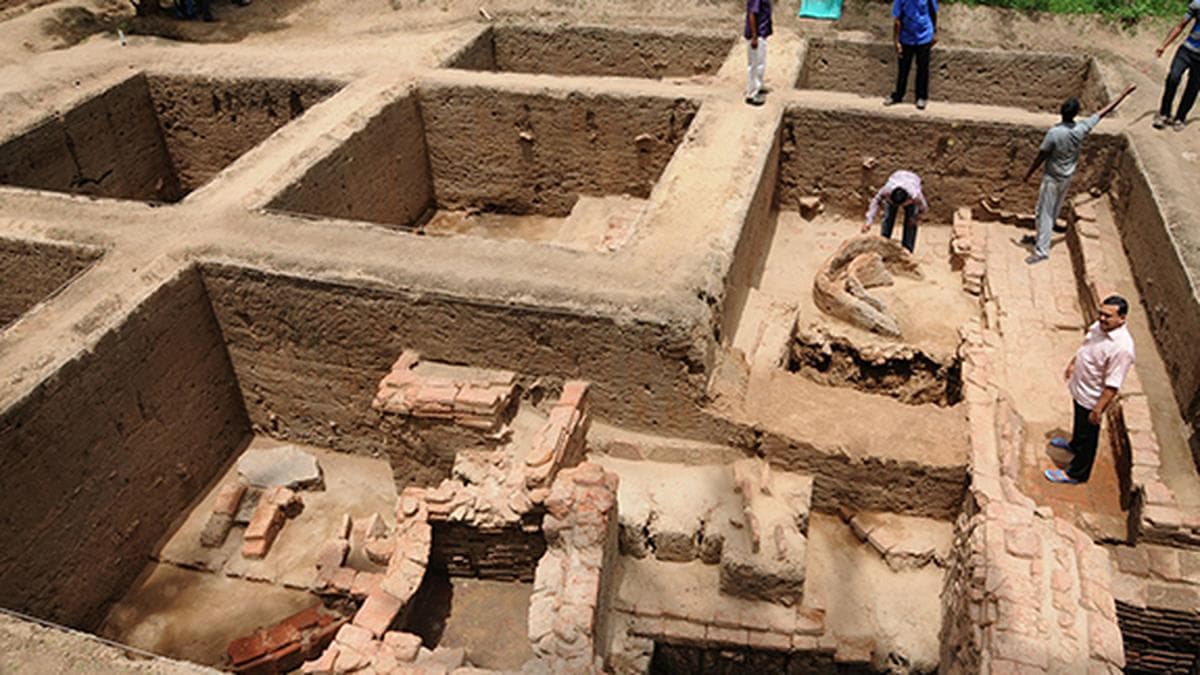
Keezhadi, situated on the banks of the Vaigai River in the Sivaganga district of Tamil Nadu, has emerged as one of India's most crucial archaeological sites. Excavations, initially by the Archaeological Survey of India (ASI) and later predominantly by the Tamil Nadu State Department of Archaeology (TNSDA), began in 2014. The findings at Keezhadi have challenged conventional timelines of urbanisation in South India, pushing back the estimated period of a sophisticated, literate society. The site has revealed evidence of a thriving urban settlement dating back to the Sangam Age (roughly 3rd century BCE to 3rd century CE), characterized by well-laid out brick structures, advanced drainage systems, pottery inscribed with Tamil-Brahmi script, beads, iron objects, and evidence of industrial activities like dyeing and weaving. These discoveries have provided strong archaeological corroboration for the vivid descriptions of urban life found in ancient Tamil Sangam literature, often considered semi-mythical by some until recently.
**What Happened: The Vaigai's Fury and Keezhadi's Fate**
The new research, based on geological and archaeological evidence, posits that significant urban structures at Keezhadi were inundated and buried approximately 1,155 years before present (around 868 CE). This event is attributed to a powerful flood in the Vaigai River, which deposited layers of coarse sands followed by finer silts and clays over the floodplain, effectively entombing parts of the settlement. Such a high-energy flood would have been catastrophic, rendering the area uninhabitable and potentially leading to the gradual or sudden abandonment of the site. This dating places the abandonment or significant decline of Keezhadi well after the traditional Sangam period, suggesting continued occupation or a later phase of habitation that was ultimately impacted by this natural disaster.
**Key Stakeholders Involved**
Primary stakeholders include the **Archaeological Survey of India (ASI)**, which initiated the excavations and is responsible for the protection and preservation of ancient monuments and archaeological sites under the Ancient Monuments and Archaeological Sites and Remains Act, 1958. The **Tamil Nadu State Department of Archaeology (TNSDA)** has played an increasingly prominent role, conducting multiple phases of excavation and spearheading research, including the recent findings. The **scientific community**, particularly geologists, hydrologists, and archaeologists from various institutions, are crucial in conducting and interpreting such interdisciplinary research. Indirectly, the **local communities** around Keezhadi are stakeholders, as the site's development can bring tourism and economic benefits, while also requiring their cooperation for preservation efforts.
**Why This Matters for India: Re-evaluating History and Heritage**
The Keezhadi findings, especially this new flood theory, hold immense significance for India. Firstly, they **reaffirm the antiquity and sophistication of urbanisation in South India**, challenging narratives that predominantly focused on North Indian developments. It provides tangible proof of a vibrant, literate society that flourished independently. Secondly, it **validates the historical accuracy of Sangam literature**, transforming poetic descriptions into archaeological facts and strengthening Tamil cultural identity and pride. Thirdly, it underscores the **impact of environmental factors on ancient civilizations**. Understanding how past societies coped with or succumbed to natural disasters like floods offers crucial lessons for modern disaster management and urban planning, especially in riverine and coastal areas. From a broader perspective, it highlights India's rich and diverse cultural heritage, fostering national pride and potentially boosting heritage tourism, contributing to the local economy.
**Historical Context and Future Implications**
Historically, river systems have been the cradles of civilizations worldwide, from the Indus Valley Civilization to Mesopotamia and Egypt. The Vaigai River's role in Keezhadi's rise and potential fall mirrors this global pattern. This research adds to the growing body of evidence about climate change and extreme weather events impacting ancient societies, a topic of increasing relevance today. Future implications include the impetus for more interdisciplinary research combining archaeology, geology, and climate science to reconstruct ancient environments. It also necessitates robust **conservation strategies** for archaeological sites, especially those vulnerable to natural disasters. Policy-wise, it reinforces the importance of the **Ancient Monuments and Archaeological Sites and Remains Act, 1958**, and the constitutional mandate under **Article 49**, which directs the State to protect monuments and places of artistic or historic interest. Further, it can inform modern policies for urban resilience and disaster preparedness, drawing lessons from how ancient communities adapted or failed to adapt to environmental challenges.
In essence, the Keezhadi flood theory is not just an archaeological revelation; it's a window into the dynamic interplay between human civilization and nature, offering vital lessons for understanding our past and preparing for our future.
Exam Tips
This topic primarily falls under GS Paper I (History & Culture - Ancient History of India, specifically South Indian History and Archaeology) for UPSC, SSC, and State PSC exams. Be prepared for questions on the Sangam Age, urbanisation in ancient India, and the significance of archaeological sites.
Study related topics such as the Indus Valley Civilization (for comparison of urban planning and riverine settlements), other significant Sangam Age sites like Arikamedu and Poompuhar, and the broader context of ancient Indian trade and maritime history. Understand the chronological order of major archaeological discoveries.
Common question patterns include direct factual questions (e.g., 'Keezhadi is located on the banks of which river?'), questions on the significance of Keezhadi's findings (e.g., 'How do Keezhadi findings challenge existing narratives of urbanisation?'), and analytical questions on the impact of geographical/environmental factors on ancient civilizations.
Related Topics to Study
Full Article
According to new research, some urban-like structures at Keezhadi were likely buried a little over a thousand years ago — around 1,155 years before present in scientists’ phrasing — and this burial was related to a high-energy flood event that deposited sands and then finer silts and clays on the floodplain