

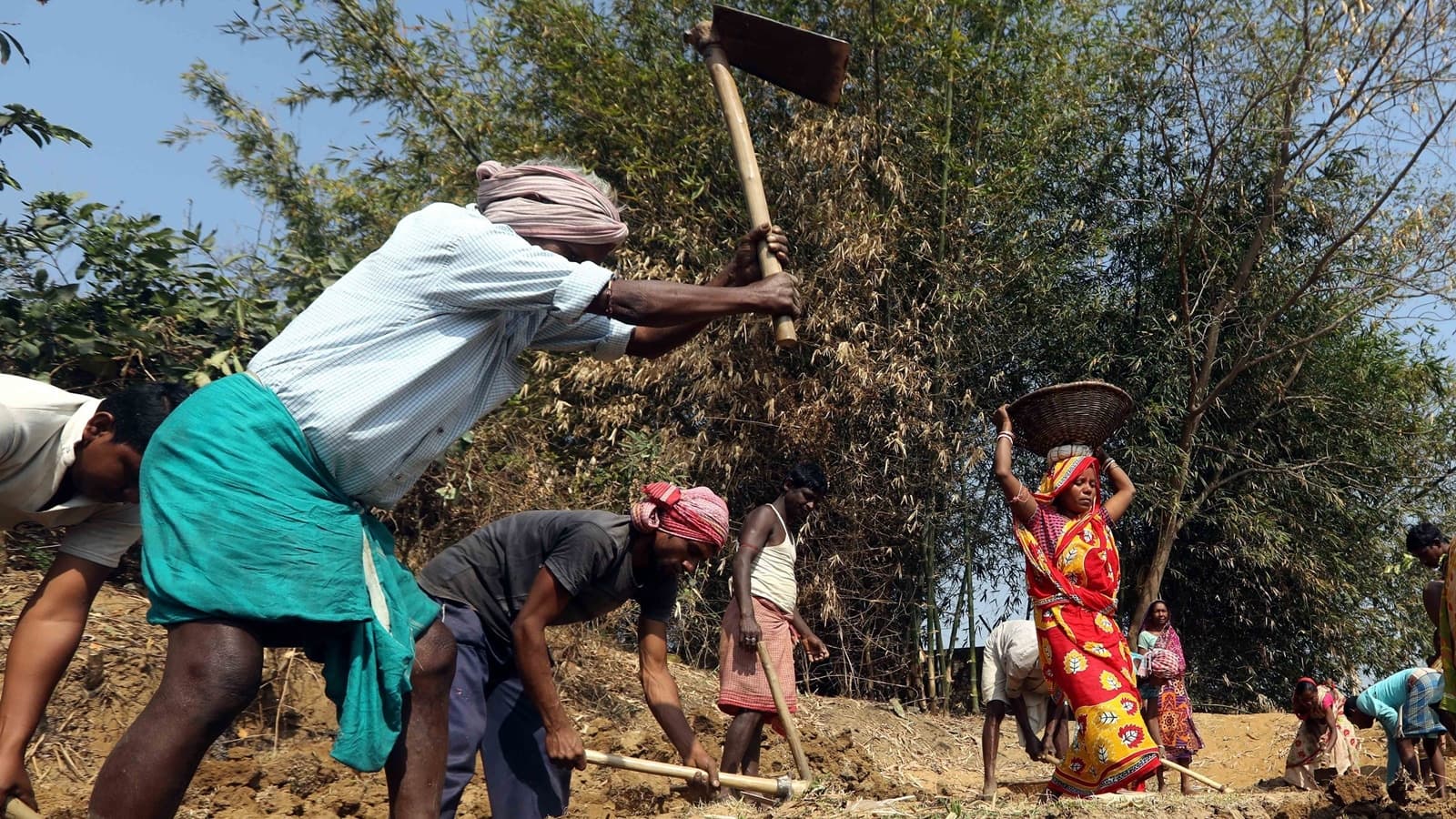


No content provided for 'G Ram G Act' analysis; unable to extract exam-relevant facts.
Summary
The provided article titled 'Decode Politics: In MGNREGA shadow, why G Ram G Act may face a bumpy road ahead' explicitly states 'No content available'. Consequently, a detailed summary explaining the specifics of the 'G Ram G Act', its challenges, or its significance in relation to MGNREGA for competitive exam preparation cannot be generated.
Key Points
- 1The input article explicitly states 'No content available' for analysis.
- 2Specific details regarding the 'G Ram G Act', its provisions, or its comparison with MGNREGA are absent.
- 3Reasons for the 'bumpy road ahead' for the 'G Ram G Act' cannot be extracted from the provided input.
- 4No names, dates, numbers, or constitutional/legal provisions related to the act are available.
- 5Without content, no exam-focused key points or MCQs can be formulated from this article.
In-Depth Analysis
The article title, 'Decode Politics: In MGNREGA shadow, why G Ram G Act may face a bumpy road ahead,' hints at a new legislative initiative, tentatively named the 'G Ram G Act,' that appears to be emerging in the context of India's flagship rural employment guarantee scheme, MGNREGA. While the content of the article is unavailable, the title itself provides a strong direction for analysis. It suggests that any new act aiming to address rural employment or welfare will inevitably be compared to and influenced by the legacy and operational realities of the Mahatma Gandhi National Rural Employment Guarantee Act (MGNREGA).
**Background Context: The Genesis of Rural Employment Guarantee**
India has a long history of grappling with rural poverty and unemployment. Prior to MGNREGA, various schemes like the Rural Landless Employment Guarantee Programme (RLEGP) and Jawahar Rozgar Yojana (JRY) existed, but they often suffered from limited reach, leakages, and inadequate funding. The need for a more robust, rights-based approach culminated in the enactment of the National Rural Employment Guarantee Act (NREGA) in 2005, which was later renamed MGNREGA in 2009. This Act marked a paradigm shift by guaranteeing 100 days of wage employment in a financial year to every rural household whose adult members volunteer to do unskilled manual work. It was a groundbreaking legislation, rooted in the Directive Principles of State Policy, particularly Article 41 (Right to work, to education and to public assistance in certain cases) and Article 43 (Living wage, etc., for workers).
**What the 'G Ram G Act' Might Be and Its Potential Challenges**
Given the title, the 'G Ram G Act' is likely another initiative focused on rural development, employment, or livelihood security. Its mention 'in MGNREGA shadow' implies that it might be an attempt to either supplement, reform, or even replace certain aspects of MGNREGA. The 'bumpy road ahead' suggests potential challenges. These could stem from several factors: the sheer scale and established legal framework of MGNREGA, its wide political acceptance (despite criticisms), the massive financial outlay it requires, and the intricate implementation machinery involving Panchayati Raj Institutions (PRIs).
Any new act in this domain would need to demonstrate clear advantages over MGNREGA. Is it designed to address MGNREGA's shortcomings, such as delayed wage payments, limited asset creation, or demand-supply mismatches? Or is it an attempt to re-orient rural employment towards specific sectors like agriculture, skill development, or climate resilience? The 'bumpy road' could also refer to political resistance, bureaucratic hurdles, or fiscal constraints, especially if it proposes an equally ambitious or more expensive scheme. The COVID-19 pandemic highlighted MGNREGA's crucial role as a safety net, significantly increasing its demand and budget allocation in recent years, making any alternative or parallel scheme's path even more challenging.
**Key Stakeholders Involved**
The primary stakeholders in any rural employment scheme are: the **Central Government** (formulating policy, providing funds), **State Governments** (implementing the scheme, sharing costs, managing ground operations), **Rural Workers** (the beneficiaries, whose livelihoods depend on it), **Panchayati Raj Institutions (PRIs)** (crucial for demand generation, work allocation, and local oversight), **Civil Society Organizations (CSOs)** (advocacy, monitoring, grievance redressal), and **Academics/Researchers** (evaluating impact, suggesting reforms). For the 'G Ram G Act' to succeed, it would need the buy-in and effective coordination of all these groups.
**Significance for India**
Rural employment schemes like MGNREGA are critical for India's socio-economic fabric. They contribute to poverty alleviation, reduce distress migration, empower women (who constitute a significant portion of MGNREGA workers), improve rural infrastructure, and inject liquidity into the rural economy. The success or failure of a new act like 'G Ram G Act' would have profound implications for millions of rural households. It could either strengthen India's social safety nets or, if poorly designed or implemented, create confusion and dilute the effectiveness of existing welfare measures.
**Future Implications**
The future of rural employment policy in India will likely involve a continuous debate on balancing welfare with productivity, ensuring timely wage payments, enhancing asset creation, and integrating skill development. The 'G Ram G Act' could represent an evolution in this policy thinking, perhaps aiming for more targeted interventions, greater convergence with other schemes (like those for agriculture or water conservation), or leveraging technology for better transparency and accountability. However, it must navigate the political economy of rural welfare, overcome implementation challenges, and secure adequate, consistent funding to avoid the 'bumpy road' implied by the article title. The experience of MGNREGA offers both lessons and a high benchmark for any successor or complementary scheme.
**Related Constitutional Articles, Acts, or Policies**
* **Article 41 & 43 of DPSP:** The foundational principles for the right to work and living wage.
* **MGNREGA Act, 2005:** The benchmark legislation for rural employment guarantee.
* **73rd & 74th Constitutional Amendment Acts (1992):** Empowered Panchayati Raj Institutions, which are vital for implementing rural schemes.
* **Pradhan Mantri Gram Sadak Yojana (PMGSY), National Rural Livelihoods Mission (NRLM):** Other significant rural development schemes with which a new act might seek convergence.
Exam Tips
This topic falls under the 'Indian Economy' and 'Indian Polity & Governance' sections of the UPSC Civil Services Syllabus (GS Paper II & III) and various State PSC exams. Focus on the evolution of welfare policies and their constitutional basis.
Study MGNREGA comprehensively: its objectives, features, implementation challenges, successes, and criticisms. Compare its structure and funding mechanisms with other social welfare schemes.
Expect questions on the role of Directive Principles of State Policy (DPSP) in guiding social legislation, the impact of rural employment schemes on poverty and migration, and the role of local self-governance (PRIs) in scheme implementation. Common question patterns include analytical essays on policy effectiveness or factual questions on specific scheme provisions.
Understand the concept of 'rights-based approach' to welfare and how it differs from discretionary schemes. Analyze the socio-economic and political implications of large-scale public works programs in India.