


Relevant for Exams
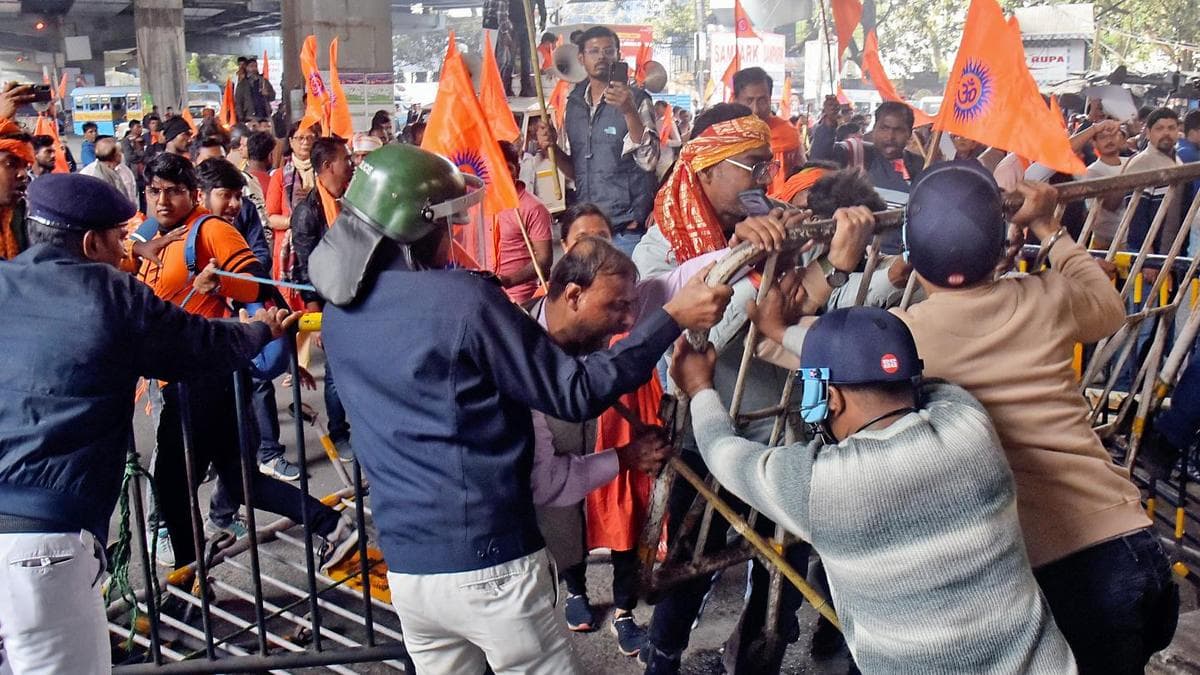
BJP accuses West Bengal police of excessive force during protests, citing baton charge.
Summary
BJP spokesperson Pradeep Bhandari accused West Bengal police of using excessive force, specifically baton charging demonstrators during protests in the state. This highlights a political contention over law and order management and police conduct in West Bengal. For competitive exams, this is a minor regional political development, primarily relevant for understanding state-level political dynamics and police accountability issues, though specific details are limited.
Key Points
- 1The accusation was made by BJP spokesperson Pradeep Bhandari.
- 2The target of the accusation was the West Bengal police.
- 3The alleged action by the police was 'baton charged demonstrators'.
- 4The incident occurred during protests held in West Bengal.
- 5BJP contrasted the situation in West Bengal with peaceful protests in other parts of the country.
In-Depth Analysis
The accusation by BJP spokesperson Pradeep Bhandari against the West Bengal police for using excessive force, specifically baton charging demonstrators, during protests in the state, while contrasting it with peaceful protests elsewhere, opens up a crucial discussion on several pillars of Indian democracy: law and order, fundamental rights, police accountability, and federal dynamics. While seemingly a regional political skirmish, its implications resonate deeply across the nation's governance framework.
To understand this incident, we must first grasp the intense political landscape of West Bengal. The state has been a hotbed of political rivalry, primarily between the ruling Trinamool Congress (TMC) and the Bharatiya Janata Party (BJP), which has emerged as the principal opposition. This rivalry often manifests in heightened rhetoric and frequent confrontations, with law and order becoming a significant point of contention. Protests are a common feature of democratic expression in India, ranging from local grievances to national policy issues. The police, as the primary law enforcement agency, are tasked with managing these protests, balancing the citizens' right to assembly with the need to maintain public order.
The core of the incident, as reported, is the alleged use of 'baton charge' by West Bengal police. Baton charge, or lathi charge, is a method of crowd dispersal by police using batons. While it is a recognized police tactic, its use is governed by strict protocols, emphasizing minimal force and proportionality. The BJP's accusation implies a deviation from these norms, suggesting an arbitrary or excessive application of force, especially when compared to protests in other states that, according to the BJP, remained peaceful. This comparison is an attempt to highlight a perceived failure of governance and law enforcement specific to West Bengal.
Several key stakeholders are involved here. Firstly, the **Bharatiya Janata Party (BJP)**, acting as the opposition, seeks to leverage such incidents to criticize the state government's handling of law and order and to galvanize public opinion against the ruling TMC. Secondly, the **West Bengal Police**, which is directly accused, operates under the administrative control of the state government. Their actions, or alleged actions, reflect on the state's governance. Thirdly, the **Trinamool Congress (TMC) government**, led by Chief Minister Mamata Banerjee, is implicitly on the defensive. They would likely either deny the allegations, justify the police action as necessary to maintain order, or initiate an internal inquiry. Lastly, the **protesters/citizens** are the direct subjects of police action, and their fundamental right to peaceful assembly and freedom of speech is at the heart of the matter.
This issue holds significant importance for India. Firstly, it underscores the critical balance between **the right to protest and public order**. Article 19(1)(b) of the Indian Constitution guarantees citizens the right to assemble peacefully and without arms. However, this right is not absolute and is subject to reasonable restrictions imposed by the state in the interests of public order, as per Article 19(3). The police's role is to ensure that protests remain peaceful and do not devolve into disorder, but without infringing upon legitimate democratic expression. Secondly, it brings to the fore the persistent issue of **police accountability and reforms**. Instances of alleged police excesses fuel calls for greater transparency, better training, and robust accountability mechanisms. The landmark **Prakash Singh vs. Union of India (2006)** Supreme Court judgment laid down directives for police reforms, aiming to professionalize the force and insulate it from undue political influence, yet implementation remains a challenge. Thirdly, it highlights aspects of **federalism**, as 'Police' and 'Public Order' fall under the State List (Entry 2 of the Seventh Schedule). This means state governments have primary responsibility for law and order, but such incidents can become national political issues, sometimes drawing comments from the Union government or central agencies, leading to centre-state tensions.
Historically, India has witnessed numerous instances of police-public confrontations during protests, often leading to charges of excessive force. From the colonial era's suppression of nationalist movements to post-independence agitations, the police's role in crowd control has been under scrutiny. The challenge has always been to modernize policing practices, moving away from a colonial-era force focused on suppression to a service-oriented one committed to protecting citizens' rights while maintaining order. The **Criminal Procedure Code (CrPC)**, particularly Sections 129, 130, and 131, outlines the powers of the police and executive magistrates to disperse unlawful assemblies, including the use of force, but always emphasizing minimum force necessary.
Looking ahead, such accusations can lead to several implications. Politically, it will likely intensify the BJP-TMC rivalry, with the opposition using it to campaign against the state government's efficiency and human rights record. It could prompt demands for investigations, potentially leading to inquiries by state human rights commissions or even judicial interventions if severe violations are alleged. For the police force, it necessitates a review of their crowd control strategies and adherence to SOPs. Ultimately, ensuring that the police act within the bounds of law and respect fundamental rights is crucial for maintaining public trust in democratic institutions and upholding the rule of law in India.
Exam Tips
This topic primarily falls under Indian Polity & Governance (UPSC GS Paper II, State PSC General Studies) and Internal Security (UPSC GS Paper III). Focus on the constitutional provisions related to fundamental rights (Article 19) and federalism (Seventh Schedule).
Study related topics like Police Reforms (Prakash Singh judgment, National Police Commission recommendations), Fundamental Rights (especially freedom of speech, assembly, and movement), Centre-State Relations (role of state police, law and order as a state subject), and the role of Human Rights Commissions.
Common question patterns include analytical questions on balancing the right to protest with maintaining public order, critical evaluations of police accountability mechanisms, and case studies on police excesses. Be prepared to discuss constitutional provisions and relevant legal frameworks (CrPC, IPC).
Related Topics to Study
Full Article
BJP spokesperson Pradeep Bhandari said protests in other parts of the country were held peacefully, but in West Bengal, the police baton charged demonstrators