

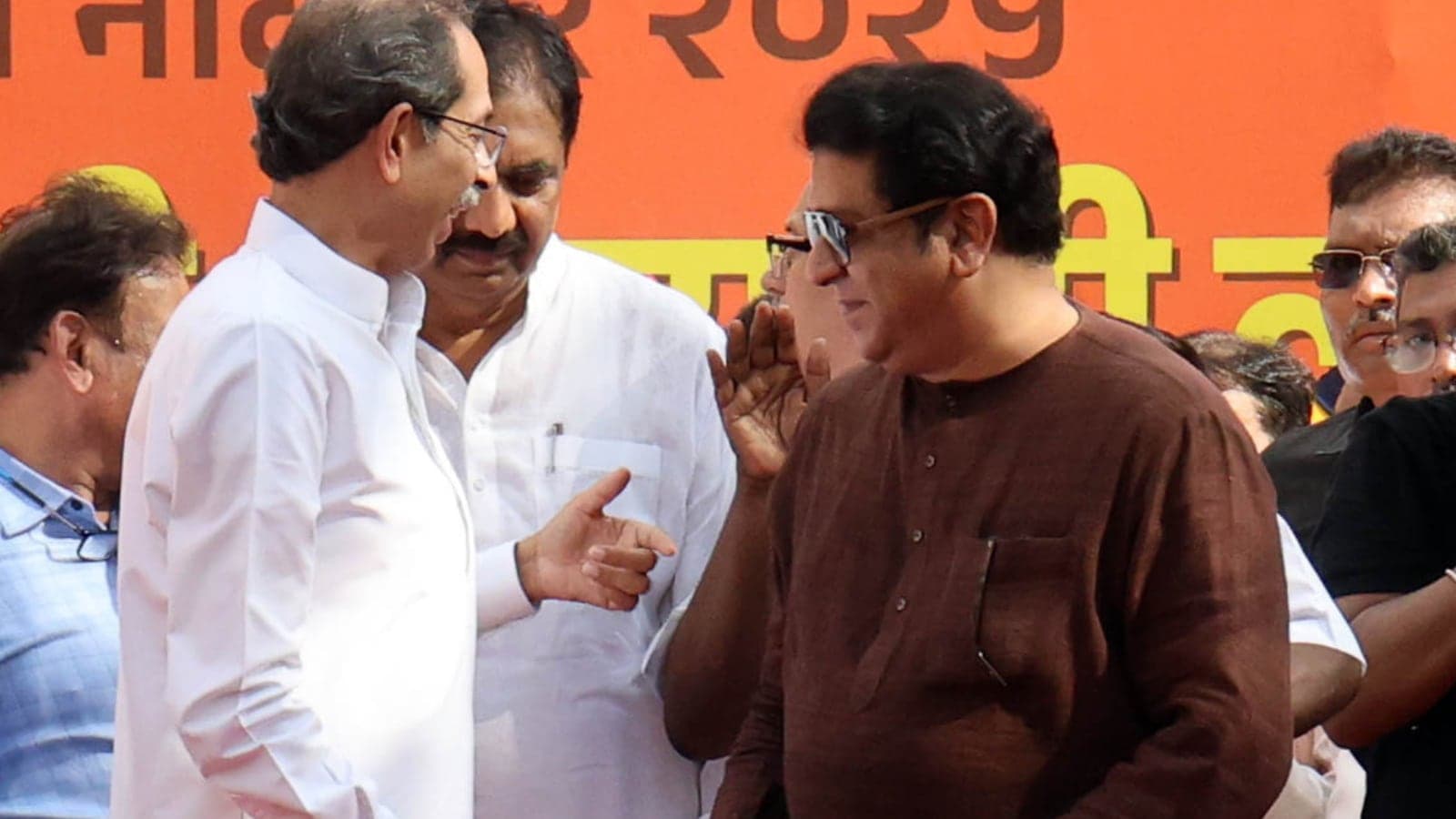


Content unavailable: Cannot summarize Thackeray brothers' reunion for BMC polls and BJP's challenge.
Summary
The provided article content is unavailable, making it impossible to analyze the political implications of Uddhav Thackeray and Raj Thackeray's potential reunion for the Brihanmumbai Municipal Corporation (BMC) polls. Without content, specific details regarding the impact on the BJP's prospects, the reasons for their reunion, or its significance for Maharashtra politics cannot be extracted. Therefore, a comprehensive summary for competitive exam preparation cannot be generated.
Key Points
- 1Content for this article is unavailable, preventing extraction of specific facts.
- 2No details on the reported reunion of Uddhav Thackeray and Raj Thackeray can be provided.
- 3Specific information regarding the Brihanmumbai Municipal Corporation (BMC) polls is absent.
- 4The potential impact on the Bharatiya Janata Party (BJP) cannot be analyzed due to lack of content.
- 5No dates, names, or specific political developments can be identified from the provided input.
In-Depth Analysis
The potential reunion of Uddhav Thackeray and Raj Thackeray for the Brihanmumbai Municipal Corporation (BMC) polls, as suggested by the article title, marks a fascinating and potentially game-changing development in Maharashtra politics. While the article content is unavailable for specific details, the mere prospect necessitates a deep dive into its implications for competitive exam aspirants.
**Background Context and Historical Roots:**
To understand the significance, one must delve into the origins of the Shiv Sena, founded by Balasaheb Thackeray in 1966. The party's core ideology centered on 'Marathi manoos' (Marathi people) and Hindutva, advocating for the rights and cultural identity of Marathis in Mumbai and Maharashtra. Balasaheb's charismatic leadership cemented Shiv Sena's dominance in Mumbai, particularly in the BMC, which it has controlled for decades. The BMC, with its massive budget and administrative reach, is considered one of Asia's wealthiest municipal corporations, making its control a coveted prize.
The split between Uddhav Thackeray and his cousin Raj Thackeray in 2006 was a pivotal moment. Raj, perceived by many as the true inheritor of Balasaheb's aggressive political style, broke away to form the Maharashtra Navnirman Sena (MNS). His departure was fueled by internal power struggles and a feeling of being sidelined by Uddhav. This split fragmented the 'Marathi manoos' vote base and the Hindutva agenda, weakening the undivided Shiv Sena's might. While MNS initially saw some success, particularly in the 2009 assembly elections, its influence waned over time, often struggling to convert popular support into electoral victories.
**What a Reunion Would Entail:**
A reunion, even if tactical for the BMC polls, would signify a consolidation of the original Thackeray legacy and a potential re-unification of the Marathi and Hindutva vote banks that were split between Shiv Sena (Uddhav faction) and MNS. This move would likely aim to leverage the collective emotional appeal of the Thackeray name and the foundational ideologies to reclaim lost ground or strengthen their position against the formidable Bharatiya Janata Party (BJP).
**Key Stakeholders and Their Stakes:**
1. **Uddhav Thackeray (Shiv Sena - UBT):** As the former Chief Minister, Uddhav Thackeray leads the Shiv Sena (Uddhav Balasaheb Thackeray) faction. He faces a significant challenge after the 2022 political crisis that saw the Eknath Shinde faction align with the BJP, leading to the collapse of the Maha Vikas Aghadi (MVA) government. For Uddhav, a reunion with Raj could provide a much-needed boost, consolidating his base and presenting a stronger front in the BMC elections, which are crucial for his faction's political survival and assertion.
2. **Raj Thackeray (MNS):** Raj Thackeray's MNS has struggled to maintain its initial momentum. A reunion could offer MNS a renewed platform, access to Shiv Sena's established organizational structure, and a chance to play a more significant role in Mumbai's politics, potentially regaining relevance. It would also allow him to tap into the legacy of Balasaheb Thackeray more directly.
3. **Bharatiya Janata Party (BJP):** The BJP has long eyed control of the BMC. After successfully forming a government with Eknath Shinde's Shiv Sena, the BJP's ambition to dominate Mumbai's civic body is higher than ever. A united Thackeray front would pose a significant challenge to the BJP-Shinde alliance, forcing them to recalibrate their strategies and potentially make the BMC elections a much tougher fight than anticipated. The BJP's strategy has been to consolidate the Hindutva vote by aligning with the Shinde faction and portraying Uddhav's Sena as having strayed from its core ideology by allying with Congress and NCP.
4. **Eknath Shinde Faction (Shiv Sena):** As the current ruling Shiv Sena faction, their legitimacy and strength are tied to their alliance with the BJP. A Thackeray reunion could undermine their claim as the true inheritors of Balasaheb's legacy and further complicate their efforts to establish dominance over Uddhav's faction.
**Significance for India and Broader Implications:**
Mumbai, as India's financial capital, holds immense strategic importance. Control over BMC translates to significant administrative power, control over urban development projects, and a substantial budget, impacting everything from infrastructure to public health. The political dynamics of Mumbai often reflect broader trends in Maharashtra, a key industrial and agricultural state. A shift in BMC power could signal changes in the state's political landscape, potentially influencing future state assembly and even parliamentary elections.
This development also touches upon themes of regional identity politics versus national party dominance. The Shiv Sena's original 'Marathi manoos' plank, while having Hindutva undertones, has often focused on local identity. The BJP, while also espousing Hindutva, operates on a national scale. A Thackeray reunion could re-emphasize regional identity in Mumbai's politics, potentially creating a counter-narrative to the BJP's nationalistic push in urban centers.
**Constitutional and Policy Relevance:**
This entire scenario is deeply rooted in the framework of local self-governance. The **74th Constitutional Amendment Act of 1992** gave constitutional status to Urban Local Bodies (ULBs) like the BMC. **Article 243W** outlines the powers, authority, and responsibilities of Municipalities, empowering them to function as institutions of self-government. The conduct of these elections falls under the purview of the **State Election Commission**, as mandated by **Article 243ZA**. The massive budget and urban development initiatives managed by BMC are also linked to various central government policies like the Smart Cities Mission, Atal Mission for Rejuvenation and Urban Transformation (AMRUT), and Swachh Bharat Abhiyan (Urban). The political maneuvering also indirectly relates to the spirit of federalism and decentralization, where local bodies are meant to address grassroots issues.
**Future Implications:**
A potential Thackeray reunion could lead to a highly competitive BMC election, testing the strength of the BJP-Shinde alliance. It might force a re-evaluation of political strategies by all major parties in Maharashtra. If successful, it could reinvigorate the 'Marathi manoos' identity in politics and potentially set the stage for a stronger challenge to the BJP in future state elections. Conversely, if the reunion doesn't materialize or fails to deliver electoral success, it could further fragment the Thackeray legacy and strengthen the BJP's position in Mumbai and Maharashtra. The BMC polls are not just about local governance; they are a critical battleground that often sets the tone for the state's political future.
Exam Tips
This topic falls under 'Indian Polity and Governance' (UPSC Mains GS-II, State PSCs) and 'Current Events of National Importance' (Prelims). Focus on the structure and functions of Urban Local Bodies, particularly the 74th Amendment Act.
Study the history of regional political parties in India, especially those based on linguistic or cultural identity. Compare and contrast the ideologies and electoral strategies of Shiv Sena, MNS, and BJP in Maharashtra.
Expect questions on the significance of local body elections (e.g., BMC) in the broader political landscape, their role in democratic decentralization, and the constitutional provisions governing them (Articles 243W, 243ZA).