



Relevant for Exams
VP Radhakrishnan urges AI integration in school curricula; India aims for global AI leadership.
Summary
Vice President C.P. Radhakrishnan recently advocated for the integration of Artificial Intelligence (AI) into school curricula, emphasizing India's ambition to become a global leader in this field. This move aims to prepare students for future technological advancements and aligns with national efforts to foster innovation. For competitive exams, this highlights the government's focus on future-ready education and technological skill development, crucial for understanding policy directions in science and education.
Key Points
- 1The statement advocating for AI integration was made by Vice President C.P. Radhakrishnan.
- 2He recommended incorporating Artificial Intelligence (AI) directly into school curricula.
- 3The Vice President stressed that India should strive to reach the top in the field of AI.
- 4The statement was made recently on a Tuesday.
- 5The focus is on preparing the next generation with essential skills in emerging technologies like AI.
In-Depth Analysis
Vice President C.P. Radhakrishnan's recent call for integrating Artificial Intelligence (AI) into school curricula and India's ambition to lead the global AI landscape marks a pivotal moment in the nation's educational and technological trajectory. This statement underscores a forward-looking vision aimed at preparing India's youth for the demands of the 21st century and beyond, positioning the country as a significant player in the rapidly evolving global tech arena.
**Background Context and What Happened:**
Globally, AI is no longer a futuristic concept but a transformative force reshaping industries, economies, and societies. Nations worldwide are investing heavily in AI research, development, and skill-building to gain a competitive edge. India, with its vast young population and a strong IT services sector, recognizes the immense potential and the imperative to adapt. The Vice President's statement on a Tuesday advocating for AI integration into school curricula is a direct response to this global shift. It's not an isolated idea but a logical extension of existing national policies and strategies aimed at fostering innovation and digital literacy. The National Education Policy (NEP) 2020, for instance, explicitly emphasizes the development of 21st-century skills, computational thinking, and the integration of technology in education. Furthermore, the NITI Aayog's 'National Strategy for Artificial Intelligence' (2018), often referred to as '#AIforAll', laid the groundwork for leveraging AI for inclusive growth, identifying education as a key sector for its application. Therefore, the VP's remarks are a reinforcement of this strategic direction, urging accelerated action at the foundational level of schooling.
**Key Stakeholders Involved:**
Implementing such a sweeping change requires the concerted effort of multiple stakeholders. The **Government of India**, through ministries like the Ministry of Education (MoE) and the Ministry of Electronics and Information Technology (MeitY), along with NITI Aayog, will be central to policy formulation, funding, and oversight. **Educational institutions**, including apex bodies like NCERT, CBSE, and state education boards, will be responsible for curriculum design, content development, and teacher training. Individual **schools** and **teachers** are the frontline implementers, requiring significant capacity building. The **tech industry** will play a crucial role in providing expertise, developing educational tools, and potentially collaborating on pilot projects and teacher training. Ultimately, **students** are the primary beneficiaries, whose future readiness is at stake, while **parents** need to be sensitized and supportive of these changes.
**Significance for India:**
Integrating AI into school curricula holds profound significance for India across several dimensions. **Economically**, it promises to create a future-ready workforce equipped with high-demand skills, thereby boosting innovation, entrepreneurship, and job creation. This can solidify India's position as a global tech hub, attracting foreign investment and fostering indigenous AI solutions. **Socially**, early exposure to AI can democratize access to advanced technological knowledge, potentially bridging the digital divide and ensuring that students from all backgrounds have opportunities in the AI-driven economy. It also fosters critical thinking, problem-solving, and computational skills essential for navigating a complex world. **Strategically**, becoming a leader in AI is crucial for national security, technological sovereignty, and enhancing India's geopolitical influence. It ensures that India is not merely a consumer but a producer and innovator of cutting-edge technologies.
**Historical Context and Constitutional Provisions:**
India has a long history of emphasizing STEM education, evident in its numerous engineering and IT graduates. However, the current push for AI goes beyond traditional computer science, focusing on application, ethics, and interdisciplinary learning from an early age. This move aligns with the spirit of the **Right to Education (Article 21A)**, which guarantees free and compulsory education to all children, implicitly suggesting quality and relevant education. While not directly mentioning AI, the **Directive Principles of State Policy (Article 41 and 46)** call upon the State to make effective provision for securing the right to education and promoting the educational and economic interests of the weaker sections. The **National Education Policy 2020** serves as the most direct policy framework, emphasizing 'foundational literacy and numeracy' alongside '21st-century skills' and 'computational thinking,' making the integration of AI a natural progression within its stated goals.
**Broader Themes and Future Implications:**
This initiative connects to broader themes of **governance** (future-proofing the education system), **economy** (skill development, innovation, global competitiveness), and **social development** (equity in access to advanced education). Looking ahead, the implications are vast. Successful implementation could lead to a generation of 'AI-native' professionals, driving India's research and development capabilities. However, challenges abound: ensuring adequate teacher training, developing age-appropriate and engaging curricula, providing necessary infrastructure (computers, internet access), and addressing ethical considerations related to AI. A critical aspect will be to ensure equitable access, preventing a widening of the digital divide between urban and rural, or privileged and underprivileged students. If executed effectively, India could indeed emerge as a global leader in AI, not just in terms of talent, but also in developing ethical, inclusive, and impactful AI solutions for global challenges, truly embodying the '#AIforAll' vision. This requires sustained political will, collaborative efforts, and a continuous adaptation to technological advancements.
Exam Tips
This topic is highly relevant for UPSC GS Paper 2 (Governance, Social Justice - Education) and GS Paper 3 (Science & Technology, Indian Economy - Skill Development). For SSC, Banking, and State PSC exams, factual questions on government initiatives and policies related to education and technology are common.
Study this topic alongside the National Education Policy (NEP) 2020, Digital India Mission, Skill India Mission, and NITI Aayog's National Strategy for AI. Understand the objectives and key provisions of these policies.
Common question patterns include: analyzing the pros and cons of AI integration in education, discussing the challenges in implementation, evaluating the government's role in promoting future skills, and essay questions on India's potential as an AI leader. Be prepared to discuss ethical considerations of AI.
For preliminary exams, expect questions on the Vice President's statement, key government bodies involved in AI policy (e.g., NITI Aayog, MeitY), and the main objectives of NEP 2020 regarding technology integration.
Focus on the 'why' and 'how' – why is AI integration important for India, and how can it be effectively implemented, considering infrastructure, teacher training, and curriculum development.
Related Topics to Study
Full Article
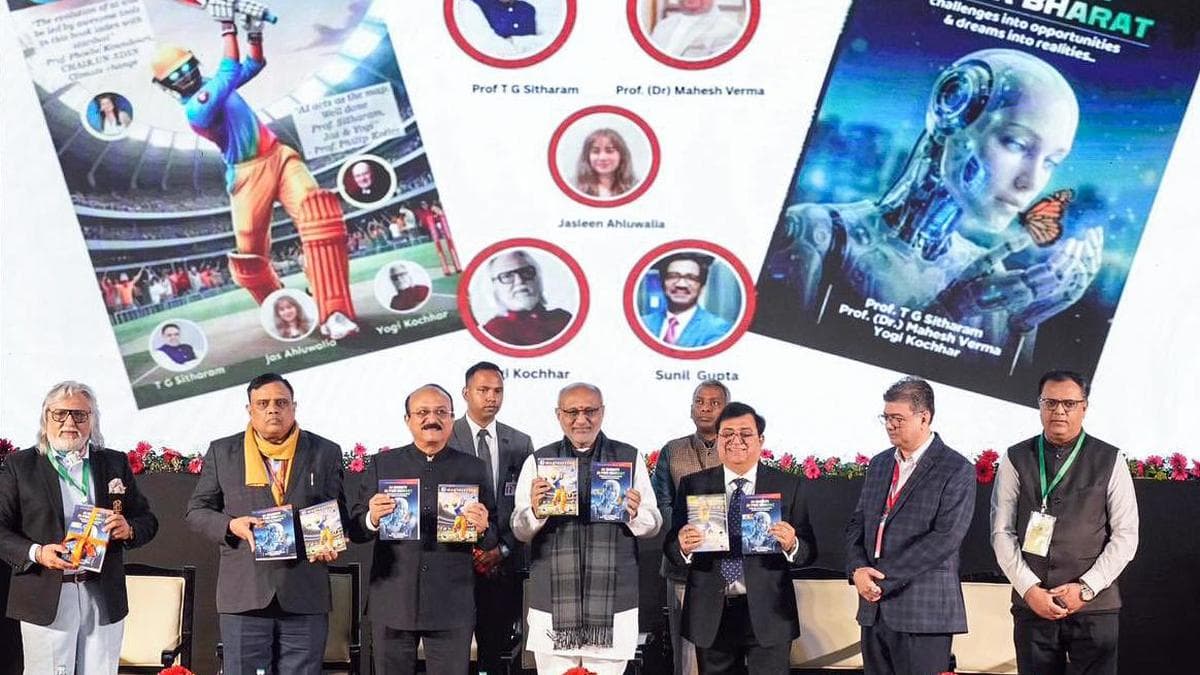
Vice President C.P. Radhakrishnan said on Tuesday that artificial intelligence should be incorporated into school curricula, and that India should be striving to reach the top of the field