



Relevant for Exams
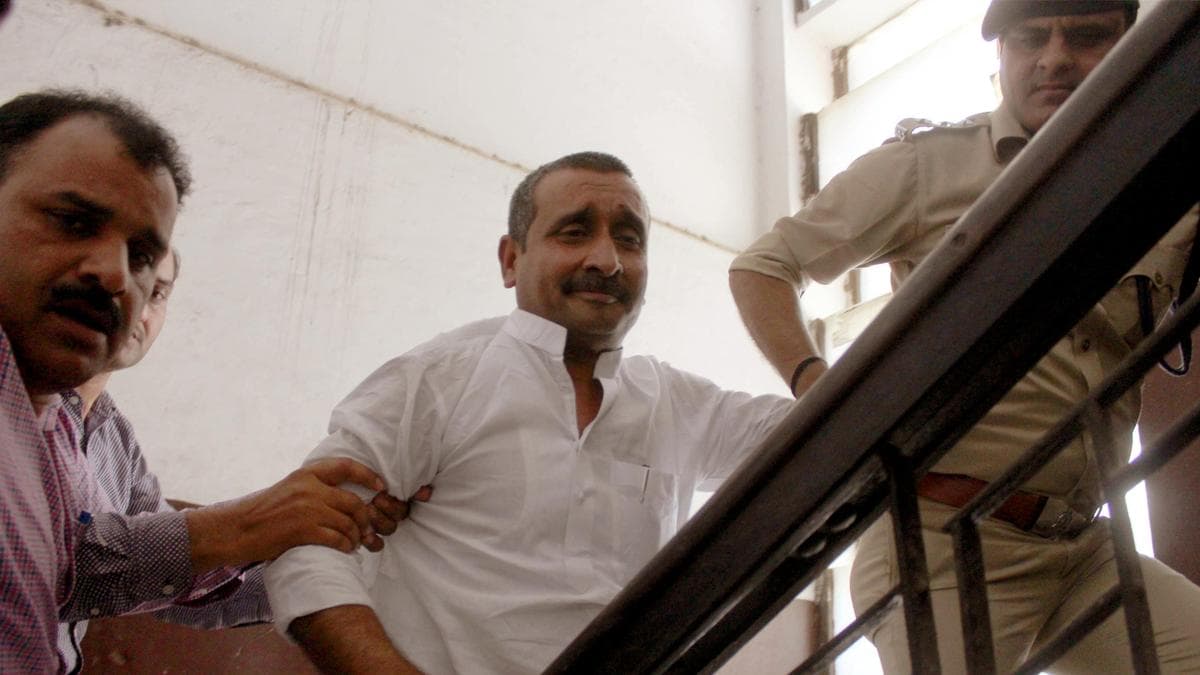
Delhi High Court grants bail to Kuldeep Sengar, suspending his jail term in Unnao rape case.
Summary
The Delhi High Court suspended the jail term of former MLA Kuldeep Sengar, granting him bail in the Unnao rape case. This judicial development is significant for competitive exams as it highlights the legal process, conditions for bail, and the ongoing proceedings in high-profile criminal cases involving public figures. It underscores the role of higher courts in reviewing lower court judgments.
Key Points
- 1Former MLA Kuldeep Sengar was granted bail by the Delhi High Court.
- 2The bail was granted in connection with the Unnao rape case.
- 3The Bench comprised Justices Subramonium Prasad and Harish Vaidyanathan Shankar.
- 4Sengar was directed to furnish a personal bond of ₹15 lakh.
- 5Bail conditions included three sureties of ₹15 lakh each.
In-Depth Analysis
The Delhi High Court's decision to suspend the jail term of former MLA Kuldeep Sengar and grant him bail in the Unnao rape case is a significant development that underscores the complexities of India's criminal justice system, particularly in high-profile cases involving powerful individuals. This ruling, while a procedural step, reignites discussions on judicial processes, victim justice, and the accountability of public figures, making it a crucial topic for competitive exam aspirants.
**Background Context: A Saga of Injustice and Judicial Intervention**
The Unnao rape case first came to national attention in 2018. The victim, then a minor, alleged that she was raped by Kuldeep Sengar, a powerful MLA from Uttar Pradesh's ruling party, in 2017. What followed was a harrowing ordeal for the victim and her family, marked by alleged police inaction, threats, and a series of tragic events. Her father was allegedly beaten in police custody and later died, and a few months later, the victim, her two aunts, and her lawyer were involved in a suspicious road accident, leading to the death of her aunts and serious injuries to her and her lawyer. These incidents, coupled with public outrage and media pressure, prompted the Supreme Court to intervene, transferring all related cases from Uttar Pradesh to Delhi in August 2019 and ordering day-to-day hearings to ensure a speedy trial. The trial court subsequently convicted Sengar in December 2019 for rape under Section 376 of the Indian Penal Code (IPC) and Section 4 of the Protection of Children from Sexual Offences (POCSO) Act, 2012, sentencing him to life imprisonment.
**What Happened: High Court's Decision and Bail Conditions**
On January 16, 2023, a division bench of Justices Subramonium Prasad and Harish Vaidyanathan Shankar of the Delhi High Court suspended Kuldeep Sengar's life sentence and granted him bail. It is crucial to understand that this is not an acquittal but a suspension of his sentence pending the final disposal of his appeal against the conviction. The court directed Sengar to furnish a personal bond of ₹15 lakh along with three sureties of the like amount. This decision allows Sengar temporary freedom while his appeal against the trial court's conviction is heard and decided. The legal principle behind such a decision often rests on factors like the duration of the sentence already served, the likelihood of the appeal being heard soon, and whether the accused poses a flight risk or a threat to witnesses.
**Key Stakeholders Involved**
Several key players are central to this case. **Kuldeep Sengar**, the former MLA, is the primary accused whose liberty is at stake. The **victim** and her family are the central figures whose quest for justice has driven the entire legal process. The **Delhi High Court** is the judicial body that made the recent decision, exercising its appellate jurisdiction. The **Central Bureau of Investigation (CBI)**, which took over the investigation on the Supreme Court's orders, played a crucial role in gathering evidence and presenting the case. The **Supreme Court of India** previously intervened to ensure a fair and timely trial. Lastly, the respective **legal teams** representing Sengar and the prosecution are vital in arguing the case at various judicial levels.
**Why This Matters for India: Rule of Law vs. Public Perception**
This case holds immense significance for India. Firstly, it highlights the intricate workings of the **criminal justice system** and the appellate process. Even after conviction by a lower court, an accused has the right to appeal to higher courts, and bail can be granted during the pendency of such appeals, guided by principles enshrined in the **Criminal Procedure Code (CrPC)**, particularly Sections 389 (suspension of sentence pending appeal) and 439 (special powers of High Court or Court of Session regarding bail). This upholds the principle of 'innocent until proven guilty' at every stage of legal scrutiny. Secondly, it underscores the challenges in ensuring **accountability of public figures**. Sengar's political influence was a significant factor in the initial delays and alleged intimidation, raising questions about the nexus between power and crime. Thirdly, it brings to the fore the ongoing struggle for **victim justice**, especially for survivors of sexual assault. The emotional and practical impact of the accused being out on bail can be profound for the victim and her family. Finally, it tests public trust in the judiciary, balancing the strict adherence to legal procedure with the public's demand for swift and decisive justice, particularly in cases of heinous crimes against women and children. The **POCSO Act, 2012**, designed for stringent punishment in child sexual abuse cases, is also being tested through the appellate process in such high-profile instances.
**Future Implications**
The immediate future implication is the continuation of Sengar's appeal against his conviction in the Delhi High Court. The bail allows him freedom during this period, but it does not absolve him of the charges. The High Court will meticulously review the evidence and the trial court's judgment. The outcome of this appeal will be a critical determinant for Sengar's future and will also be closely watched by legal experts and the public. This case will continue to be a reference point in discussions on judicial independence, the effectiveness of the POCSO Act, and the broader issue of justice for victims in India.
**Related Constitutional Articles, Acts, and Policies**
This case touches upon several fundamental legal and constitutional provisions:
* **Article 21 of the Constitution (Protection of Life and Personal Liberty)**: This article forms the bedrock for the right to fair trial, legal representation, and the principles governing bail, as detention impacts personal liberty.
* **Articles 226 and 227**: These articles empower High Courts with writ jurisdiction and superintendence over lower courts, enabling them to review and intervene in judicial matters.
* **Criminal Procedure Code (CrPC)**: Specific sections like **Section 389** (suspension of sentence pending appeal) and **Section 439** (special powers of High Court regarding bail) are directly relevant to the High Court's decision.
* **Indian Penal Code (IPC)**: Sections like **376 (Rape)** under which Sengar was convicted.
* **Protection of Children from Sexual Offences (POCSO) Act, 2012**: This special law, designed to protect children from sexual abuse, was applied in Sengar's conviction. Its robust provisions aim for stringent punishment and speedy justice.
* **Judicial Review**: The High Court's role in examining the legality and correctness of the trial court's decision is a manifestation of the principle of judicial review, a basic feature of the Indian Constitution.
Exam Tips
This topic falls under the 'Indian Polity and Governance' and 'Social Justice' sections of the UPSC Civil Services Syllabus (GS-II). For SSC, Banking, Railway, and State PSC exams, it's relevant for 'Current Affairs' and 'Indian Constitution & Legal Framework'.
Focus on understanding the hierarchy of courts (Trial Court, High Court, Supreme Court), the appellate process, and the conditions for granting bail as per the CrPC. Also, thoroughly study the key provisions of the POCSO Act, 2012.
Common question patterns include: Direct questions on constitutional articles related to personal liberty (Article 21), powers of High Courts (Articles 226, 227), or provisions of the POCSO Act. Case studies or scenario-based questions might be asked about the criminal justice system, victim protection, or accountability of public figures.
Related Topics to Study
Full Article
A Bench of Justices Subramonium Prasad and Harish Vaidyanathan Shankar released Mr. Sengar on bail while directing him to furnish a personal bond of ₹15 lakh with three sureties of the like amount