



Relevant for Exams
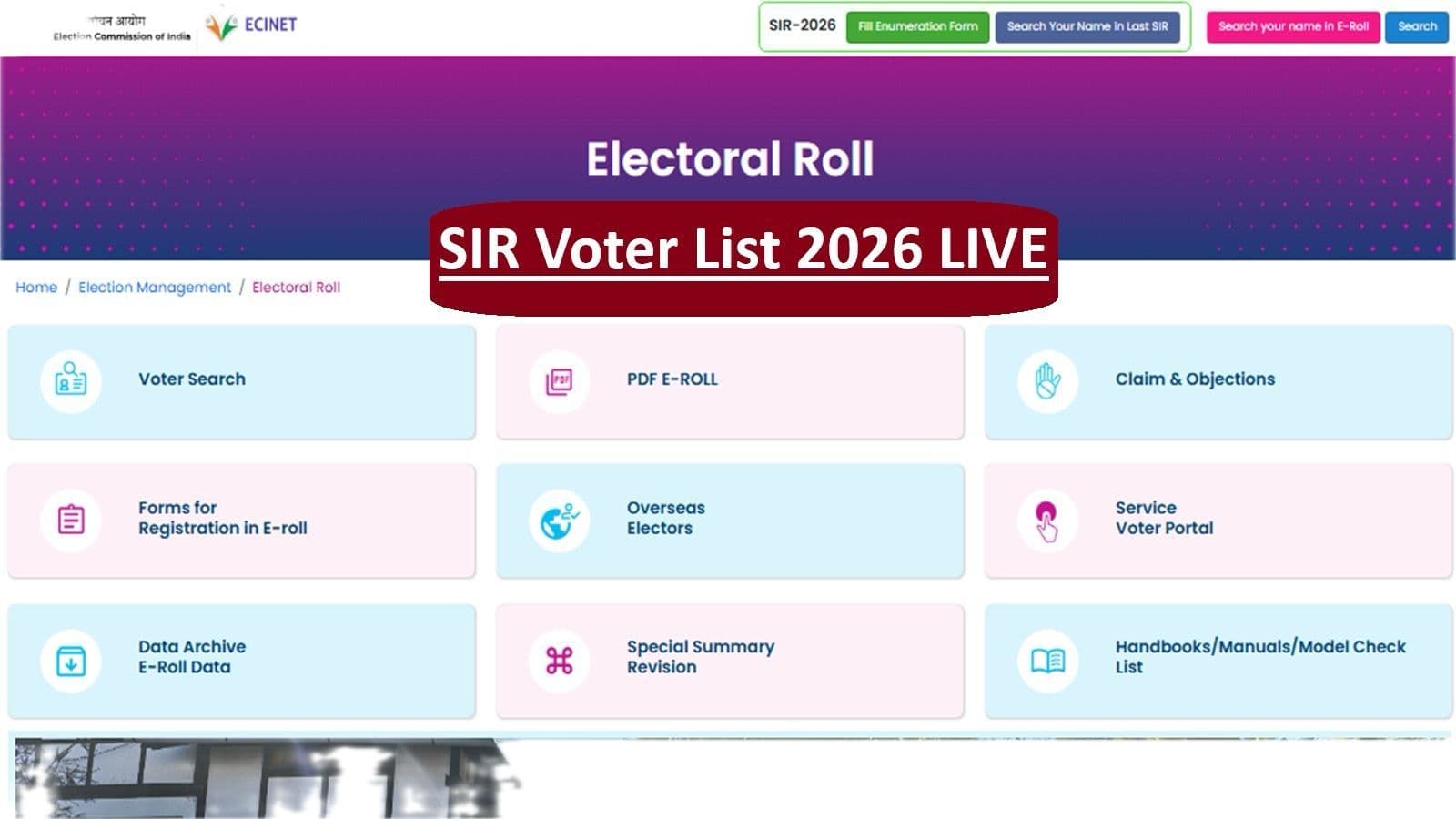
ECI to release 2026 "SIR Draft Roll" voter list for Kerala, MP, Chhattisgarh, Andaman & Nicobar.
Summary
The Election Commission of India (ECI) is set to release the 2026 "SIR Draft Roll" voter list for Kerala, Madhya Pradesh, Chhattisgarh, and Andaman & Nicobar. This is a crucial step in the continuous electoral roll revision process, ensuring updated and accurate voter data. Such releases are fundamental for maintaining the integrity of democratic elections and are vital for competitive exam aspirants to understand the ECI's functions and electoral procedures.
Key Points
- 1The Election Commission of India (ECI) is responsible for the release and revision of electoral rolls.
- 2The specific electoral roll mentioned is the "SIR Draft Roll" for the 2026 voter list.
- 3The states covered in this draft roll release include Kerala, Madhya Pradesh (MP), and Chhattisgarh.
- 4The Union Territory of Andaman & Nicobar is also part of this upcoming voter list release.
- 5The release of draft voter lists is a standard procedure by the ECI to update voter information and ensure accuracy.
In-Depth Analysis
The bedrock of any vibrant democracy lies in its electoral process, and at its core is the electoral roll – a comprehensive list of all eligible voters. The recent announcement by the Election Commission of India (ECI) regarding the release of the 'SIR Draft Roll' for the 2026 voter list for states like Kerala, Madhya Pradesh, Chhattisgarh, and the Union Territory of Andaman & Nicobar, underscores the continuous and meticulous efforts required to maintain the integrity of India's democratic framework. This isn't just a bureaucratic exercise; it's a fundamental step ensuring that every eligible citizen has the opportunity to exercise their franchise.
**Background Context and What Happened:**
Electoral rolls are dynamic documents, constantly needing updates due to births, deaths, migrations, and changes in residency. To ensure accuracy and inclusivity, the ECI undertakes periodic revisions. These revisions can be 'intensive' (house-to-house verification) or 'summary' (based on claims and objections filed by citizens). The 'SIR Draft Roll' likely refers to a 'Special Integrated Revision' or 'Summary Revision' process. This particular release pertains to the 2026 voter list, meaning the ECI is proactively preparing for future electoral cycles, allowing ample time for verification and correction. Releasing a 'draft' roll signifies an invitation to the public and political parties to scrutinize the list, identify discrepancies, and submit claims for inclusion or objections against erroneous entries. This participatory approach is crucial for building trust in the electoral system.
**Key Stakeholders Involved:**
Several key players are central to this process. Firstly, the **Election Commission of India (ECI)**, an autonomous constitutional body established under **Article 324** of the Indian Constitution, holds the ultimate responsibility for the superintendence, direction, and control of the preparation of electoral rolls and the conduct of elections. Beneath the ECI, the **Chief Electoral Officers (CEOs)** in each state/UT, along with **District Election Officers (DEOs)**, **Electoral Registration Officers (EROs)**, and thousands of **Booth Level Officers (BLOs)**, form the ground machinery responsible for data collection, verification, and revision. **Political parties** are crucial stakeholders, as they are encouraged to appoint Booth Level Agents (BLAs) to assist in verifying the draft rolls and ensuring their supporters are correctly registered. Most importantly, **citizens** are the ultimate beneficiaries and active participants, responsible for checking their details, registering if not already done, and filing claims or objections.
**Significance for India:**
This process holds immense significance for India's democracy. Accurate electoral rolls are the bedrock of **free and fair elections**, preventing malpractices like bogus voting and ensuring that every vote counts. It upholds the principle of 'one person, one vote'. Socially, it ensures **inclusive representation**, giving a voice to all eligible sections of society, including marginalized groups, by actively encouraging their enrollment. Politically, it enhances the **legitimacy of elected representatives** and strengthens public faith in democratic institutions. Economically, while not directly impacting the economy, the integrity of the electoral process underpins political stability, which is essential for long-term economic growth and investment.
**Historical Context and Constitutional Provisions:**
Since India's first general election in 1951-52, the preparation and revision of electoral rolls have been a continuous challenge, given the vast population and diverse geography. Initially, processes were largely manual, leading to errors and delays. Over decades, the ECI has progressively adopted technology, from photo electoral rolls in the 1990s to the current digitized, searchable databases. The legal framework governing this process is primarily laid out in the **Representation of the People Act, 1950 (RPA, 1950)**, which deals specifically with the preparation and revision of electoral rolls, the allocation of seats, and the delimitation of constituencies. The **Representation of the People Act, 1951 (RPA, 1951)**, complements this by dealing with the conduct of elections and related matters.
**Future Implications:**
The continuous revision process, exemplified by the SIR Draft Roll release, has several future implications. It ensures that when the next set of assembly elections or the general elections occur, the voter lists are as current and accurate as possible, minimizing disputes and facilitating smooth polling. The ECI is also exploring advanced technologies like Artificial Intelligence (AI) for more efficient data de-duplication and demographic analysis, though data privacy concerns remain paramount. The integration of Aadhaar with voter ID, though currently voluntary and facing legal scrutiny, is another discussed measure aimed at enhancing accuracy. However, challenges like ensuring the enrollment of migrant workers, homeless individuals, and tackling misinformation campaigns during the revision period will continue to demand the ECI's vigilant attention and innovative solutions to ensure the electoral process remains robust and truly representative of India's diverse populace.
Exam Tips
This topic falls under the 'Indian Polity and Governance' section of the UPSC Civil Services Exam (Prelims & Mains GS-II), State PSCs, and other competitive exams. Focus on the ECI's constitutional mandate, functions, and electoral reforms.
Study the key provisions of Article 324 of the Constitution and the Representation of the People Acts (1950 and 1951). Understand the difference between the roles of the ECI and State Election Commissions.
Common question patterns include direct questions on the powers and functions of the ECI, the process of electoral roll revision, types of electoral reforms, and the role of various election officials (e.g., BLOs, EROs).