



Relevant for Exams
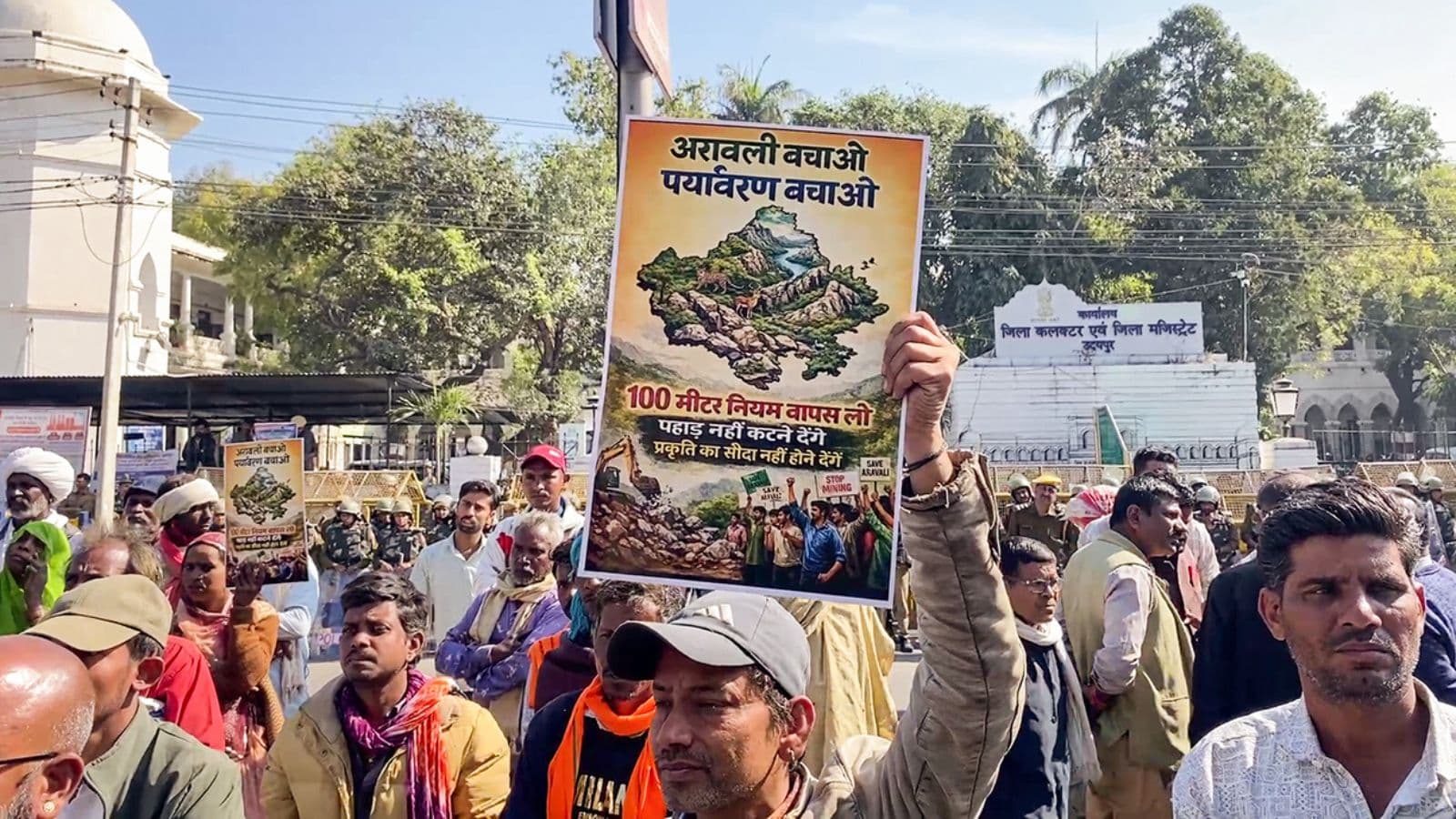
Rajasthan faces protests over mining threat to Aravalli range, raising environmental concerns.
Summary
Protests are escalating in Rajasthan against the perceived threat of mining activities in the ecologically sensitive Aravalli mountain range. This issue highlights critical environmental concerns, regional governance challenges, and the conflict between economic development and conservation. It is highly relevant for competitive exams focusing on geography, environment, and public policy, especially for UPSC and State PSC examinations.
Key Points
- 1The Aravalli Range is one of the oldest fold mountains in the world, stretching approximately 692 km across Gujarat, Rajasthan, Haryana, and Delhi.
- 2It plays a crucial ecological role, acting as a natural barrier against the eastward expansion of the Thar Desert.
- 3Mining activities in the Aravallis are governed by environmental regulations, including the Environment (Protection) Act, 1986, and state-specific mining rules.
- 4The Supreme Court of India has previously intervened to protect the Aravallis, notably in cases concerning illegal mining and environmental degradation.
- 5Protests related to Aravalli mining often involve local communities and environmental groups, highlighting issues of sustainable development and resource management.
In-Depth Analysis
The ongoing protests in Rajasthan against the threat of mining in the Aravalli mountain range bring to the forefront India's perennial struggle between economic development and environmental conservation. This issue is a critical case study for understanding complex challenges in geography, environment, and public policy, especially relevant for competitive examinations.
**Background Context and Ecological Significance:**
The Aravalli Range, one of the oldest fold mountains in the world, is a geological marvel stretching approximately 692 km across Gujarat, Rajasthan, Haryana, and Delhi. Formed during the Precambrian era, its ancient hills are not just geographical features but vital ecological assets. The Aravallis act as a crucial natural barrier, preventing the eastward expansion of the Thar Desert into the fertile Indo-Gangetic plains. They are also a significant watershed, feeding several rivers like the Banas, Luni, and Sabarmati, and recharging groundwater aquifers, thus playing a pivotal role in the water security of the region. Furthermore, they are home to rich biodiversity, including various flora and fauna, many of which are endemic. The historical context reveals a long-standing conflict; the region has been a site for mining activities for decades, with both legal and illegal operations leading to significant degradation over time.
**What's Happening and Key Stakeholders:**
Currently, protests are escalating in Rajasthan, driven by local communities and environmental activists who perceive renewed threats from mining activities. These protests highlight concerns about the irreversible damage to the fragile ecosystem, including deforestation, loss of biodiversity, air and water pollution, and disruption of traditional livelihoods. The key stakeholders involved in this complex issue are manifold. **Local Communities**, particularly those dependent on the Aravallis for water, fodder, and non-timber forest produce, are at the forefront of the protests, fearing displacement and loss of their way of life. **Environmental Groups and NGOs** advocate for the conservation of the Aravallis, conducting awareness campaigns, scientific studies, and filing legal petitions. The **Rajasthan State Government** finds itself in a difficult position, balancing the need for revenue generation and industrial development through mining with its constitutional responsibility to protect the environment. **Mining Companies** are driven by economic imperatives, seeking to extract valuable minerals but often accused of neglecting environmental safeguards. Finally, the **Judiciary**, particularly the Supreme Court and High Courts, plays a crucial role as the ultimate arbiter, interpreting environmental laws and issuing directives to protect the Aravallis.
**Significance for India and Historical Context:**
The Aravalli mining issue holds immense significance for India. Environmentally, the continued degradation of the Aravallis could accelerate desertification, exacerbate water scarcity, and severely impact the climate resilience of northern India. Economically, while mining provides revenue and employment, uncontrolled extraction often leads to environmental costs that far outweigh the short-term economic gains, impacting agriculture, tourism, and public health in the long run. Socially, it's a matter of environmental justice, affecting the most vulnerable communities. Historically, the Supreme Court of India has intervened multiple times to protect the Aravallis. Landmark judgments, such as those related to illegal mining in Haryana's Aravalli region in the late 1990s and early 2000s (e.g., M.C. Mehta vs. Union of India cases), have emphasized the 'polluter pays' principle and the 'public trust doctrine,' asserting that the state holds natural resources in trust for the benefit of the public. These judgments have often led to bans or strict regulations on mining activities in sensitive zones.
**Constitutional Provisions and Future Implications:**
This issue is deeply rooted in India's constitutional framework and environmental policies. **Article 48A** of the Directive Principles of State Policy mandates that "The State shall endeavour to protect and improve the environment and to safeguard the forests and wild life of the country." Complementing this, **Article 51A(g)**, a Fundamental Duty, states that it is the duty of every citizen "to protect and improve the natural environment including forests, lakes, rivers and wild life, and to have compassion for living creatures." Key legislative instruments include the **Environment (Protection) Act, 1986**, the **Forest (Conservation) Act, 1980**, and the **Mines and Minerals (Development and Regulation) Act, 1957**. The future implications are profound. The current protests could lead to renewed judicial scrutiny, potentially resulting in stricter enforcement of existing laws or new policy formulations. There might be a push for more sustainable mining practices, greater emphasis on Environmental Impact Assessments (EIAs), and the promotion of alternative livelihoods for affected communities. The outcome of these protests will not only determine the fate of the Aravallis but also set a precedent for similar conflicts across India, influencing the broader discourse on sustainable development and environmental governance.
**Broader Themes:**
This issue links to broader themes of governance, sustainable development, climate change adaptation, and the role of civil society in environmental protection. It highlights the challenges of implementing environmental laws effectively, the need for transparent decision-making, and the importance of balancing industrial growth with ecological preservation to ensure intergenerational equity.
Exam Tips
This topic falls under GS-I (Geography: Physical Geography, Resources) and GS-III (Environment & Ecology: Conservation, Environmental Pollution & Degradation; Economy: Sustainable Development, Resource Mobilization) for UPSC. For State PSCs, it's relevant for Geography, Environment, and Current Affairs sections.
Study related topics like the National Green Tribunal (NGT) and its role in environmental justice, the Environmental Impact Assessment (EIA) process and its criticisms, and the concept of 'Sustainable Development' as enshrined in international conventions and Indian jurisprudence.
Common question patterns include direct questions on the ecological significance of Aravallis, critical analysis of the development vs. environment debate, case studies on illegal mining, and questions linking constitutional provisions (Article 48A, 51A(g)) with environmental protection.
Be prepared to discuss the 'Public Trust Doctrine' and 'Polluter Pays Principle' in the context of environmental law and judicial interventions.
Understand the geographical spread of the Aravallis, the types of minerals found, and the specific environmental threats posed by mining activities (e.g., groundwater depletion, air pollution, biodiversity loss).