



Relevant for Exams
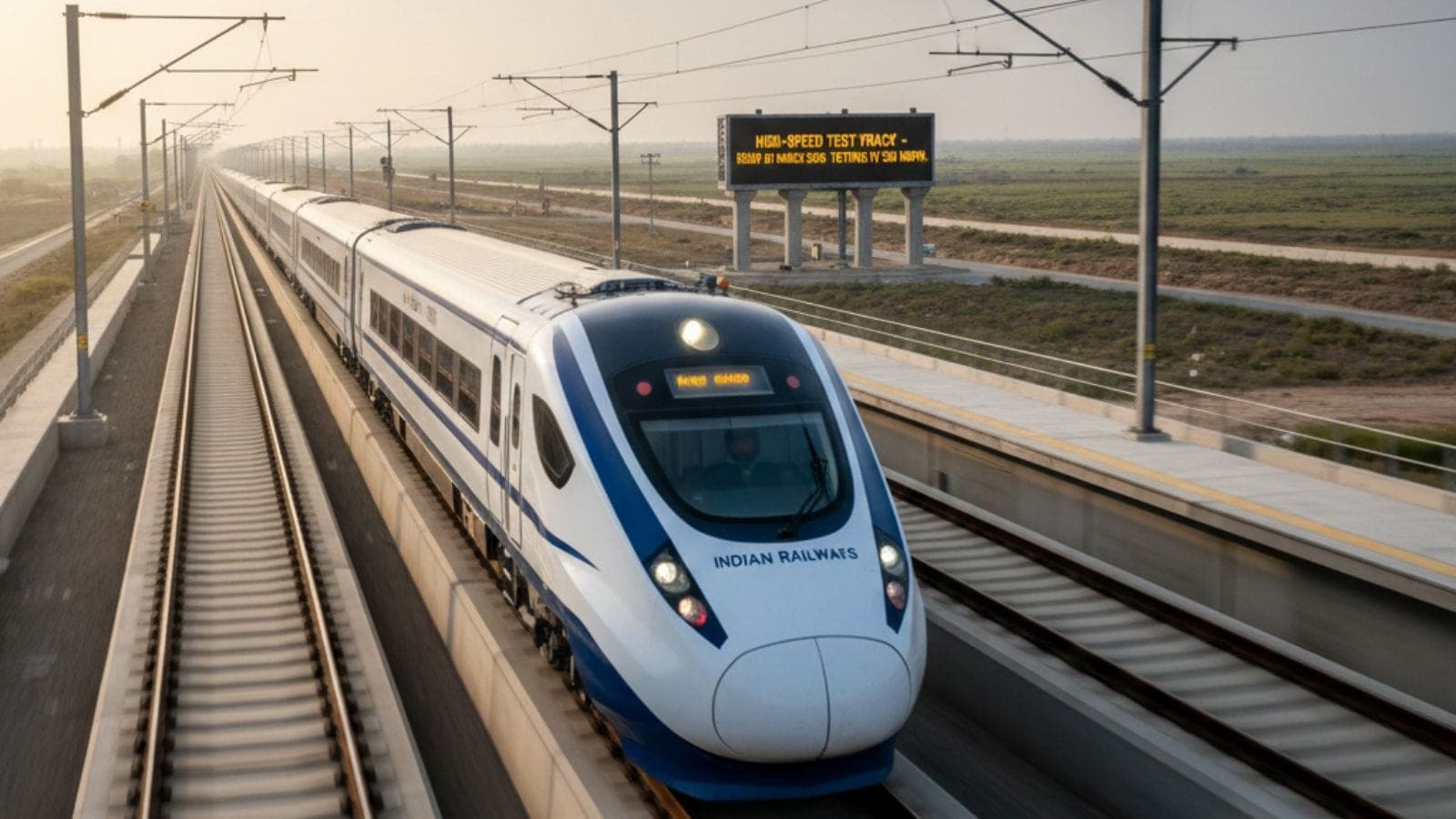
Indian Railways' first high-speed test track for 220 kmph trains ready by March 2026.
Summary
Indian Railways is set to complete its first dedicated high-speed test track by March 2026. This crucial infrastructure will enable testing of trains at speeds up to 220 kmph, significantly boosting India's indigenous capabilities in high-speed rail technology and rolling stock development. This project is vital for future high-speed rail expansion and technological self-reliance, making it highly relevant for competitive exams on infrastructure and national development.
Key Points
- 1Indian Railways is developing its first dedicated high-speed test track.
- 2The test track is targeted to be ready for operation by March 2026.
- 3It will facilitate the testing of trains at a maximum speed of 220 kmph.
- 4This project marks India's inaugural dedicated facility for high-speed rail testing.
- 5The initiative is crucial for advancing indigenous capabilities in high-speed rolling stock development.
In-Depth Analysis
Indian Railways, often termed the lifeline of the nation, is embarking on a significant journey towards modernizing its infrastructure and enhancing its technological capabilities. The recent announcement regarding the completion of India's first dedicated high-speed test track by March 2026, designed to test trains at speeds up to 220 kmph, marks a pivotal moment in this endeavor. This project is not merely about laying tracks; it represents a strategic leap towards self-reliance, safety, and efficiency in one of the world's largest railway networks.
**Background Context and Historical Journey:**
India's railway history dates back to 1853 with the first passenger train running between Mumbai and Thane. For decades, the focus remained on expanding the network to connect diverse regions, often under challenging conditions. Post-independence, while the network grew, speed and modernization often took a backseat compared to capacity expansion and accessibility. The late 20th century saw the introduction of faster trains like the Rajdhani and Shatabdi Express, pushing speeds to 120-130 kmph. However, the true push for high-speed rail, comparable to global standards, gained momentum in the 21st century, notably with the ambitious Mumbai-Ahmedabad High-Speed Rail (MAHSR) project, popularly known as the 'Bullet Train' project, initiated in 2017. This project, while groundbreaking, highlighted India's reliance on foreign technology and expertise, primarily from Japan. This reliance underscored the urgent need for indigenous research, development, and testing infrastructure.
**The Genesis of the Dedicated Test Track:**
Currently, Indian Railways relies on its operational tracks for testing new rolling stock, which limits the speeds that can be achieved safely and efficiently without disrupting regular services. The absence of a dedicated, controlled environment for high-speed trials has been a significant bottleneck in developing and certifying advanced locomotives and coaches. This new 59-kilometer long test track, located in the Jodhpur division of North Western Railway (specifically between Gudha and Thathana Mithri in Rajasthan), will fill this critical void. It is designed to simulate various operating conditions, curves, and gradients, allowing for comprehensive testing of train dynamics, braking systems, signaling, and track-train interaction at speeds up to 220 kmph, with potential for even higher speeds in future phases.
**Key Stakeholders Involved:**
Several entities are instrumental in this project. The **Ministry of Railways** is the overarching authority providing policy direction and funding. **Indian Railways**, through its various departments and zonal railways (like North Western Railway), is executing the project. The **Research Designs and Standards Organisation (RDSO)**, Indian Railways' sole R&D arm, will play a crucial role in utilizing this track for testing and validating new technologies and designs. **Rail Vikas Nigam Limited (RVNL)**, a public sector undertaking under the Ministry of Railways, is often involved in project execution. Furthermore, private sector manufacturers of rolling stock and signaling equipment, both domestic and international, will be direct beneficiaries, using the facility to test their products for the Indian market.
**Significance for India and Broader Themes:**
This test track holds immense significance for India's aspirations of becoming a global manufacturing hub and a leader in advanced technologies. Firstly, it is a direct embodiment of the **'Make in India'** initiative, promoting indigenous development of high-speed rolling stock, components, and systems. By reducing dependence on foreign suppliers, India can save foreign exchange, create domestic jobs, and build a robust local ecosystem. This aligns perfectly with the **National Rail Plan (2030)**, which envisions a future-ready railway system and aims to achieve 100% electrification and upgrade speed limits across key routes. Secondly, it will significantly enhance the safety and reliability of India's rail network. Rigorous testing in a controlled environment will identify and rectify potential issues before trains enter commercial service, leading to fewer accidents and breakdowns. Economically, the project will spur growth in ancillary industries, foster innovation, and attract investments in railway technology. It also contributes to the broader objective of the **PM Gati Shakti National Master Plan**, which aims for integrated infrastructure development and multi-modal connectivity, ensuring that India's logistics and passenger transport systems are world-class.
**Constitutional and Policy Framework:**
Constitutionally, railways fall under **Entry 22 of the Union List in the Seventh Schedule**, granting the Parliament exclusive legislative power over this sector. This central control allows for coordinated national policies and large-scale infrastructure projects like the test track. The project is also supported by the Directive Principles of State Policy, particularly **Article 38** (promoting welfare of the people) and **Article 39(b) and (c)** (distribution of material resources for common good, prevention of concentration of wealth), as robust public infrastructure is crucial for economic development and reducing regional disparities. Various policies like the **National Transport Policy** and the **Railway Act, 1989** (which governs the establishment and operation of railways), provide the legal and regulatory framework for such developments.
**Future Implications:**
The completion of this test track will pave the way for India to develop its own 'Vande Bharat' style high-speed trains capable of reaching 200-220 kmph, and eventually even higher speeds for future bullet train projects. It will accelerate the pace of technological upgrades for existing lines and facilitate the expansion of high-speed rail corridors across the country. Furthermore, it positions India as a potential exporter of high-speed rail technology and expertise to other developing nations, thereby boosting its geopolitical influence. This indigenous capability will not only transform passenger experience by reducing travel times significantly but also create a more sustainable and efficient freight movement system, thereby impacting India's overall economic competitiveness and environmental footprint. The long-term vision is to establish India as a global leader in railway technology, moving beyond being merely a consumer to an innovator and provider.
Exam Tips
This topic falls under 'Indian Economy - Infrastructure' and 'Science & Technology - Indigenous Development' for UPSC CSE (GS Paper III), and 'General Awareness - Indian Railways' for SSC, Banking, and Railway exams. Focus on factual details (completion date, speed, location) and analytical aspects (significance for Make in India, economic impact).
Study related topics like the National High-Speed Rail Corporation Limited (NHSRCL) and its projects (e.g., Mumbai-Ahmedabad HSR corridor), the Vande Bharat Express trains, and the National Rail Plan (2030) to understand the broader context of railway modernization.
Common question patterns include direct factual questions (e.g., 'What is the maximum testing speed of India's first high-speed test track?'), policy-oriented questions (e.g., 'How does this project align with the Make in India initiative?'), and analytical questions on its economic or technological significance for India.