

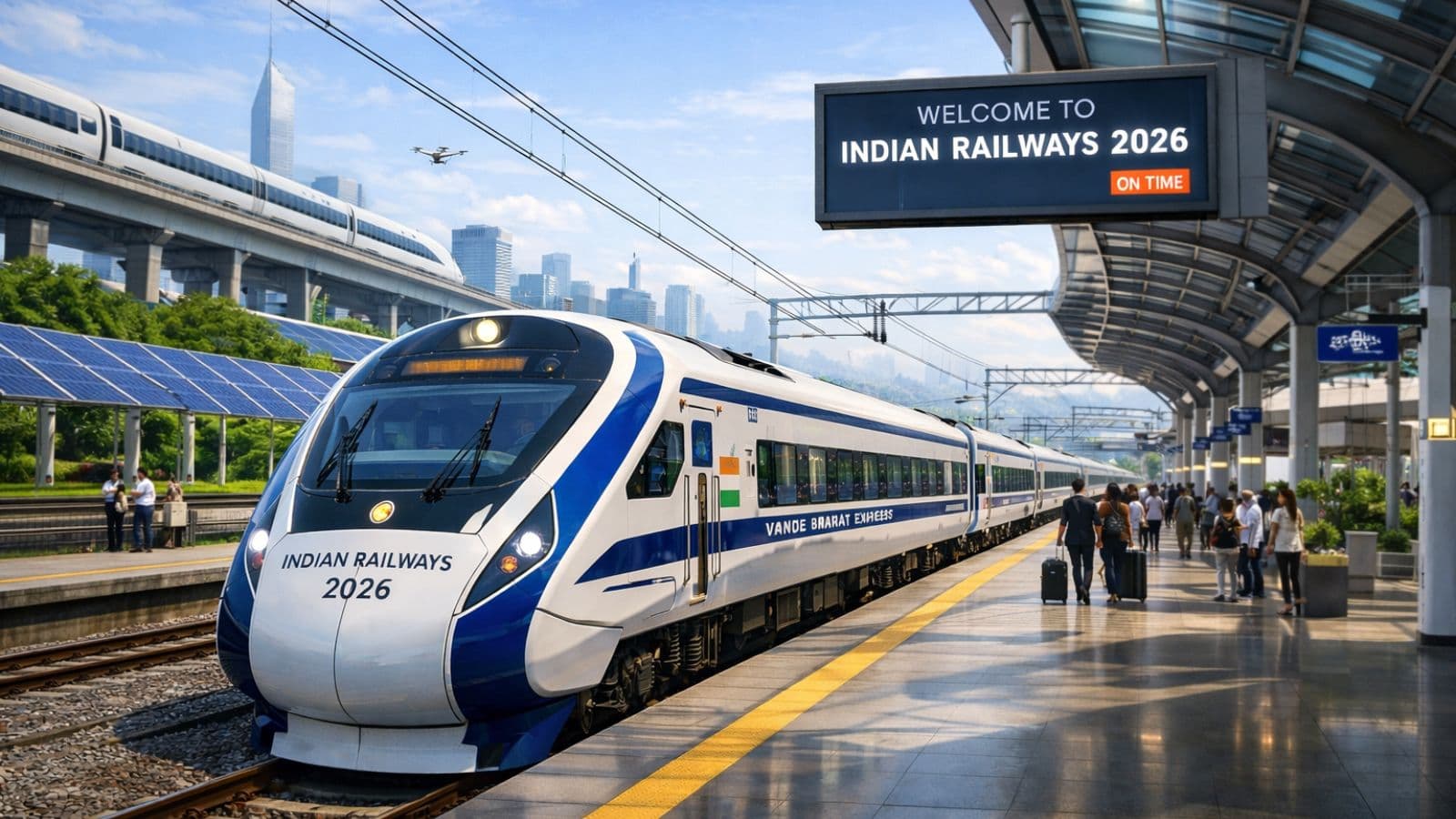


Indian Railways 2026 changes article lacks content; no specific details for exam preparation.
Summary
The provided article title indicates a discussion on significant changes expected in Indian Railways by 2026, encompassing aspects like ticket booking and new train introductions. However, no actual content was supplied for analysis, making it impossible to extract specific details, policy implications, or their relevance for competitive exam preparation. Consequently, a factual summary of the proposed changes cannot be generated.
Key Points
- 1No specific content was provided for the analysis of Indian Railways changes in 2026.
- 2Details regarding new trains, ticket booking, or other policy shifts are unavailable.
- 3The article title indicates potential future developments in Indian Railways.
- 4Without content, specific dates, names, or numbers related to these changes cannot be extracted.
- 5Therefore, no exam-relevant facts could be identified from the provided input.
In-Depth Analysis
While the specific content regarding Indian Railways' changes for 2026 is not available, the very title suggests a dynamic and forward-looking approach to one of India's most critical infrastructure pillars. Indian Railways, often called the nation's lifeline, is not merely a mode of transport but a colossal engine driving economic growth, social integration, and strategic connectivity. Understanding its ongoing transformation, even in the absence of specific 2026 details, is crucial for competitive exam aspirants.
**Background Context: A Legacy of Connectivity and the Urgency for Modernization**
Indian Railways boasts a rich history, dating back to 1853 with its first train running between Mumbai and Thane. Post-independence, it was unified and expanded, becoming one of the world's largest railway networks. However, decades of underinvestment, capacity constraints, and technological stagnation led to challenges in speed, safety, and efficiency. The demand for both passenger and freight movement has surged with India's economic growth, putting immense pressure on existing infrastructure. This necessitated a paradigm shift from incremental upgrades to comprehensive modernization. The current push for change is rooted in the realization that a robust railway system is indispensable for India to achieve its economic aspirations, including becoming a manufacturing hub and a $5 trillion economy.
**What is Happening: The Broad Strokes of Transformation**
The anticipated changes for 2026 are likely to be a continuation and acceleration of several ongoing initiatives aimed at transforming Indian Railways. These broadly fall under categories like: **1. Speed Enhancement:** Introduction of semi-high-speed trains like Vande Bharat Express, upgrading existing tracks, and planning for high-speed rail corridors (e.g., Mumbai-Ahmedabad bullet train project). **2. Capacity Augmentation:** Construction of Dedicated Freight Corridors (DFCs) to segregate freight and passenger traffic, thereby increasing speed and reducing transit times for goods. **3. Digitalization and Passenger Experience:** Modernization of ticket booking systems (IRCTC), real-time train tracking, improved station amenities, better onboard services, and leveraging technology for operational efficiency. **4. Safety and Security:** Upgrading signaling systems (e.g., Kavach anti-collision system), eliminating unmanned level crossings, and improved surveillance. **5. Infrastructure Development:** Station redevelopment projects (e.g., Gandhinagar Capital, Rani Kamalapati), electrification of routes, and investment in modern rolling stock. **6. Sustainability:** Focus on electrification to reduce carbon footprint and promote green transportation.
**Key Stakeholders and Their Roles**
The transformation of Indian Railways involves a multitude of stakeholders. The **Ministry of Railways** and the **Railway Board** are the primary policy-making and executive bodies. **Indian Railway Catering and Tourism Corporation (IRCTC)** handles online ticketing and catering services. Various Zonal Railways and Production Units (like Integral Coach Factory, Chittaranjan Locomotive Works) are responsible for implementation and manufacturing. **Private players** are increasingly involved through Public-Private Partnership (PPP) models in areas like station redevelopment, freight operations, and manufacturing. **Commuters and freight customers** are direct beneficiaries and also provide feedback. **State Governments** play a role in land acquisition for new projects and maintaining law and order. International collaborators, such as Japan for the High-Speed Rail project, are also significant.
**Significance for India: A Multidimensional Impact**
Modernizing Indian Railways holds immense significance across economic, social, and environmental dimensions. **Economically**, it boosts infrastructure development, creates millions of direct and indirect jobs, improves logistics efficiency, reduces transportation costs for industries, and enhances regional connectivity, thereby fostering balanced economic growth. An efficient rail network is crucial for the success of initiatives like 'Make in India' and 'National Logistics Policy'. **Socially**, it improves accessibility for millions, connects remote areas, promotes national integration, and offers safer, more comfortable travel experiences. It also plays a vital role in disaster relief and national security. **Environmentally**, the shift of freight from roads to electrified rail reduces carbon emissions and eases road congestion, contributing to India's climate change commitments.
**Historical Context and Policy Frameworks**
From its colonial origins, Indian Railways has evolved. Post-independence, it became a symbol of national pride and an instrument of planned development. Historically, the Railway Budget was presented separately until 2017, when it was merged with the Union Budget, reflecting a more integrated approach to national infrastructure planning. The push for modernization gained significant momentum in the 21st century. Key policy documents driving this transformation include the **National Rail Plan 2030**, which outlines a long-term vision to create a 'Future Ready' railway system by 2030, capable of meeting projected demand till 2050. The **National Infrastructure Pipeline (NIP)** and **National Monetisation Pipeline (NMP)** also earmark significant investments and asset monetization opportunities for railways.
**Constitutional and Legal Provisions**
Indian Railways falls under the **Union List (Entry 22 of the Seventh Schedule)** of the Constitution, granting the Central Government exclusive legislative and executive powers over it. This centralized control allows for a unified national policy. The **Indian Railways Act, 1890** (and its subsequent amendments) governs its operations, safety, and regulatory aspects. Financial allocations for railway projects are primarily drawn from the **Consolidated Fund of India (Article 266)**, with parliamentary approval. The government also utilizes provisions like **Article 282** for grants for public purposes, funding large-scale infrastructure projects. The legal framework facilitates public-private partnerships, land acquisition, and environmental clearances necessary for expansion and modernization.
**Future Implications: Towards a Robust and Integrated Network**
The ongoing changes, including those anticipated by 2026, are set to transform Indian Railways into a more modern, efficient, and technologically advanced network. This will lead to faster transit times for both passengers and freight, significantly boosting India's economic competitiveness. Enhanced safety and passenger amenities will make rail travel more attractive. Greater private sector involvement is expected, bringing in capital and expertise. The integration of advanced technologies like AI, IoT, and big data analytics in railway operations, maintenance, and customer service will become more prevalent. Ultimately, these changes aim to make Indian Railways a world-class system, capable of supporting India's aspirations on the global stage, ensuring sustainable development and inclusive growth.
Exam Tips
This topic falls primarily under **GS Paper III (Economy - Infrastructure, Investment Models)** and **GS Paper I (Indian Geography - Transport Systems)**. Be prepared to discuss the economic implications and geographical spread of railway projects.
Study related topics like the National Rail Plan 2030, Dedicated Freight Corridors (DFCs), Public-Private Partnership (PPP) models in infrastructure, National Logistics Policy, and specific projects like the Vande Bharat Express and High-Speed Rail corridors. Understand their objectives and progress.
Common question patterns include: 'Discuss the role of Indian Railways in India's economic development.' 'Analyze the challenges faced by Indian Railways and the measures being taken to address them.' 'Evaluate the impact of initiatives like DFCs or station redevelopment.' 'Explain the significance of the National Rail Plan 2030.' Expect questions on policy initiatives, their impact, and associated challenges.
Pay attention to facts, figures, and specific names of projects (e.g., Kavach system, specific DFC routes, Vande Bharat manufacturing units) as these are often tested in prelims. For mains, focus on the 'why' and 'how' – the rationale behind policies, their implementation, and their broader impact.
Be aware of the constitutional provisions (e.g., Union List - Entry 22, Articles 266, 282) and key Acts (Indian Railways Act, 1890) that govern Indian Railways, as these can be directly asked in both prelims and mains.