

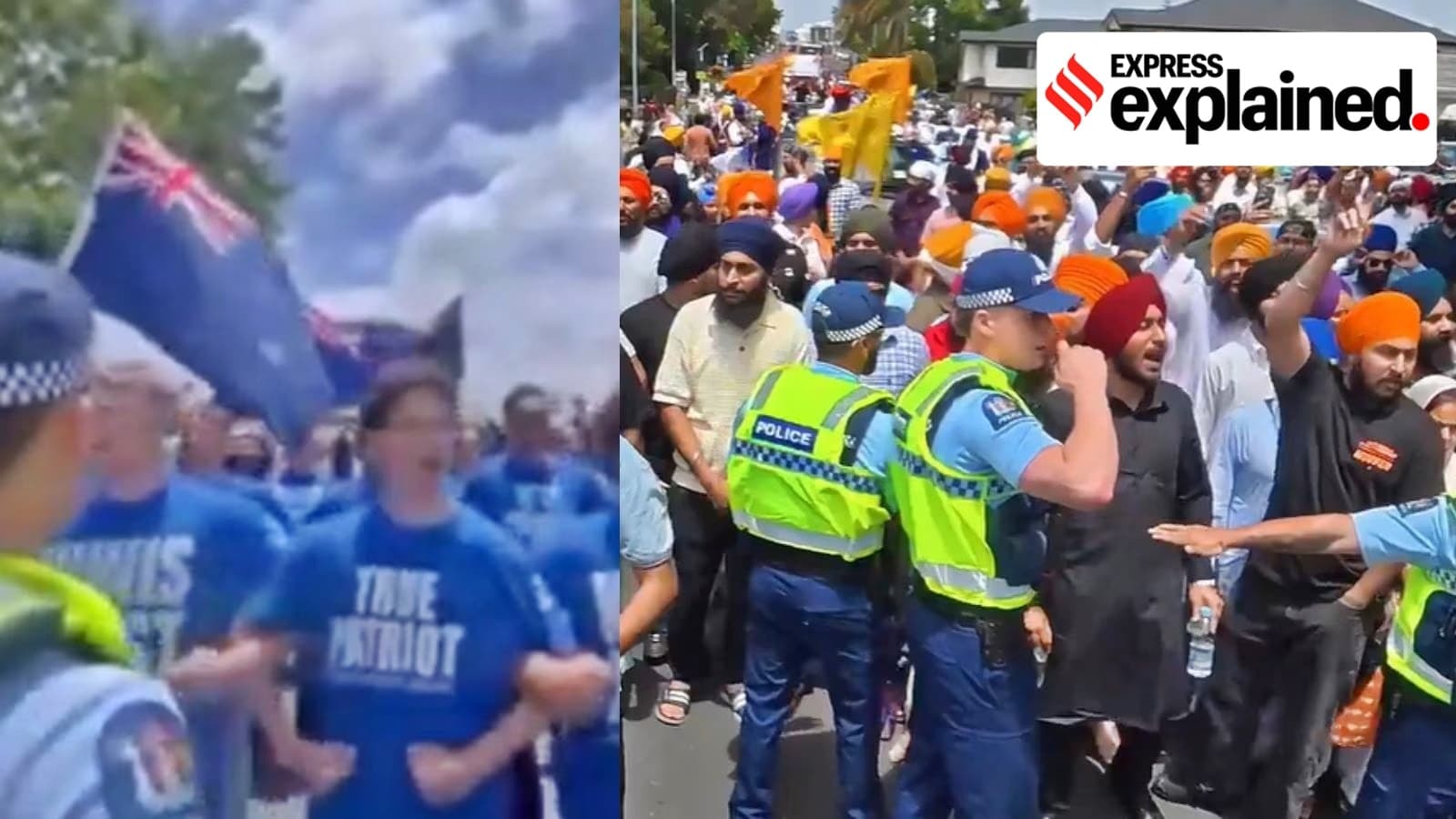


Content unavailable: 'Haka' protest against Sikh procession in New Zealand cannot be analyzed.
Summary
The article's content is unavailable, preventing a detailed summary of the 'Haka' protest against the Sikh procession in New Zealand. Without the text, it's impossible to explain the context, specific events, or their significance for competitive exam preparation, including the broader immigration issues mentioned in the title.
Key Points
- 1No specific details regarding the 'Haka' protest event are available due to missing content.
- 2Dates, locations, and participants of the Sikh procession or protest in New Zealand are not provided.
- 3The article content is missing, thus specific immigration issues mentioned cannot be identified.
- 4No names of organizations or individuals involved in the event are extractable from the provided input.
- 5Without content, the exact reasons, sequence of events, or outcomes of the protest remain unknown.
In-Depth Analysis
The reported incident of a 'Haka' protest against a Sikh procession in New Zealand, while specific details of the event are unavailable, serves as a crucial lens through which to examine complex themes pertinent to competitive exams: multiculturalism, indigenous rights, immigration, and the dynamics of diaspora communities. The very title suggests a potential clash or assertion of cultural identities within a host nation, a scenario increasingly common in our globalized world.
**Background Context and What Happened (Generalised):**
The 'Haka' is a traditional ancestral war dance or challenge of the Māori people, the indigenous Polynesian people of mainland New Zealand. It is a powerful display of a tribe's pride, strength, and unity, often performed to welcome distinguished guests, acknowledge great achievements, or as a show of defiance. Its use in a protest context, therefore, signifies a strong assertion of Māori identity, sovereignty, or grievance. A Sikh procession, on the other hand, is a religious and cultural demonstration, often involving a 'Nagar Kirtan' (a street procession involving the congregational singing of holy hymns), which is an important aspect of Sikh religious practice and community building. The juxtaposition of a Māori 'Haka' and a Sikh 'Nagar Kirtan' implies a potential conflict arising from differing cultural expressions, possibly fueled by broader immigration issues.
While the specific incident details are missing, such a protest could hypothetically stem from various factors: perceived cultural insensitivity, competition for resources, anti-immigrant sentiment, or local grievances related to land, employment, or cultural space. New Zealand, a nation with a significant immigrant population, particularly from Asia, has grappled with questions of national identity, integration, and the impact of demographic shifts. The country's official commitment to multiculturalism and the Treaty of Waitangi (1840), which established a partnership between the Māori and the British Crown, provides a framework, but real-world integration can be challenging.
**Key Stakeholders Involved:**
* **Māori Community:** As the indigenous people, their cultural expressions, like the Haka, are deeply tied to their identity and historical grievances. Their concerns often revolve around land rights, cultural preservation, and the impacts of non-Māori immigration on their heritage and socio-economic standing.
* **Sikh Community (Indian Diaspora):** A vibrant and growing community in New Zealand, Sikhs seek to practice their religion and preserve their culture. Their processions are vital for community cohesion and religious freedom. Their stake lies in ensuring their rights to religious expression and peaceful assembly are protected.
* **New Zealand Government:** Responsible for maintaining social cohesion, upholding human rights (including religious freedom and freedom of expression), managing immigration, and addressing indigenous concerns. They must balance the rights of all communities.
* **Indian Government:** Concerned with the welfare and rights of its diaspora abroad. Incidents affecting Indian communities can trigger diplomatic engagement, emphasizing the protection of Indian citizens' rights and cultural freedoms in host countries.
**Why This Matters for India and Constitutional Provisions:**
For India, the welfare and security of its vast diaspora are paramount. Incidents like these, even if localized, resonate deeply, as they touch upon the fundamental rights of Indian-origin citizens living abroad. India's foreign policy increasingly focuses on diaspora engagement, recognizing their role as cultural ambassadors and economic contributors. The Indian Constitution, particularly **Article 25 (Freedom of Conscience and Free Profession, Practice and Propagation of Religion)** and **Article 26 (Freedom to Manage Religious Affairs)**, enshrines the right to religious practice, which is a core expectation for Indian communities globally. While these articles apply domestically, their spirit informs India's diplomatic stance on religious freedom for its citizens overseas. Furthermore, **Article 19 (Protection of certain rights regarding freedom of speech, etc.)** covers the right to assemble peacefully, which is fundamental to public processions.
**Historical Context and Broader Themes:**
New Zealand has a history of immigration, initially from Europe, and more recently from Asia and the Pacific. This has led to a diverse society but also occasional tensions. The Māori experience, marked by colonization and efforts to reclaim rights, provides a critical historical context for understanding their assertions of identity. The incident highlights broader themes of multiculturalism, identity politics, and the challenges of social cohesion in diverse societies. It underscores the global phenomenon where local communities, often indigenous, feel marginalized or overwhelmed by immigration-driven demographic changes.
**Future Implications:**
Such events necessitate robust dialogue and cultural understanding initiatives. For New Zealand, it means strengthening policies that promote integration while respecting both indigenous rights and immigrant freedoms. It calls for better understanding between different cultural groups to prevent misunderstandings and conflict. For India, it emphasizes the continued importance of consular support, cultural diplomacy, and advocating for the rights of its diaspora through bilateral channels. Globally, it reinforces the need for countries to develop nuanced immigration policies that consider socio-cultural impacts alongside economic benefits, ensuring that diversity remains a strength rather than a source of division. The incident, even in its abstract form, serves as a reminder that safeguarding religious and cultural freedoms requires constant vigilance and proactive measures from both host governments and origin countries.
Exam Tips
This topic falls under 'International Relations' (specifically 'Indian Diaspora' and 'India's Foreign Policy') and 'Social Issues' (Multiculturalism, Indigenous Rights, Immigration) in the UPSC Civil Services Syllabus (GS Paper II).
When studying, connect this to related topics like 'Cultural Diplomacy and Soft Power', 'Challenges of Globalization', 'Minority Rights', and 'The role of United Nations and other international bodies in protecting human rights'.
Common question patterns include case studies on diaspora challenges, analytical questions on the impact of immigration on host countries, and questions on India's efforts to protect its citizens abroad. Be prepared to discuss the balance between national sovereignty and international human rights norms.