



Relevant for Exams
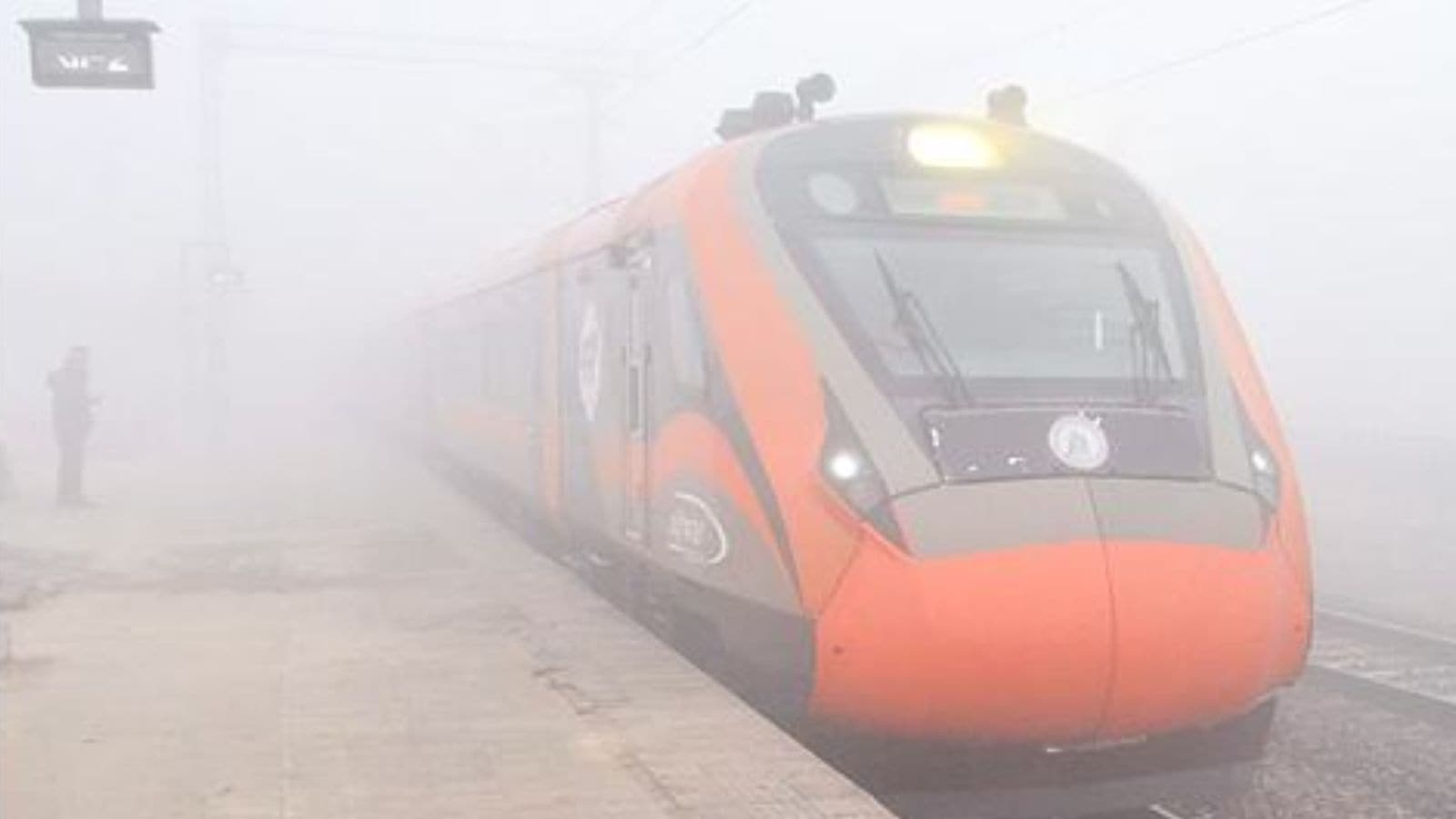
Dense fog hits North India rail, delaying Vande Bharat, Rajdhani trains by hours due to poor visibility.
Summary
Dense fog significantly impacted North India, leading to poor visibility and extensive delays in rail traffic. Key trains like Vande Bharat and Rajdhani Express were among those experiencing hours-long delays, disrupting travel. This highlights the recurring challenges weather conditions pose to transportation networks in the region, relevant for geography and disaster management topics.
Key Points
- 1Dense fog conditions gripped the North India region.
- 2Poor visibility was the primary cause of disruption to rail traffic.
- 3Vande Bharat Express was specifically mentioned among the delayed trains.
- 4Rajdhani Express services were also impacted by the extensive delays.
- 5Train operations experienced delays lasting for 'hours' due to the fog.
In-Depth Analysis
The recurring phenomenon of dense fog gripping North India during winter months, causing widespread disruption to critical infrastructure like the railway network, is a significant challenge for the nation. This particular incident, where premier trains like the Vande Bharat and Rajdhani Express faced hours-long delays, underscores the vulnerability of even modern transportation systems to adverse weather conditions.
**Background Context: Understanding North Indian Fog**
Dense fog in North India, particularly across the vast Indo-Gangetic Plain, is a common feature from late December to February. Its formation is a complex interplay of several meteorological factors. Firstly, the region experiences clear skies and calm winds after the passage of Western Disturbances, leading to significant radiative cooling of the ground overnight. This cools the air near the surface. Secondly, high moisture content, often residual from previous rainfall or agricultural irrigation, gets trapped in the lower atmosphere. Thirdly, the presence of abundant particulate matter (dust, smoke from stubble burning, industrial emissions, vehicular pollution) acts as condensation nuclei, facilitating the formation of fog droplets even at relatively higher temperatures (known as 'smog' when combined with smoke/pollution). A crucial factor is temperature inversion, where a layer of warm air traps cooler, moist air near the surface, preventing vertical mixing and allowing fog to persist for extended periods, sometimes throughout the day.
**What Happened: A Recurring Nightmare for Commuters**
As the article highlights, dense fog led to significantly reduced visibility, plummeting to less than 50 meters in many areas. This severely hampered the ability of train drivers to operate at normal speeds, necessitating drastically reduced speeds for safety. Consequently, major rail services, including the flagship Vande Bharat Express and the high-priority Rajdhani Express, experienced delays stretching for several hours. Such delays ripple across the entire network, impacting subsequent train schedules, crew availability, and platform management. While the specific details of the delays are not provided, the mention of these premium services indicates the widespread and severe nature of the disruption, affecting thousands of passengers and impacting the punctuality record of Indian Railways.
**Key Stakeholders and Their Roles**
Several entities are directly involved and impacted. **Indian Railways**, as the primary operator, bears the brunt of managing the crisis, implementing safety protocols, rescheduling trains, and communicating with passengers. The **Ministry of Railways** is responsible for policy, infrastructure upgrades, and allocating resources for fog mitigation technologies. **Passengers** are the most directly affected, facing inconvenience, missed connections, and potential health risks from prolonged exposure in cold weather. The **India Meteorological Department (IMD)**, under the Ministry of Earth Sciences, plays a crucial role by providing timely and accurate fog forecasts, which are vital for railway planning and operational decisions. **State Governments** are indirectly involved through local law enforcement and emergency services, especially if passengers require assistance at stations.
**Significance for India: Economic, Social, and Governance Challenges**
The impact of such disruptions extends far beyond mere inconvenience. **Economically**, delays in passenger and freight trains translate to lost productivity, missed business opportunities, and disruptions to supply chains. Businesses reliant on timely transport of goods suffer, impacting the broader economy. For example, the timely delivery of perishables or critical industrial components can be severely affected. **Socially**, millions of commuters, students, and tourists face hardships, affecting their daily routines, exam schedules, and travel plans. The psychological toll of uncertainty and long waits can be substantial. From a **governance** perspective, it highlights the need for robust, all-weather infrastructure and effective disaster preparedness strategies for weather-related events, even those considered routine. Ensuring public safety and efficient public services falls under the broader mandate of good governance.
**Historical Context and Evolution of Mitigation**
Fog has historically been a challenge for Indian Railways. In the past, accidents attributed to poor visibility were not uncommon. Over the years, Indian Railways has adopted various measures, including the use of detonators (fog signals), which are explosive devices placed on tracks to alert drivers. More recently, technological advancements have led to the deployment of **Fog Pilot Assistance System for Safety (FOGPASS)** devices, which are GPS-based systems providing real-time information about approaching signals, level crossings, and other landmarks, thereby assisting drivers in low visibility conditions. However, the widespread nature of fog and the vastness of the network mean that complete immunity from delays remains a challenge.
**Future Implications and Policy Responses**
Looking ahead, the emphasis will continue to be on enhancing technological solutions. Further deployment and refinement of FOGPASS systems, improved signaling infrastructure, and better integration of real-time weather data with operational control centers are crucial. The **National Rail Plan 2030** aims to create a 'future-ready' railway system, which implicitly includes resilience against weather disruptions. There's also a need to explore alternative transportation modes during severe fog, though rail remains the backbone for long-distance travel. The broader issue of air pollution, which exacerbates fog formation (leading to 'smog'), also needs to be addressed through policies like the **National Clean Air Programme (NCAP)** launched in 2019, as cleaner air could potentially reduce the severity and persistence of fog. While no specific constitutional article directly mandates fog mitigation, the state's responsibility to ensure public welfare and safety, implicitly guided by **Article 38 (Directive Principles of State Policy)**, underpins the government's efforts in this regard. The **Indian Railways Act, 1989**, provides the legal framework for the operation and safety of railways.
In essence, while fog is a natural phenomenon, its impact on India's critical infrastructure necessitates continuous technological upgrades, robust operational planning, and a coordinated approach involving meteorological agencies and transportation authorities to minimize disruptions and ensure public safety.
Exam Tips
This topic falls under 'Geography (Climatology, Indian Geography)', 'Indian Economy (Infrastructure, Transport)', and 'Disaster Management' sections of competitive exam syllabi. Be prepared for questions on the causes of fog formation in North India, its economic and social impacts, and mitigation strategies adopted by Indian Railways.
Study related topics such as temperature inversion, Western Disturbances, the role of air pollution (especially stubble burning) in exacerbating fog/smog, and the functioning and modernization efforts of Indian Railways (e.g., Vande Bharat, Dedicated Freight Corridors). Understanding the interplay of these factors is crucial.
Common question patterns include direct questions on the meteorological conditions leading to dense fog, multiple-choice questions on technological solutions like FOGPASS, and analytical questions on the socio-economic implications of transport disruptions. You might also encounter questions comparing the impact of fog with other weather-related disruptions (e.g., floods, heatwaves) on infrastructure.