



Relevant for Exams
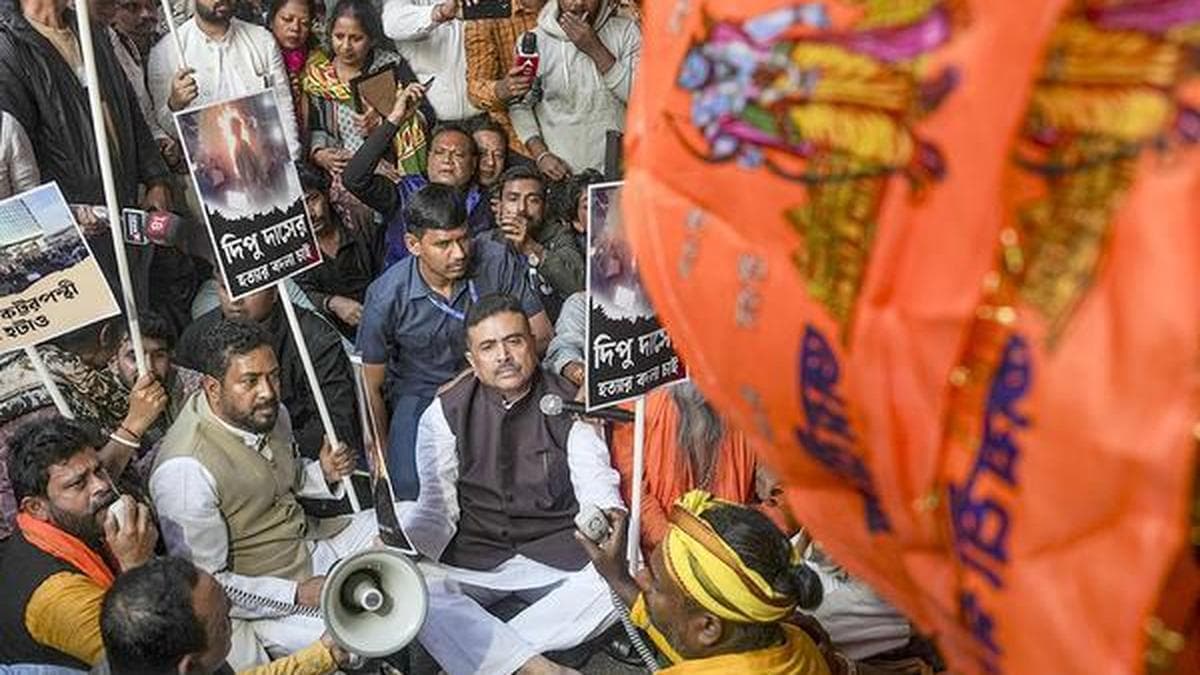
BJP's Suvendu Adhikari criticizes police action at Bangladeshi mission in Kolkata.
Summary
Police reportedly quelled violence at the Bangladeshi mission in Kolkata. BJP leader Suvendu Adhikari criticized the police action, drawing a parallel between Mamata Banerjee's government in West Bengal and Mohammad Yunus's government in Bangladesh. This incident highlights ongoing political tensions and law and order concerns in West Bengal, making it relevant for state-level competitive exams focusing on regional current affairs and political developments.
Key Points
- 1Violence was quelled by police at the Bangladeshi mission in Kolkata.
- 2BJP leader Suvendu Adhikari made a statement regarding the incident.
- 3Adhikari criticized the police action, linking it to Mamata Banerjee's government in West Bengal.
- 4He drew a comparison between the Bengal government and Mohammad Yunus's government in Bangladesh.
- 5The incident occurred at the Bangladeshi diplomatic mission located in Kolkata.
In-Depth Analysis
The incident involving police intervention to quell violence at the Bangladeshi mission in Kolkata, followed by BJP leader Suvendu Adhikari's strong criticism, offers a multifaceted lens through which to examine India's internal political dynamics, federal structure, and international relations. This event is not merely a local law and order issue but resonates with broader themes crucial for competitive exam aspirants.
**Background Context and What Happened:**
Kolkata, the capital of West Bengal, shares deep historical, cultural, and linguistic ties with Bangladesh. It often serves as a significant hub for diplomatic and cultural exchanges between the two nations. Diplomatic missions, such as the Bangladeshi mission, are sovereign territories of their respective countries under international law, and their security and inviolability are paramount. The specific details regarding the cause of the violence at the mission are not fully elaborated in the summary, but such incidents often stem from domestic political issues within the home country, or protests against its policies, sometimes spilling over into host nations where large diaspora communities reside. In this instance, the West Bengal police reportedly intervened to control the situation and quell the violence, which is their primary duty when public order is threatened. The swiftness and method of police action became the focal point of the subsequent political backlash.
**Key Stakeholders Involved:**
1. **West Bengal Police:** As the primary law enforcement agency, their role was to maintain public order and ensure the security of the diplomatic mission, adhering to both national laws and international conventions. Their actions are directly accountable to the state government.
2. **Government of West Bengal (Mamata Banerjee):** The ruling Trinamool Congress (TMC) government, led by Chief Minister Mamata Banerjee, is ultimately responsible for law and order in the state. Any perceived failure or excessive force by the police is attributed to the state administration, making them a direct target of opposition criticism.
3. **Bharatiya Janata Party (BJP) and Suvendu Adhikari:** As the principal opposition party in West Bengal, the BJP, through its prominent leader Suvendu Adhikari, seized the opportunity to critique the state government. Adhikari's statement, comparing the West Bengal government to Mohammad Yunus's government in Bangladesh (implying poor governance or authoritarian tendencies), is a classic example of political rhetoric aimed at discrediting the incumbent.
4. **Bangladeshi Diplomatic Mission/Government:** Their premises were the site of the violence, and their primary concern would be the safety of their personnel and the inviolability of their mission. Any breach of security directly impacts bilateral relations and diplomatic protocols.
**Why This Matters for India:**
This incident carries significant implications for India. Firstly, it highlights persistent **law and order challenges** in West Bengal, a frequent point of contention between the state and the central government. The security of foreign missions is a central government responsibility under the **Vienna Convention on Diplomatic Relations, 1961**, to which India is a signatory. Article 22 of this convention mandates that the receiving state (India) must protect the premises of the mission against any intrusion or damage and prevent any disturbance of the peace of the mission or impairment of its dignity. Any failure to do so, even if handled by state police, reflects on India's commitment to international law and its diplomatic credibility.
Secondly, the political commentary by Suvendu Adhikari underscores the intense **federal political rivalry** in India, particularly between the BJP-led Centre and non-BJP state governments. Such criticisms often escalate into debates about the state's capacity to govern and maintain peace, sometimes leading to calls for central intervention. This touches upon the constitutional scheme of **Article 256 and 257**, which obligate states to comply with Union laws and directions, and **Article 355**, which imposes a duty on the Union to protect states against external aggression and internal disturbance, hinting at potential grounds for **Article 356 (President's Rule)**, though this is an extreme step.
Thirdly, the reference to Bangladesh, while a political jab, subtly brings **India-Bangladesh bilateral relations** into the domestic political discourse. Bangladesh is a crucial neighbor for India's 'Act East' policy and regional stability. Any insinuation or comparison, even if rhetorical, can be sensitive, particularly given the historical context of shared liberation struggles and ongoing cooperation on trade, security, and connectivity.
**Historical Context and Future Implications:**
West Bengal has a history of robust political activism, sometimes escalating into violence. The political landscape is often characterized by fierce contests, especially between the TMC and BJP in recent years. The security of diplomatic missions has been a focus globally, especially post-9/11, emphasizing the need for robust protection mechanisms. India has generally maintained excellent relations with Bangladesh since its liberation in 1971, with India playing a pivotal role. Kolkata's proximity and cultural affinity make it a natural place for such interactions, and unfortunately, also a potential site for protests related to Bangladeshi internal affairs.
The future implications could include increased scrutiny on West Bengal's law and order situation by the central government, potentially leading to enhanced central security advisories or even deployment of central forces if the situation deteriorates further and impacts national or international interests. For India-Bangladesh relations, while a single incident might not severely damage ties, repeated security lapses concerning diplomatic missions could strain trust and cooperation. Domestically, such incidents will continue to fuel the political slugfest between the BJP and TMC, shaping public perception and electoral narratives in the state.
**Related Constitutional Articles, Acts, or Policies:**
* **Seventh Schedule (State List, Entry 1 & 2):** "Public Order" and "Police" fall under the exclusive legislative and executive domain of the state governments, making the West Bengal government primarily responsible for the incident.
* **Article 256 & 257:** These articles govern the administrative relations between the Union and the States, obligating states to exercise their executive power to ensure compliance with Union laws and not to impede the executive power of the Union. The security of foreign missions falls under the Union's external affairs remit.
* **Vienna Convention on Diplomatic Relations, 1961:** As a signatory, India is bound by its provisions, particularly Article 22, which ensures the inviolability of diplomatic premises and requires the host state to protect them.
* **Foreigners Act, 1946:** Pertains to the entry, presence, and departure of foreigners in India, relevant if the protesters included Bangladeshi nationals.
* **Protection of Human Rights Act, 1993:** Applicable if there are allegations of human rights violations or excessive force by the police during the quelling of violence.
Exam Tips
This topic falls under 'Polity & Governance' (State Administration, Centre-State Relations, Law & Order) and 'International Relations' (India-Bangladesh Bilateral Relations, Diplomatic Protocol) for UPSC, State PSCs, and SSC exams. Pay attention to the constitutional provisions governing law and order and federalism.
Study related topics like the Vienna Convention on Diplomatic Relations (1961), the Seventh Schedule of the Indian Constitution, Articles 256, 257, 355, and 356, and the overall framework of India's foreign policy towards its neighbours, especially Bangladesh.
Common question patterns include: factual questions on constitutional articles related to law and order, analytical questions on the implications of state-level incidents on national foreign policy, and questions on the role and responsibilities of diplomatic missions and host states under international law. Be prepared for questions comparing the powers of state police vs. central forces.
Related Topics to Study
Full Article
Suvendu Adhikari said police violence proved that there is no difference between Mamata Banerjee’s government in Bengal and Mohammad Yunus’s government in Bangladesh