



Relevant for Exams
Bird flu outbreak confirmed in Kerala's Alappuzha and Kottayam districts, impacting poultry sector.
Summary
A bird flu outbreak, caused by the highly pathogenic avian influenza virus, has been confirmed in Kerala's Alappuzha and Kottayam districts. This development significantly impacts poultry farmers, especially ahead of the Christmas-New Year season, raising concerns about economic losses and public health. For competitive exams, this highlights the importance of understanding zoonotic diseases, public health responses, and state-specific current events.
Key Points
- 1A bird flu outbreak has been confirmed in Kerala.
- 2The affected districts are Alappuzha and Kottayam.
- 3The outbreak is caused by the highly pathogenic avian influenza virus.
- 4In Alappuzha, the outbreak was confirmed in one ward each of eight panchayats.
- 5In Kottayam, the outbreak was confirmed in four villages.
In-Depth Analysis
The recent confirmation of a highly pathogenic avian influenza (HPAI) virus, commonly known as bird flu, in Kerala's Alappuzha and Kottayam districts, represents a significant public health and economic challenge. This outbreak, occurring just before the crucial Christmas-New Year season, delivers a substantial blow to poultry farmers, highlighting the recurring vulnerability of the region to such zoonotic diseases.
Bird flu is an infectious disease of birds caused by Type A influenza viruses. While many strains are mild, HPAI strains, such as H5N1 or H5N8, are extremely virulent and can cause severe illness and high mortality in poultry. The concern extends beyond poultry to human health, as certain strains can, though rarely, cross the species barrier and infect humans, leading to severe respiratory illness and even death. Kerala has a history of bird flu outbreaks, with incidents reported in various years including 2014, 2016, 2020, 2021, and 2022. This recurring pattern underscores the state's susceptibility, often attributed to the presence of migratory birds that act as carriers, dense poultry farming practices, and proximity to wetlands.
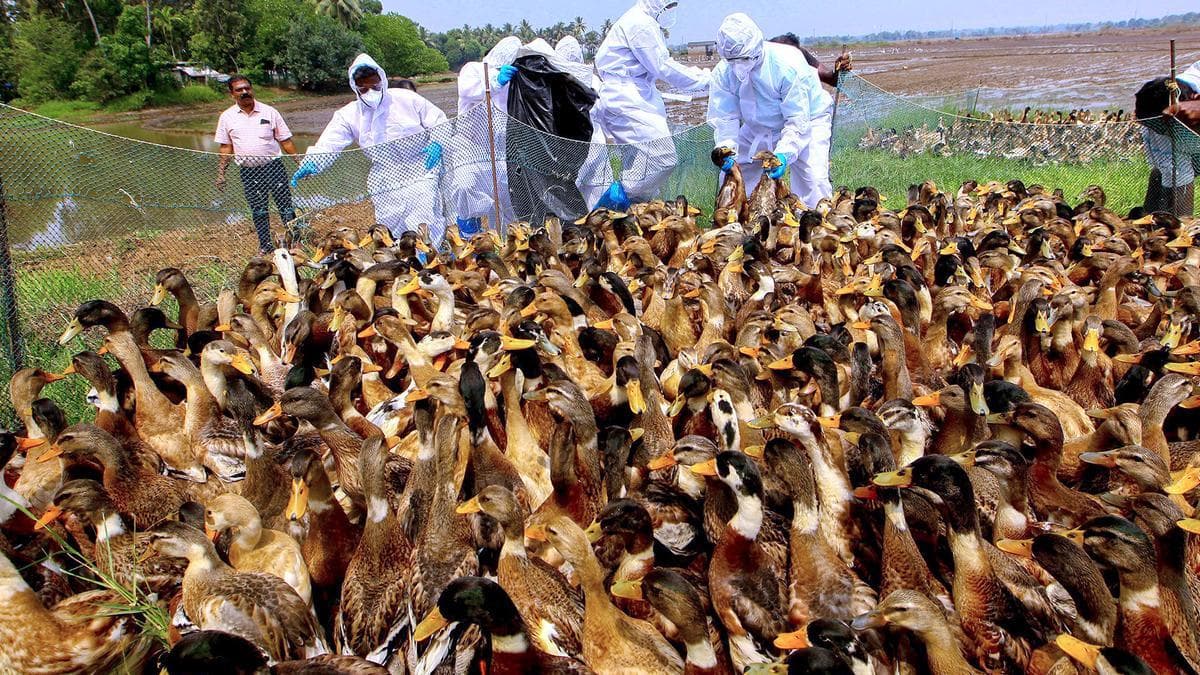
In the current scenario, the outbreak has been confirmed in specific wards across eight panchayats in Alappuzha and four villages in Kottayam. The immediate response involves rapid containment measures, primarily culling of affected poultry and surveillance in a specified radius around the epicenters. This proactive step aims to prevent further spread and mitigate the risk of human transmission. The economic ramifications are profound, particularly for the poultry industry, which is a vital component of India's agricultural economy, estimated to be worth over ₹1.2 lakh crore annually. Farmers face immediate losses from culling, disruption in supply chains, and a potential dip in consumer confidence, especially during peak festive demand. This directly impacts the livelihoods of thousands of small and marginal farmers, who often lack sufficient financial resilience to absorb such shocks.
Several key stakeholders are involved in managing this crisis. The **Kerala State Government**, through its Animal Husbandry Department and Health Department, is at the forefront, responsible for implementing containment strategies, providing compensation to affected farmers, and issuing public health advisories. District administrations play a crucial role in on-ground execution. The **Central Government**, particularly the Ministry of Fisheries, Animal Husbandry and Dairying, and the Ministry of Health and Family Welfare, provides technical guidance, financial assistance, and coordinates national-level responses. **Poultry farmers** are direct victims, bearing the brunt of economic losses and disruptions to their livelihoods. **Veterinarians and public health officials** are critical frontline workers for detection, surveillance, and containment. The **general public** is also a stakeholder, needing to follow health advisories regarding safe handling and cooking of poultry products.
This incident holds significant implications for India. Economically, beyond the immediate losses to poultry farmers, there can be broader impacts on allied industries like feed production and processing. Public health remains a paramount concern; while human-to-human transmission of avian influenza is rare, the potential for viral mutation and a future pandemic cannot be ignored, necessitating robust surveillance and preparedness. This situation also highlights issues of food security and the need for diversified agricultural income sources for farmers. The **'One Health' approach**, which recognizes the interconnectedness of human, animal, and environmental health, becomes crucial here, emphasizing collaboration across sectors to address zoonotic threats.
From a constitutional perspective, the management of such outbreaks involves both state and central powers. **Entry 15 of List II (State List) of the Seventh Schedule** empowers states to legislate on 'Preservation, protection and improvement of stock and prevention of animal diseases; veterinary training and practice.' Similarly, **Entry 6 of List II** covers 'Public health and sanitation.' The Central Government's role is often facilitated by **List III (Concurrent List)** entries like 'Prevention of cruelty to animals' (Entry 17) and through central legislation. The **Prevention and Control of Infectious and Contagious Diseases in Animals Act, 2009**, is a key central legislation empowering states to take measures like culling, containment, and compensation. Furthermore, large-scale outbreaks can be managed under the **Disaster Management Act, 2005**, which provides a framework for coordinated response from national to local levels.
Looking ahead, the future implications are multi-faceted. There is an urgent need for enhanced, year-round surveillance, particularly in areas frequented by migratory birds. Strengthening biosecurity measures on poultry farms is paramount to prevent future outbreaks. Research into effective vaccines for poultry and humans, alongside improved diagnostic tools, will be crucial. Timely and adequate compensation mechanisms for farmers are essential to ensure their economic stability and encourage compliance with culling orders. Lastly, public awareness campaigns on safe handling and consumption of poultry products, and the importance of reporting unusual bird deaths, are vital for effective disease control and prevention. This recurring challenge underscores the need for a comprehensive, multi-sectoral strategy to protect both public health and the agricultural economy.
Exam Tips
This topic falls under GS Paper III (Economy, Environment, Disaster Management, Science & Technology) and GS Paper II (Governance, Health) for UPSC. For SSC, Banking, Railway, and State PSC exams, it's relevant for Current Affairs, General Science, and General Awareness sections.
Study related topics such as 'Zoonotic Diseases and Pandemics,' 'National Disaster Management Authority (NDMA) and its role,' 'Animal Husbandry Sector in India,' 'Public Health Infrastructure,' and the 'One Health Concept' to gain a holistic understanding.
Expect questions on the specific strain of the virus (e.g., H5N1, H5N8), affected regions, government policies (e.g., compensation, culling protocols), constitutional provisions related to public health and animal husbandry, and the economic impact on the poultry sector. Analytical questions on the 'One Health' approach are also common.
Related Topics to Study
Full Article
In blow to poultry farmers ahead of Christmas-New Year season, authorities confirm presence of highly pathogenic avian influenza virus in one ward each of eight panchayats in Alappuzha and in four villages in Kottayam