



Relevant for Exams
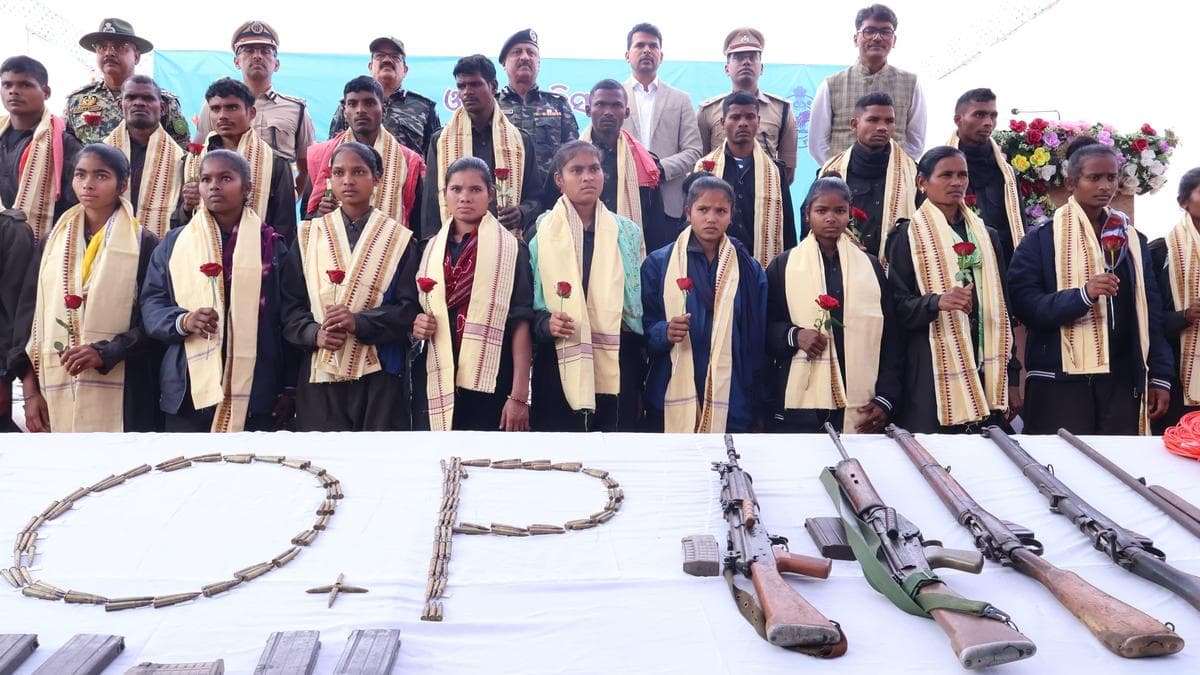
22 CPI (Maoist) cadres surrender in Odisha with ₹1.84 crore collective bounty.
Summary
22 cadres of the CPI (Maoist) organization surrendered to authorities in Odisha, carrying a collective bounty of ₹1.84 crore. This event highlights the effectiveness of government efforts to combat left-wing extremism and integrate former militants into mainstream society. For competitive exams, it's relevant for understanding internal security, state-specific anti-Naxal strategies, and rehabilitation policies in India.
Key Points
- 1A total of 22 CPI (Maoist) cadres surrendered to authorities.
- 2The surrendered individuals were members of the Communist Party of India (Maoist) organization.
- 3The surrender event took place in the state of Odisha.
- 4The collective bounty on the heads of the 22 surrendered cadres amounted to ₹1.84 crore.
- 5Odisha Police announced rehabilitation provisions including subsidised housing, health plans, and other welfare measures for their mainstreaming.
In-Depth Analysis
The recent surrender of 22 CPI (Maoist) cadres in Odisha, carrying a collective bounty of ₹1.84 crore, marks a significant development in India's ongoing struggle against Left-Wing Extremism (LWE). This event is not an isolated incident but rather a testament to the persistent, multi-pronged approach adopted by both central and state governments to address one of the nation's most formidable internal security challenges. It highlights the effectiveness of combined security operations, development initiatives, and crucial rehabilitation policies.
**Background Context: The Genesis of Left-Wing Extremism**
Left-Wing Extremism, often referred to as Naxalism, traces its roots back to the Naxalbari uprising in West Bengal in 1967. This peasant revolt, led by radical communist leaders like Charu Majumdar and Kanu Sanyal, advocated for armed struggle against what they perceived as an exploitative state and feudal landlords. Over the decades, various splinter groups emerged, notably the People's War Group (PWG) and the Maoist Communist Centre (MCC), which eventually merged in 2004 to form the Communist Party of India (Maoist) – the organization at the heart of this surrender. Their ideology, deeply rooted in Maoist philosophy, seeks to overthrow the existing democratic state through protracted armed struggle, establishing a 'people's government.' The movement primarily thrives in the 'Red Corridor,' a contiguous stretch across several states including Chhattisgarh, Jharkhand, Odisha, Bihar, and parts of Maharashtra, Andhra Pradesh, and Telangana, often exploiting socio-economic grievances such as land alienation, forest rights issues, displacement due to development projects, and lack of basic amenities among tribal and marginalized communities.
**What Happened and Key Stakeholders**
In this particular incident, 22 members of the CPI (Maoist) voluntarily laid down their arms before the authorities in Odisha. The substantial collective bounty on their heads underscores their previous involvement and the importance of their surrender. The Odisha Police, a primary stakeholder, has committed to providing a comprehensive rehabilitation package, including subsidized housing, health plans, and other welfare provisions. This commitment is crucial for their successful mainstreaming. Other key stakeholders include the **Government of India**, particularly the Ministry of Home Affairs (MHA), which formulates national policies and provides central armed police forces (like CRPF) for anti-LWE operations; the **State Government of Odisha**, responsible for law and order, implementing development projects, and executing rehabilitation policies; the **CPI (Maoist) organization** itself, whose weakening leadership and dwindling cadre strength are evident from such surrenders; and most importantly, the **local populations**, especially tribal communities, who are often caught between the state and the Maoists, bearing the brunt of the violence and underdevelopment.
**Significance for India and Broader Themes**
This surrender carries profound significance for India's internal security landscape. Firstly, it directly contributes to weakening the LWE movement, reducing their operational strength and ideological appeal. Every surrender is a symbolic victory for the state and a step towards restoring peace. Secondly, it bolsters the government's credibility and demonstrates that a path to a dignified life exists beyond extremism. This encourages more cadres to give up arms, creating a positive feedback loop. Thirdly, peace in LWE-affected regions is a prerequisite for development. Areas plagued by Naxalism often lag significantly in infrastructure, education, and healthcare. Surrenders pave the way for effective implementation of government schemes and economic activities, thereby addressing the very root causes of discontent. This links to broader themes of **governance**, **socio-economic development**, and **inclusive growth**.
**Constitutional Provisions and Policy References**
India's Constitution provides the framework for addressing such challenges. **Article 355** mandates the Union's duty to protect states against internal disturbance, justifying central assistance to LWE-affected states. The **Seventh Schedule** delineates powers, with 'Public Order' falling under the State List (List II) and 'Criminal Law' under the Concurrent List (List III), necessitating robust Centre-State cooperation. Key legislative and policy measures include the **Panchayats (Extension to Scheduled Areas) Act, 1996 (PESA)**, which aims to empower tribal communities by granting them self-governance rights over their natural resources, and the **Scheduled Tribes and Other Traditional Forest Dwellers (Recognition of Forest Rights) Act, 2006 (FRA)**, which addresses historical injustices regarding forest land. The **National Policy and Action Plan to Combat LWE (2015)** outlines a comprehensive strategy focusing on security, development, ensuring rights and entitlements, public perception management, and rehabilitation. Specific state-level **Surrender & Rehabilitation Policies** (like Odisha's) are critical components of this strategy, offering incentives and support for mainstreaming former cadres.
**Future Implications**
The successful rehabilitation of these 22 cadres will send a powerful message to others still operating within the Maoist fold. It reinforces the notion that the government is committed not just to security operations but also to providing an exit strategy and a chance at a normal life. This could lead to more surrenders, further eroding the Maoist base. However, challenges remain. Sustaining rehabilitation efforts, ensuring economic integration, addressing residual grievances of tribal populations, and preventing the resurgence of extremism are crucial. The government must continue to focus on improving governance, delivering justice, and accelerating development in these remote and historically neglected regions to truly stamp out LWE. The Odisha surrender serves as a beacon of hope, demonstrating that a combination of firm security action and compassionate rehabilitation can yield positive results in the long battle against internal strife.
Exam Tips
This topic falls under 'Internal Security' (UPSC GS Paper III) and 'Governance & Social Justice' (UPSC GS Paper II). For State PSCs and SSC, it's relevant for General Awareness and Current Affairs, often focusing on key policies, affected states, or recent developments.
When studying, connect LWE with related topics such as tribal rights, land reforms, forest policies (FRA, PESA), socio-economic development indicators of backward regions, and the role of various security forces (CRPF, BSF, State Police).
Expect questions like: 'Critically analyze the multi-pronged strategy adopted by the Government of India to tackle Left-Wing Extremism.' or 'Discuss the socio-economic factors contributing to the persistence of Naxalism and evaluate the effectiveness of rehabilitation policies.' Multiple-choice questions might focus on the 'Red Corridor' states, key Acts, or the name of the main LWE organization.
Pay attention to the specific rehabilitation measures mentioned (subsidized housing, health plans) as they highlight policy implementation. Also, note the 'collective bounty' as it indicates the scale and significance of the surrender.
Related Topics to Study
Full Article
They carried collective bounty of ₹1.84 crore on their heads; Odisha Police say they will be given subsidised housing, health plans and other welfare provisions to facilitate their mainstreaming