



Relevant for Exams
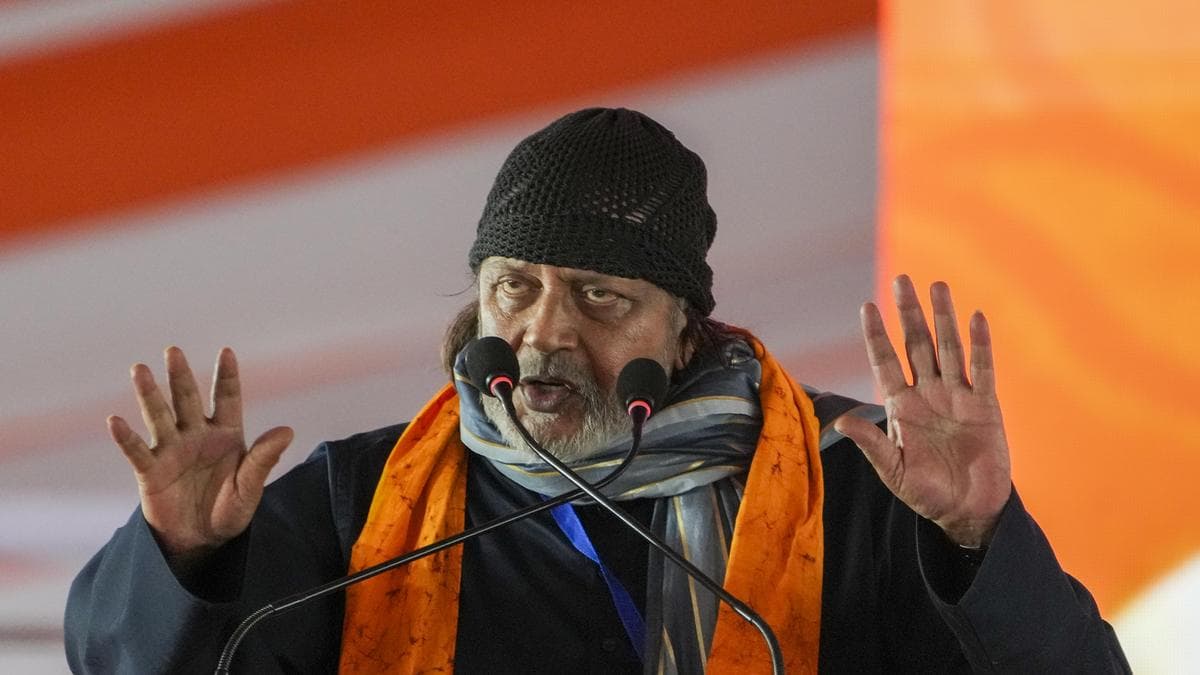
BJP leader Mithun Chakraborty vows West Bengal won't become Bangladesh amid violence parallels.
Summary
BJP leader and actor Mithun Chakraborty stated that West Bengal would not be allowed to become Bangladesh, drawing parallels to recent violence in Bangladesh. This political rhetoric by the West Bengal BJP leadership aims to highlight perceived issues within the state by comparing them to cross-border events. For competitive exams, this highlights political discourse, key figures, and the geopolitical context of India's eastern states, particularly relevant for state-level examinations.
Key Points
- 1The statement was made by BJP leader and actor Mithun Chakraborty.
- 2Chakraborty asserted that West Bengal would not be allowed to become Bangladesh.
- 3The context for this statement was violence that recently erupted in Bangladesh.
- 4West Bengal BJP leadership is actively trying to draw parallels between the situation in Bangladesh and West Bengal.
- 5The statement specifically concerns the Indian state of West Bengal and its political future.
In-Depth Analysis
The statement by BJP leader and actor Mithun Chakraborty, asserting that "West Bengal would not be allowed to become Bangladesh," is a potent example of political rhetoric deeply rooted in historical anxieties, demographic concerns, and contemporary electoral strategies in India. This declaration, made in the context of recent violence in Bangladesh, aims to draw parallels between perceived law and order issues or demographic shifts in West Bengal and the socio-political situation in its eastern neighbour.
**Background Context: A Shared Yet Divided History**
To truly understand this statement, one must delve into the complex history of Bengal. The Partition of British India in 1947 led to the division of Bengal into West Bengal (part of India) and East Pakistan (which later became Bangladesh in 1971 after a bloody liberation war). This partition was not just geographical but also deeply communal, leading to massive population exchanges and enduring trauma. The memory of this division, coupled with subsequent waves of migration, both legal and illegal, from Bangladesh into West Bengal, has always been a sensitive political and social issue. Economic disparities and political instability in Bangladesh have historically driven migration, often leading to demographic shifts and resource competition in bordering Indian states. The narrative of West Bengal's 'identity' and 'security' against external influences is thus a recurring theme in its political discourse.
**What Happened and Key Stakeholders**
The statement by Mithun Chakraborty, a prominent face of the BJP in West Bengal, reflects the party's consistent strategy to highlight alleged deteriorating law and order, communal appeasement, and unchecked illegal immigration under the Trinamool Congress (TMC) government. The 'violence in Bangladesh' mentioned serves as a contemporary trigger, allowing the BJP to frame these internal West Bengal issues within a broader regional context. Key stakeholders include:
* **Mithun Chakraborty and West Bengal BJP Leadership:** They are the proponents of this narrative, seeking to consolidate Hindu votes, raise concerns about security, and challenge the TMC's governance.
* **Trinamool Congress (TMC):** As the ruling party, they are the primary target of this criticism, often dismissing such claims as communal polarisation tactics by the BJP.
* **Citizens of West Bengal:** Divided by political affiliations and socio-economic concerns, they are directly impacted by such rhetoric, which can inflame communal sentiments or reinforce existing anxieties.
* **Government of India:** While not directly involved in the statement, the Union government's policies on border management, citizenship (e.g., CAA), and internal security are implicitly invoked.
* **Bangladesh:** The neighbouring country whose internal situation is used as a comparative benchmark, potentially affecting bilateral diplomatic relations.
**Why This Matters for India: A Multifaceted Impact**
This political rhetoric carries significant implications for India. Firstly, it fuels **identity politics and communal polarisation**, particularly in a state like West Bengal with a substantial Muslim population and a history of communal sensitivities. Such statements can deepen societal divisions and undermine communal harmony, which is crucial for a secular democracy. Secondly, it touches upon **national security and border management** concerns. The issue of illegal immigration from Bangladesh has been a long-standing challenge for India, impacting demographics, resource allocation, and internal security. The Border Security Force (BSF) constantly monitors the porous Indo-Bangladesh border, a task made complex by difficult terrain and human trafficking networks. Thirdly, it influences **federal dynamics** as it often involves the Union government (responsible for border security and citizenship) and the state government (responsible for public order). Accusations of failing law and order or appeasement by one political party against another highlight the constant tension and cooperation required in India's federal structure. Lastly, such comparisons can subtly strain **India-Bangladesh relations**, even if the statements are primarily for domestic consumption. Bangladesh is a key partner in India's 'Neighbourhood First' policy, and maintaining good relations is vital for regional stability and economic cooperation.
**Constitutional and Policy References**
The discourse around 'West Bengal becoming Bangladesh' implicitly invokes several constitutional provisions and acts:
* **Seventh Schedule (Articles 246):** This schedule delineates powers between the Union and State governments. 'Public order' and 'Police' fall under the State List, while 'Citizenship, naturalisation and aliens', 'Defence of India', and 'Foreign affairs' are Union subjects. This highlights the intertwined responsibilities when discussing law and order, migration, and national security.
* **Citizenship Act, 1955 and Citizenship (Amendment) Act, 2019 (CAA):** The CAA, which offers a path to Indian citizenship for religious minorities (excluding Muslims) who fled persecution from Pakistan, Bangladesh, and Afghanistan before December 31, 2014, is directly relevant. The BJP's narrative often links the need for CAA to address migration from Bangladesh, framing it as a solution to protect certain communities and manage demographic changes.
* **Article 355 & 356:** While extreme, discussions around deteriorating law and order can sometimes implicitly allude to the Union government's duty to protect states against external aggression and internal disturbance (Art. 355) and the imposition of President's Rule (Art. 356) in case of constitutional machinery breakdown. However, invoking these is a rare and severe step.
**Future Implications**
This rhetoric is likely to intensify as West Bengal approaches crucial elections, including the upcoming Lok Sabha elections. It serves as a rallying cry for the BJP, aiming to consolidate its base and appeal to anxieties about identity and security. The implications include a potential rise in communal tensions, continued debate over the implementation of the CAA, and a persistent focus on border security and demographic changes in the state. For India, it underscores the challenges of managing diverse identities, maintaining federal harmony, and navigating complex geopolitical realities in its neighbourhood while upholding the constitutional values of secularism and inclusive governance.
Exam Tips
This topic falls primarily under GS Paper II (Polity & Governance) for competitive exams, particularly concerning federalism, centre-state relations, and citizenship. It also touches upon GS Paper I (History - Partition of India) and GS Paper III (Internal Security - border management, communalism).
When studying, connect this issue to broader themes like India's 'Neighbourhood First' policy, the challenges of illegal immigration, the debate surrounding the Citizenship (Amendment) Act (CAA), and the role of political rhetoric in shaping electoral outcomes and communal harmony.
Expect questions on the historical context of Bengal's partition, the provisions of the CAA and the Citizenship Act, India's border management strategies, and the constitutional division of powers between the Union and states regarding law and order and immigration. Be prepared for analytical questions on the impact of such political statements on social cohesion and international relations.
Related Topics to Study
Full Article
Ever since violence erupted in Bangladesh, the West Bengal BJP leadership has been trying to draw a parallel between the situation in Bangladesh and West Bengal