



Relevant for Exams
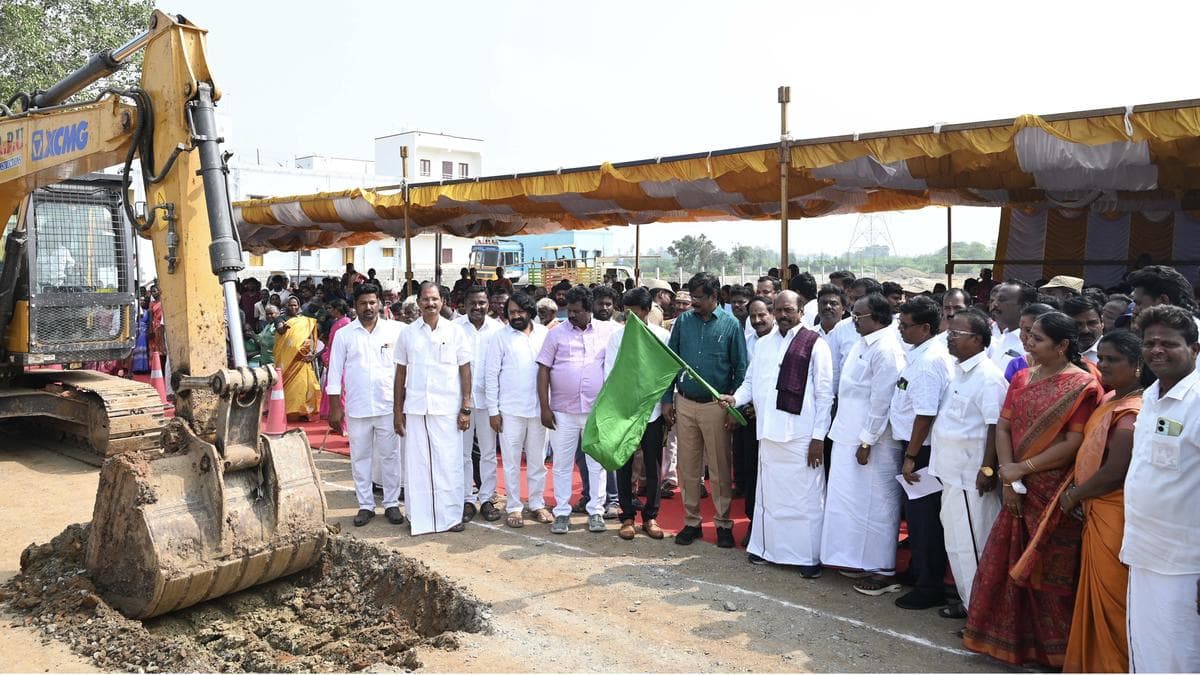
Tiruvannamalai - Avalurpet Main Road widening's second phase begins under CMRDP 2024-25 at ₹64 crore.
Summary
The State Highways department has initiated the second phase of widening the Tiruvannamalai - Avalurpet Main Road in Tamil Nadu. This infrastructure project, costing ₹64 crore, is funded under the Chief Minister’s Road Development Plan (CMRDP) for the 2024–25 fiscal year. It signifies the state government's focus on improving regional connectivity and infrastructure, making the scheme name and project details relevant for state-level competitive exams.
Key Points
- 1The project involves the second phase of widening the Tiruvannamalai - Avalurpet Main Road.
- 2The road widening project is funded under the Chief Minister’s Road Development Plan (CMRDP).
- 3The specific financial year for the funding under CMRDP is 2024–25.
- 4The total cost allocated for this second phase is ₹64 crore.
- 5The project is being undertaken by the State Highways department in Tamil Nadu.
In-Depth Analysis
Road infrastructure forms the backbone of any nation's economic progress and social integration. In India, a country with diverse geographical terrain and a vast population, efficient road networks are crucial for trade, tourism, agricultural produce transport, and access to essential services. The recent announcement by the State Highways department in Tamil Nadu regarding the second phase of widening the Tiruvannamalai - Avalurpet Main Road, funded under the Chief Minister’s Road Development Plan (CMRDP) 2024–25, exemplifies the ongoing commitment at the state level to enhance connectivity.
Historically, India's road network, though extensive, has suffered from issues of quality, capacity, and maintenance. Post-independence, various plans like the Nagpur Plan (1943) and subsequent Bombay and Lucknow Plans laid the groundwork for systematic road development. However, significant impetus came with national initiatives like the National Highway Development Project (NHDP) in the late 1990s and the Pradhan Mantri Gram Sadak Yojana (PMGSY) in 2000, focusing on national highways and rural connectivity respectively. States, recognizing their pivotal role, also launched their own ambitious programs to complement these national efforts and address specific regional needs. Tamil Nadu, being one of India's most industrialized states with a robust manufacturing and services sector, heavily relies on a well-maintained road network to sustain its economic momentum and ensure the smooth flow of goods and people.
This particular project involves the second phase of widening a significant state road, the Tiruvannamalai - Avalurpet Main Road, at an estimated cost of ₹64 crore. The funding source, the Chief Minister’s Road Development Plan (CMRDP) for the 2024–25 fiscal year, highlights a dedicated state-specific policy designed to upgrade and expand the state's arterial and district road networks. The State Highways Department is the primary implementing agency, responsible for the technical execution, project management, and quality control of the widening work.
Key stakeholders in this project include the **Government of Tamil Nadu**, which through the CMRDP, sets the policy direction, allocates funds, and oversees the overall vision for state infrastructure. The **Chief Minister's Road Development Plan (CMRDP)** itself is a critical institutional stakeholder, serving as the financial and strategic framework for such projects. The **State Highways Department** acts as the executive arm, translating policy into tangible infrastructure. Most importantly, the **local population, commuters, farmers, and businesses** in and around Tiruvannamalai and Avalurpet are the direct beneficiaries. Improved roads mean reduced travel time, lower transportation costs, enhanced safety, and better access to markets for agricultural produce, educational institutions, and healthcare facilities. Indirectly, industries and tourism in the region also benefit from improved logistics and accessibility, contributing to local employment and economic vibrancy.
This project holds significant implications for India. Firstly, it underscores the principle of **fiscal federalism** and the division of powers outlined in the Indian Constitution. As per the **Seventh Schedule**, 'Roads, other than National Highways' fall under **Entry 13 of the State List**, empowering state governments to legislate and implement projects on state roads. This project is a direct manifestation of this constitutional provision. Secondly, it contributes to India's broader economic growth story. Efficient state road networks complement national highways, forming an integrated logistics chain that is vital for achieving a target of a higher GDP growth rate. Reduced congestion and faster transit times enhance productivity and competitiveness for businesses operating in Tamil Nadu. Thirdly, it promotes balanced regional development. By improving connectivity in semi-urban or rural areas like Tiruvannamalai, such projects help integrate these regions into the mainstream economy, potentially curbing distress migration to larger cities and ensuring more equitable distribution of development benefits. Furthermore, such infrastructure development aligns with the **Directive Principles of State Policy (DPSP)**, particularly Article 38 and 39, which emphasize the state's role in promoting the welfare of the people and securing a social order based on justice.
Looking ahead, the successful completion of this phase is likely to pave the way for further expansion and similar projects under the CMRDP across Tamil Nadu. The future implications include a continued focus on improving inter-district connectivity, potentially attracting more investment into the regions served by these upgraded roads. However, challenges such as land acquisition (governed by the **Right to Fair Compensation and Transparency in Land Acquisition, Rehabilitation and Resettlement Act, 2013**), environmental clearances, and ensuring long-term maintenance remain crucial aspects that the State Highways department will need to meticulously manage. This project, while local in scope, is a microcosm of India's ongoing infrastructure push, reflecting a coordinated effort to build a more connected and prosperous nation.
Exam Tips
This topic falls under 'Indian Economy' (Infrastructure Development, State Finances) and 'Indian Polity' (Federalism, State List, State Schemes) sections of competitive exams. Students should focus on understanding the constitutional division of powers regarding infrastructure projects.
Study related topics such as the National Highway Development Project (NHDP), Pradhan Mantri Gram Sadak Yojana (PMGSY), Bharatmala Pariyojana, and other state-specific road development schemes. Compare their objectives, funding mechanisms, and impact.
Common question patterns include: identifying which list (Union, State, Concurrent) a particular subject falls under; questions on major central/state government schemes and their objectives/funding; and the economic and social impact of infrastructure development. Be prepared for questions on the role of specific departments (e.g., State Highways Department).
Related Topics to Study
Full Article
Funded under the Chief Minister’s Road Development Plan (CMRDP) 2024–25, the second phase will be taken up at a cost of ₹64 crore