



Relevant for Exams
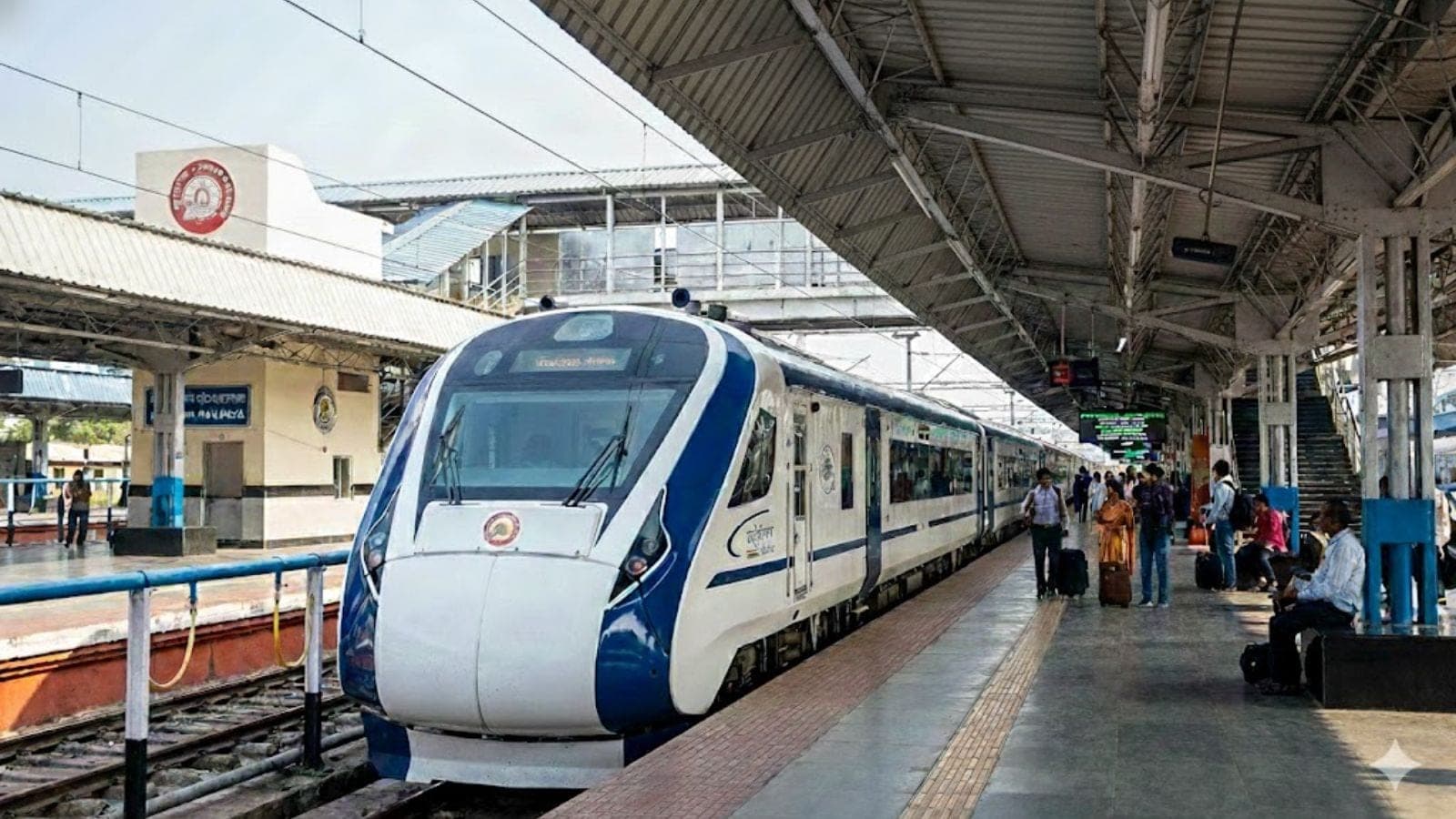
Kalaburagi-SMVT Bengaluru Vande Bharat train re-routed from Jan 1; specific details unavailable.
Summary
The Railway Board has approved the re-routing of the Kalaburagi–SMVT Bengaluru Vande Bharat train, effective January 1. This decision impacts the connectivity between these two cities. However, specific details regarding the new route, stoppages, timings, and ticket prices are not available in the provided content, limiting a comprehensive analysis for competitive exam preparation.
Key Points
- 1The Railway Board approved the re-routing of the Kalaburagi–SMVT Bengaluru Vande Bharat train.
- 2The re-routing is scheduled to be effective from January 1.
- 3The train service connects the cities of Kalaburagi and SMVT Bengaluru.
- 4Specific details regarding the new route, stoppages, timings, and ticket prices are not available in the provided content.
- 5Vande Bharat Express trains are a significant initiative for modernizing India's railway infrastructure.
In-Depth Analysis
The re-routing of the Kalaburagi–SMVT Bengaluru Vande Bharat train, effective January 1, signifies a dynamic aspect of Indian Railways' continuous efforts to optimize its vast network and enhance passenger experience. While specific details of the new route are not provided, the very act of re-routing a flagship service like Vande Bharat reflects the strategic planning undertaken by the Railway Board to meet evolving demands, improve operational efficiency, or connect new regions.
**Background Context and What Happened:** Indian Railways, one of the world's largest railway networks, is the lifeline of the nation, transporting millions daily. Over the past decade, there has been a concerted push towards modernizing this critical infrastructure. The Vande Bharat Express, India's first semi-high-speed indigenous train, launched in February 2019, is a cornerstone of this modernization drive. Manufactured under the 'Make in India' initiative at the Integral Coach Factory (ICF) in Chennai, these trains symbolize India's growing capabilities in advanced manufacturing and engineering. The Kalaburagi–SMVT Bengaluru route, connecting a significant city in North Karnataka (Kalaburagi, formerly Gulbarga) with the state capital Bengaluru, is vital for regional connectivity. Re-routing such a service often stems from detailed feasibility studies, operational constraints, the commissioning of new tracks, or a strategic decision to serve different population centers, thereby optimizing resource utilization and maximizing public benefit. The implementation date of January 1 suggests a planned change, allowing for necessary operational adjustments and public notification.
**Key Stakeholders Involved:** The primary stakeholder is the **Indian Railways**, specifically the **Railway Board**, which is the apex decision-making body. Under the aegis of the **Ministry of Railways**, the Board is responsible for policy formulation, infrastructure development, train operations, and tariff setting. **Passengers** are direct stakeholders, as their travel convenience, time, and access to services are directly impacted. Local **state governments** and **Members of Parliament** often advocate for railway connectivity and route changes based on regional development needs and public demand. **Local businesses and industries** in the affected regions also have a stake, as improved or altered connectivity can influence trade, tourism, and economic activity. Finally, the **local communities** along the new or old routes are stakeholders, as railway lines often pass through populated areas, impacting daily life and local economies.
**Significance for India:** The re-routing, though seemingly a minor operational change, holds significant implications. Firstly, it underscores the **dynamic nature of infrastructure planning** in India, adapting to growth and development. Secondly, Vande Bharat trains are crucial for **enhancing regional connectivity and reducing travel times**, which is vital for economic growth. Faster connectivity between Kalaburagi and Bengaluru can boost trade, tourism, and easier movement for professionals, students, and businesses. This aligns with the broader goal of **balanced regional development**, bringing Tier-2 and Tier-3 cities closer to metropolitan hubs. The 'Make in India' aspect of Vande Bharat trains reinforces India's commitment to **self-reliance and technological advancement** in critical sectors. Such initiatives contribute to the **National Rail Plan (NRP) 2030**, which aims to create a 'Future Ready' railway system by 2030, focusing on increasing modal share of railways in freight and passenger traffic.
**Historical Context and Future Implications:** Indian Railways has a rich history, dating back to 1853. Post-independence, it has played a pivotal role in national integration and economic development. From steam engines to electric locomotives and now semi-high-speed trains, the journey reflects continuous evolution. Historically, route changes were often driven by industrial needs or population shifts. Today, they are increasingly influenced by passenger convenience, speed, and the integration of new infrastructure projects. Looking ahead, the re-routing of Vande Bharat trains suggests a future where the railway network is highly responsive and optimized. We can expect more such adjustments as the Vande Bharat network expands, potentially connecting all major cities. This will likely lead to **increased economic integration** across regions, **reduced carbon footprint** compared to road or air travel, and a **modernized travel experience** for millions. The government's continued focus on projects like the **PM Gati Shakti National Master Plan**, which aims for integrated infrastructure development, will further streamline such decisions, ensuring that railway routes are part of a holistic national logistics and transport strategy.
**Related Constitutional Articles, Acts, or Policies:** Indian Railways falls under the **Union List** (Entry 22) of the **Seventh Schedule** of the Indian Constitution, granting the Union Parliament exclusive power to legislate on railways. The operations and administration are primarily governed by the **Indian Railways Act, 1989**. Policies such as the **National Rail Plan (NRP) 2030** provide a long-term strategic framework for railway development, including network expansion, speed enhancement, and technological upgrades. The **PM Gati Shakti National Master Plan**, launched in October 2021, is another overarching policy that integrates infrastructure projects, including railways, roads, and ports, to improve logistics efficiency and reduce costs. Decisions like re-routing are made within the framework of these constitutional provisions and policy guidelines, aiming to achieve national development objectives.
Exam Tips
This topic falls under General Studies Paper 3 (Economy – Infrastructure) and General Studies Paper 1 (Indian Geography – Transport). Focus on government initiatives, economic impact, and technological advancements in railways.
Study related topics like the 'Make in India' initiative, the National Rail Plan (NRP) 2030, PM Gati Shakti National Master Plan, and the role of Public-Private Partnerships (PPPs) in infrastructure development. Understand the difference between various types of trains (Vande Bharat, Tejas, Gatimaan).
Common question patterns include: factual questions about Vande Bharat trains (e.g., manufacturing location, first route), analytical questions on the economic and social impact of high-speed rail, and policy-oriented questions on government initiatives for railway modernization and connectivity.