



Relevant for Exams
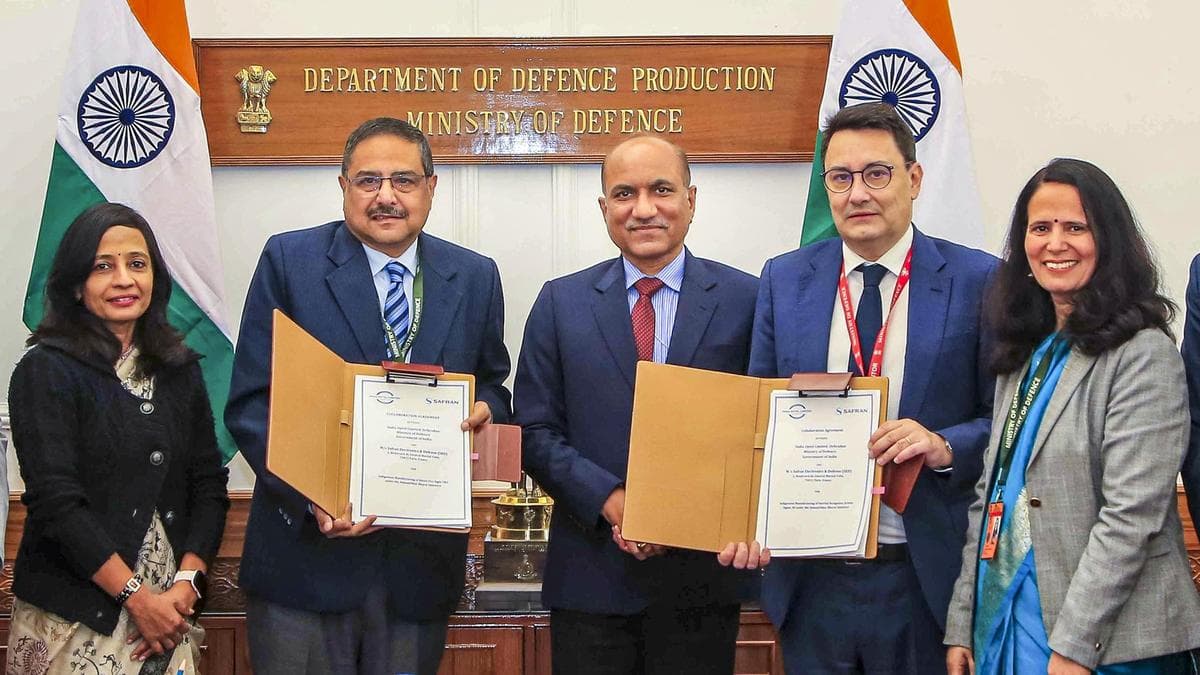
India Optel (PSU) partners France's Safran to manufacture advanced defence systems, boosting 'Make in India'.
Summary
India Optel, a Public Sector Undertaking, has partnered with France's Safran group to jointly manufacture two crucial advanced defence systems within India. This collaboration aims to significantly reduce India's reliance on defence imports, aligning with the 'Make in India' initiative. The venture is vital for enhancing indigenous defence capabilities, particularly for artillery guns, missiles, radars, and anti-drone applications, making it highly relevant for competitive exams on national security and economic policy.
Key Points
- 1India Optel, a Public Sector Undertaking (PSU), has signed a pact with France's Safran group.
- 2The partnership focuses on the joint manufacture of two key advanced defence systems in India.
- 3These systems are widely used in artillery guns, missiles, radars, and anti-drone applications.
- 4The Defence Ministry stated the venture will reduce India's dependency on defence imports.
- 5This collaboration is a significant step towards bolstering indigenous defence manufacturing under the 'Make in India' initiative.
In-Depth Analysis
India's journey towards self-reliance in defence manufacturing has been a long and arduous one, traditionally marked by a heavy reliance on imports. For decades, India has been one of the world's largest arms importers, a legacy stemming from its post-independence industrial base and strategic needs during the Cold War. This dependency often led to vulnerabilities concerning spare parts, technology transfer, and geopolitical pressures. Recognising this strategic imperative, successive governments have pushed for greater indigenisation. The current 'Make in India' initiative, coupled with the 'Atmanirbhar Bharat Abhiyan' (Self-Reliant India Campaign) launched in 2020, has significantly accelerated this drive, particularly in the critical defence sector. The goal is not just to produce equipment domestically but to foster a robust defence industrial ecosystem that includes research, design, development, and manufacturing.
The recent pact between India Optel Limited (IOL), a Public Sector Undertaking (PSU) under the Ministry of Defence, and France's Safran group is a significant milestone in this direction. This collaboration focuses on the joint manufacture of two crucial advanced defence systems within India. These systems are not niche products; they are widely used in a range of critical military applications, including artillery guns, guided missiles, advanced radars, and increasingly vital anti-drone technologies. The Defence Ministry has explicitly stated that this venture will substantially reduce India's dependency on foreign defence imports, thereby bolstering its strategic autonomy and operational readiness.
Key stakeholders in this partnership represent a blend of India's public sector aspirations and global private sector expertise. India Optel Limited (IOL) is one of the seven new Defence Public Sector Undertakings (DPSUs) formed in 2021 following the corporatisation of the erstwhile Ordnance Factory Board (OFB). IOL specialises in opto-electronics, a critical component in modern defence systems, and its involvement underscores the government's push to leverage these newly formed entities for advanced manufacturing. Safran Group, on the other hand, is a French multinational company with a global presence, renowned for its expertise in aerospace propulsion, equipment, and defence. Its collaboration brings cutting-edge technology, manufacturing know-how, and global quality standards to India, benefiting from India's large market and skilled workforce. The Ministry of Defence (MoD) acts as the facilitator and primary client, setting the policy framework and procurement priorities that enable such partnerships.
This partnership holds immense significance for India on multiple fronts. Strategically, it is a direct step towards achieving 'Atmanirbhar Bharat' in defence. Reducing import dependency means India can equip its armed forces with state-of-the-art systems without being beholden to geopolitical shifts or the whims of foreign suppliers. Economically, joint manufacturing within India will lead to job creation, skill development, and technology absorption, fostering a vibrant domestic defence industrial base. It will also contribute to India's GDP and potentially position India as a defence exporter in the future. The indigenous production of advanced systems for anti-drone applications, in particular, addresses a rapidly evolving threat landscape, enhancing national security against new forms of warfare.
Historically, India's defence procurement has been a complex interplay of strategic needs, geopolitical alignments, and economic considerations. The shift from simply 'buying' to 'making' in India gained significant traction with policies like the Defence Acquisition Procedure (DAP) 2020. DAP 2020 prioritises procurement from Indian vendors and includes categories like 'Buy (Indian – Indigenously Designed, Developed and Manufactured)' and 'Make' projects, which encourage indigenous design, development, and production. Furthermore, the Defence Production and Export Promotion Policy (DPEPP) 2020 aims to achieve a turnover of ₹1,75,000 crore ($25 billion) in defence manufacturing by 2025, including exports of ₹35,000 crore ($5 billion). This specific collaboration aligns perfectly with these policy goals.
While no single constitutional article directly mandates defence manufacturing, the Union List (Seventh Schedule) places 'Defence of India' (Entry 1) and 'Arms, firearms, ammunition and explosives' (Entry 5) under the exclusive legislative domain of the Parliament, empowering the central government to formulate and implement policies like 'Make in India' in defence. The broader directive principles of state policy, particularly Article 38 (promoting welfare of the people) and Article 39 (securing a social order), implicitly support a strong and self-reliant nation capable of defending its sovereignty and promoting its economic interests.
The future implications of such partnerships are profound. They signal a continued trend of foreign defence majors collaborating with Indian entities, leading to greater technology transfer and co-development. This could transform India from a mere assembler to a hub for advanced defence manufacturing and research, potentially attracting more foreign investment in the sector, especially given the increased Foreign Direct Investment (FDI) limit in defence manufacturing to 74% under the automatic route and 100% through the government route where it is likely to result in access to modern technology. This move is crucial for modernising the Indian armed forces and solidifying India's position as a responsible and capable regional power.
Exam Tips
This topic falls under GS Paper 3 (Economy, Science & Technology, Internal Security) for UPSC and similar sections for State PSCs, SSC, and Banking exams. Focus on policy details like DAP 2020 and 'Atmanirbhar Bharat' in defence.
Study related topics such as India's defence procurement policy, FDI in defence, the corporatisation of Ordnance Factories, and India's strategic partnerships with countries like France. Understand the difference between 'Make in India' and 'Buy Global'.
Common question patterns include: analytical questions on the impact of defence indigenisation on India's economy and security, policy-based questions on DAP 2020, and specific factual questions about key collaborations or defence PSUs. Be prepared to discuss challenges and opportunities.
Pay attention to the specific applications mentioned (artillery, missiles, radars, anti-drone systems) as they highlight critical areas of defence modernisation.
Understand the role of PSUs (like India Optel) and private players in India's defence ecosystem. Questions might compare their contributions or discuss the government's strategy to boost both.
Related Topics to Study
Full Article
India Optel and Safran will jointly manufacture two key systems widely used in artillery guns, missiles, radars, anti-drone applications; Defence Ministry says the venture will reduce dependency on imports