



Relevant for Exams
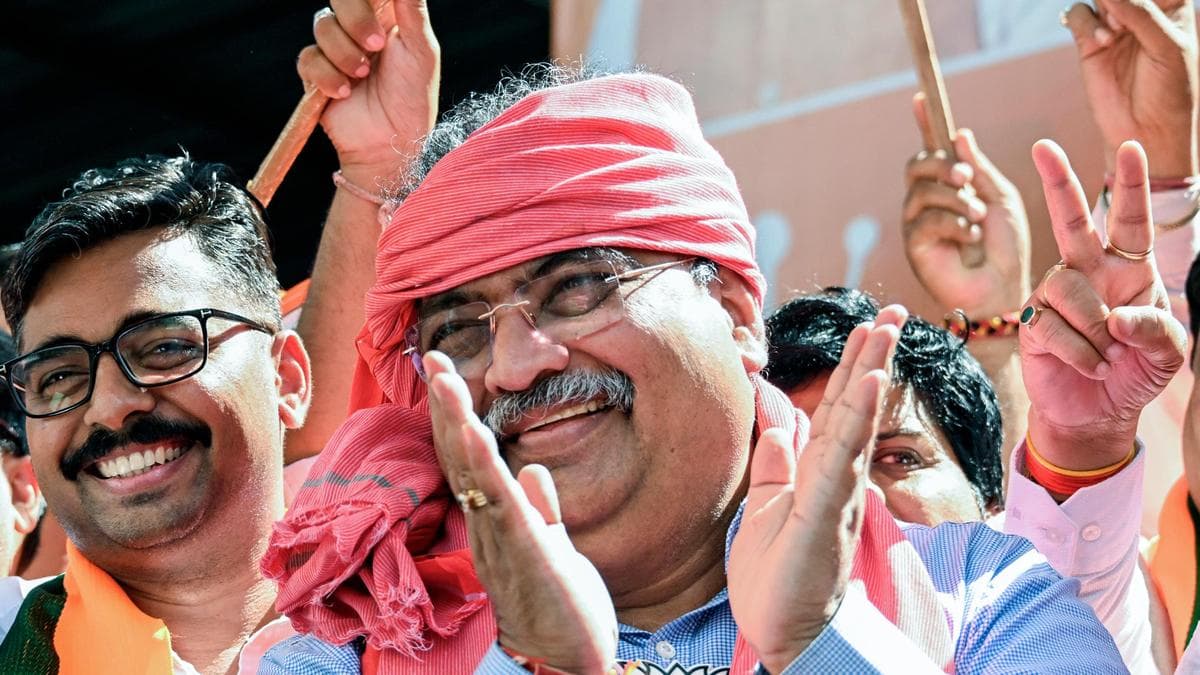
Mahayuti alliance (BJP, Shiv Sena, NCP) sweeps 207 out of 288 local body president posts on Dec 22, 2025.
Summary
The Mahayuti alliance, comprising BJP, Shiv Sena, and NCP, achieved a significant victory in local body elections held on December 22, 2025. They swept elections to 288 municipal councils and nagar panchayats, securing 207 president posts. This outcome highlights the alliance's grassroots outreach and development vision, providing crucial insights into state-level political dynamics for competitive exam aspirants.
Key Points
- 1The Mahayuti alliance consists of the BJP, Shiv Sena, and NCP.
- 2Elections were held on Sunday, December 22, 2025.
- 3The elections were for 288 municipal councils and nagar panchayats.
- 4The Mahayuti alliance won 207 posts of presidents in these local bodies.
- 5The victory was attributed to grassroots outreach and a development vision.
In-Depth Analysis
The resounding victory of the Mahayuti alliance, comprising the Bharatiya Janata Party (BJP), Shiv Sena (Eknath Shinde faction), and Nationalist Congress Party (NCP - Ajit Pawar faction), in the local body elections held on December 22, 2025, in Maharashtra, marks a critical juncture in the state's political landscape and holds significant implications for India's federal structure and grassroots governance. The alliance swept 207 out of 288 president posts in municipal councils and nagar panchayats, attributing their success to robust grassroots outreach and a clear development vision.
**Background Context and What Happened:**
Maharashtra's political scenario has been tumultuous since the 2019 assembly elections, which saw an unexpected alliance form – the Maha Vikas Aghadi (MVA) – between Shiv Sena (Uddhav Thackeray faction), NCP (Sharad Pawar faction), and the Indian National Congress, despite the BJP emerging as the single largest party. This arrangement collapsed in June 2022 when Eknath Shinde led a rebellion within Shiv Sena, aligning with the BJP to form the Mahayuti government. Further political realignment occurred in July 2023, when Ajit Pawar, along with a significant number of NCP MLAs, joined the Mahayuti, splitting the NCP. These local body elections were the first major electoral test for this expanded Mahayuti alliance, particularly for the legitimacy and public acceptance of the new factions of Shiv Sena and NCP. The sweep, winning an overwhelming majority of president posts, demonstrates a strong endorsement of the ruling alliance's strategy and narrative at the local level.
**Key Stakeholders Involved:**
1. **Bharatiya Janata Party (BJP):** As the national party and senior partner in the alliance, the BJP's primary stake is to consolidate its power base in Maharashtra, a crucial state for national politics. A strong performance locally signals effective ground-level organization and strengthens its position for upcoming state assembly and general elections.
2. **Shiv Sena (Eknath Shinde Faction):** For this faction, the victory is a crucial validation of its claim to the original Shiv Sena's legacy and its decision to align with the BJP. It helps counter the narrative of being a 'breakaway group' and demonstrates its ability to win elections independently of the Uddhav Thackeray faction.
3. **Nationalist Congress Party (Ajit Pawar Faction):** Similarly, the Ajit Pawar faction needed this win to legitimize its split from the Sharad Pawar-led NCP and prove its grassroots strength. It underscores the faction's ability to deliver electoral results as part of the ruling alliance.
4. **Opposition (Maha Vikas Aghadi - MVA):** Comprising Shiv Sena (Uddhav Thackeray faction), NCP (Sharad Pawar faction), and Congress, this outcome is a significant setback. It suggests that their narrative, which often focuses on the 'betrayal' by the breakaway factions, did not resonate strongly enough with local voters, necessitating a strategic re-evaluation.
**Why This Matters for India and Historical Context:**
Local self-governance has been a cornerstone of India's democratic framework, dating back to ancient village republics and formalized during British rule, notably by Lord Ripon's Resolution of 1882. Post-independence, the need for robust local bodies led to the landmark **73rd and 74th Constitutional Amendment Acts of 1992**. These amendments institutionalized Panchayati Raj Institutions (PRIs) in rural areas and Urban Local Bodies (ULBs) in urban areas, granting them constitutional status, powers, and responsibilities. The municipal councils and nagar panchayats, central to this election, fall under the purview of the **74th Amendment Act**, which added Part IX-A (The Municipalities) to the Constitution, covering Articles **243P to 243ZG**. This victory matters for India as it underscores the vitality of decentralized governance. Local bodies are critical for the efficient delivery of public services like water supply, sanitation, local infrastructure, and primary healthcare, directly impacting citizens' daily lives. Politically, local election results often serve as a barometer for public sentiment, influencing state and national political narratives and potentially shaping strategies for upcoming general and assembly elections. A strong ruling alliance at the local level can ensure smoother implementation of state and central government schemes, fostering a more cohesive development agenda.
**Future Implications and Constitutional References:**
This local election sweep is a significant morale booster for the Mahayuti alliance, particularly heading into the crucial 2024 Lok Sabha elections and the subsequent Maharashtra Assembly elections. It solidifies the position of the Shinde and Ajit Pawar factions, potentially reducing internal tensions and strengthening the alliance's bargaining power. For the opposition MVA, it signals a need for introspection and a revamped strategy to counter the ruling alliance's narrative of 'development' and 'grassroots outreach.' The victory may lead to further consolidation of power, enabling the state government to push its development agenda more effectively through aligned local bodies. From a constitutional perspective, the successful conduct and outcome of these elections reaffirm the principles enshrined in the 74th Amendment, demonstrating the functioning of democratically elected urban local bodies as the third tier of governance, crucial for the democratic health of the nation. These bodies, empowered by the Constitution, play a vital role in local planning, social justice, and economic development, as envisioned by Articles such as **243W** (Powers, authority and responsibilities of Municipalities) and the Twelfth Schedule, which lists 18 functional items within their purview.
Exam Tips
This topic falls under the 'Indian Polity' section of the UPSC, State PSC, SSC, and Railway exams, specifically 'Local Self-Government' and 'Constitutional Amendments'. Students should focus on the 73rd and 74th Constitutional Amendment Acts.
Study the functions and powers of Municipalities (Nagar Palikas, Nagar Panchayats, Municipal Corporations) as outlined in the 74th Amendment. Understand the role of the State Election Commission and State Finance Commission in relation to local bodies.
Common question patterns include direct questions on the articles related to local self-government (e.g., Article 243W), the schedules associated (11th and 12th), the committees that recommended these amendments, and the types of urban local bodies. Political analysis questions on the significance of local elections might appear in State PSC mains exams.
Related Topics to Study
Full Article
Mahayuti alliance of the BJP, Shiv Sena, and NCP on Sunday (December 22, 2025) swept the elections to 288 municipal councils and nagar panchayats, winning 207 posts of presidents in the local bodies