

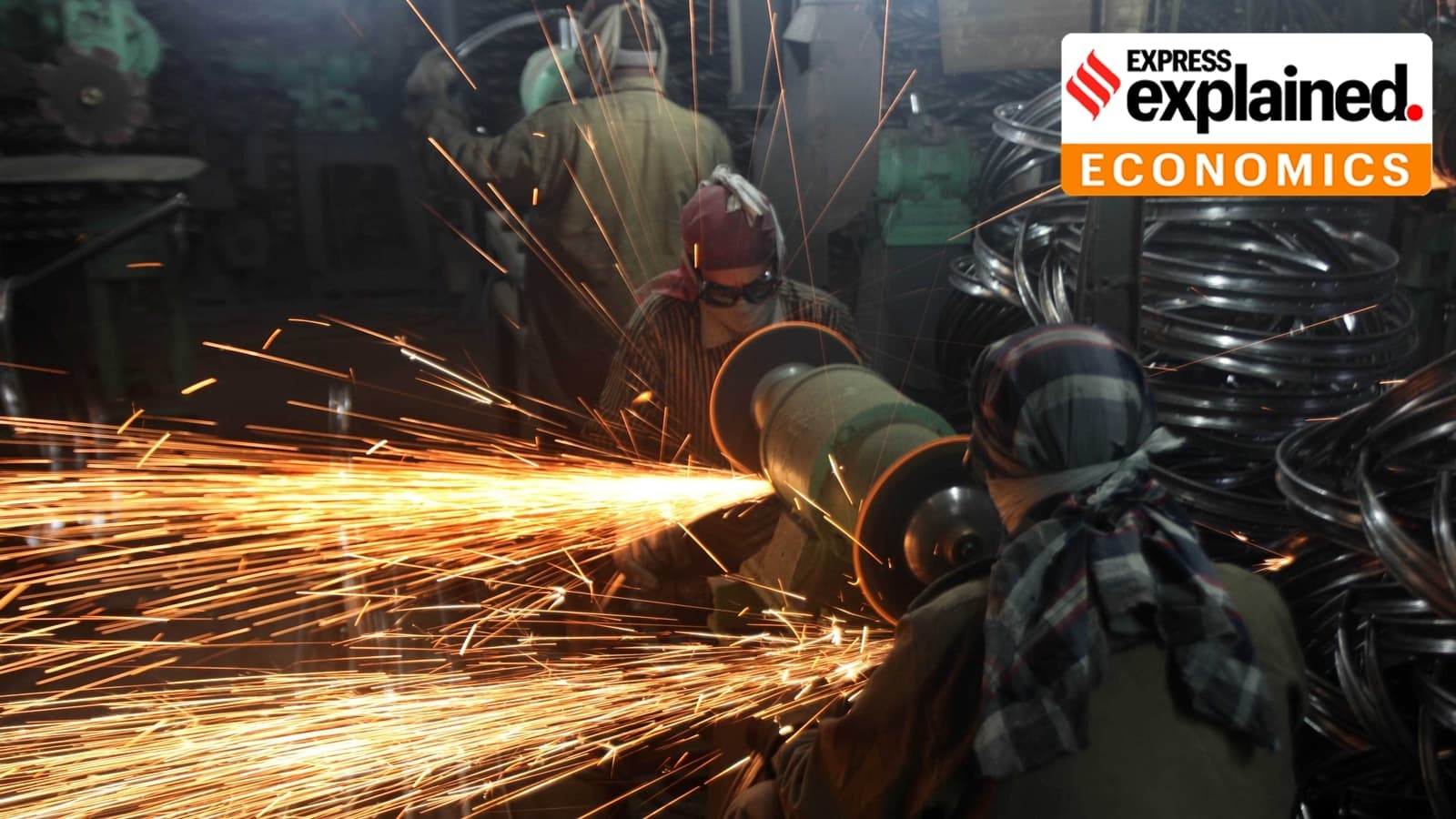


No content provided; analysis of GDP growth and private capex not possible for exam prep.
Summary
Due to the explicit statement 'No content available', this article cannot be analyzed for exam-relevant facts. Without content, it is impossible to extract specific details about GDP growth or private capital expenditure, thus limiting its significance for competitive exam preparation as no factual information can be derived.
Key Points
- 1The provided article explicitly stated 'No content available' for analysis.
- 2Therefore, no specific facts, dates, names, numbers, or percentages could be extracted.
- 3This prevents the generation of exam-focused key points as per the instructions.
- 4Detailed analysis of GDP growth and private capital expenditure requires actual article text.
- 5Without content, the article holds no direct factual relevance for competitive exams.
In-Depth Analysis
The paradox of robust Gross Domestic Product (GDP) growth not translating into a commensurate surge in private capital expenditure (capex) has been a significant point of discussion in India's economic landscape. GDP growth, which measures the total value of goods and services produced in an economy, has often been touted as India's strength, positioning it as one of the fastest-growing major economies globally in recent years. However, private capex – investment by businesses in fixed assets like machinery, buildings, and technology – is the engine for sustainable, long-term growth and job creation. When private capex lags, it signals underlying structural issues or a lack of confidence among businesses.
Historically, India's growth trajectory has often seen cycles of investment. Following the economic reforms of 1991, private investment played a crucial role in expanding industrial capacity and modernizing the economy. However, post-2008 global financial crisis, and exacerbated by the 'twin balance sheet problem' (stressed corporate balance sheets and non-performing assets in banks), private investment slowed considerably. While the government has stepped in with significant public capital expenditure, especially in infrastructure, to crowd in private investment, the expected private sector response has been somewhat muted.
Several key stakeholders are involved in this dynamic. The **Government** plays a dual role: directly through public capex (e.g., roads, railways, ports) and indirectly by creating a conducive policy environment, ensuring macroeconomic stability, and implementing reforms. The **Reserve Bank of India (RBI)**, through its monetary policy, influences interest rates and credit availability, which are critical for investment decisions. The **Private Sector (Corporates)** are the primary decision-makers for private capex. Their investment choices are influenced by factors like demand outlook, existing capacity utilization, policy certainty, ease of doing business, cost of capital, and global economic conditions. **Banks and Financial Institutions** are crucial in providing the necessary credit for these investments. Finally, **Households**, through their consumption patterns, provide the demand signals that often drive corporate investment decisions.
This phenomenon matters profoundly for India. A sustained lack of private capex has direct implications for **job creation**, especially in manufacturing and construction, which are critical for absorbing India's vast young workforce. While public capex creates some jobs, private sector expansion is essential for large-scale, sustainable employment. Moreover, private investment drives **productivity growth** by introducing new technologies and efficient processes, enhancing India's global competitiveness. An over-reliance on public capex, while necessary in the short term, can strain government finances, potentially leading to higher fiscal deficits and public debt, governed by frameworks like the **Fiscal Responsibility and Budget Management (FRBM) Act, 2003**. This could limit the government's ability to fund other essential social sector programs. For long-term, equitable growth and achieving the vision of a developed nation by 2047, a strong resurgence in private investment is indispensable.
From a constitutional perspective, while there isn't a direct article on private capex, the **Directive Principles of State Policy (DPSP)**, particularly **Articles 38 and 39**, emphasize the state's duty to secure a social order for the promotion of welfare of the people, minimize inequalities, and ensure that the operation of the economic system does not result in the concentration of wealth and means of production to the common detriment. Robust private investment, leading to job creation and wealth generation, aligns with these broader constitutional goals of economic justice and welfare. Furthermore, various **Industrial Policies** and schemes like 'Make in India' and **Production Linked Incentive (PLI) schemes** are policy instruments designed to stimulate private manufacturing and investment, reflecting the government's commitment to boosting industrial output and exports.
Looking ahead, the future implications are significant. If private capex does not pick up sufficiently, India might struggle to fully capitalize on its demographic dividend, potentially leading to unemployment challenges. The government's continued focus on improving the 'Ease of Doing Business', infrastructure development, and structural reforms (like the **Insolvency and Bankruptcy Code (IBC), 2016** to resolve stressed assets) are aimed at instilling confidence and reducing risks for investors. A global economic slowdown or geopolitical uncertainties could further dampen private investment sentiment. Conversely, a sustained period of political stability, consistent policy reforms, and a robust domestic demand environment could finally unlock the latent potential of private capital, propelling India towards a higher, more inclusive growth trajectory. The balance between public and private investment will be key to India's economic success in the coming decades.
Exam Tips
This topic falls under the 'Indian Economy' section (UPSC GS Paper III, State PSCs, RBI Grade B, Bank PO exams). Focus on understanding the interlinkages between various economic indicators.
Study related topics like National Income Accounting (GDP components), Fiscal Policy (government capex, FRBM Act), Monetary Policy (RBI's role, interest rates), and various government schemes aimed at boosting manufacturing and investment (e.g., PLI scheme, Make in India).
Expect analytical questions asking for causes and effects of economic phenomena (e.g., 'Discuss the reasons for sluggish private investment despite high GDP growth and its implications for India's economic development'). Be prepared to provide policy solutions and constitutional linkages.
Practice interpreting economic data and trends. Understand the difference between 'crowding in' and 'crowding out' effects of public expenditure on private investment.
Familiarize yourself with key economic terms like capacity utilization, capital formation, gross fixed capital formation, and twin balance sheet problem, as these are frequently used in economic analyses.