

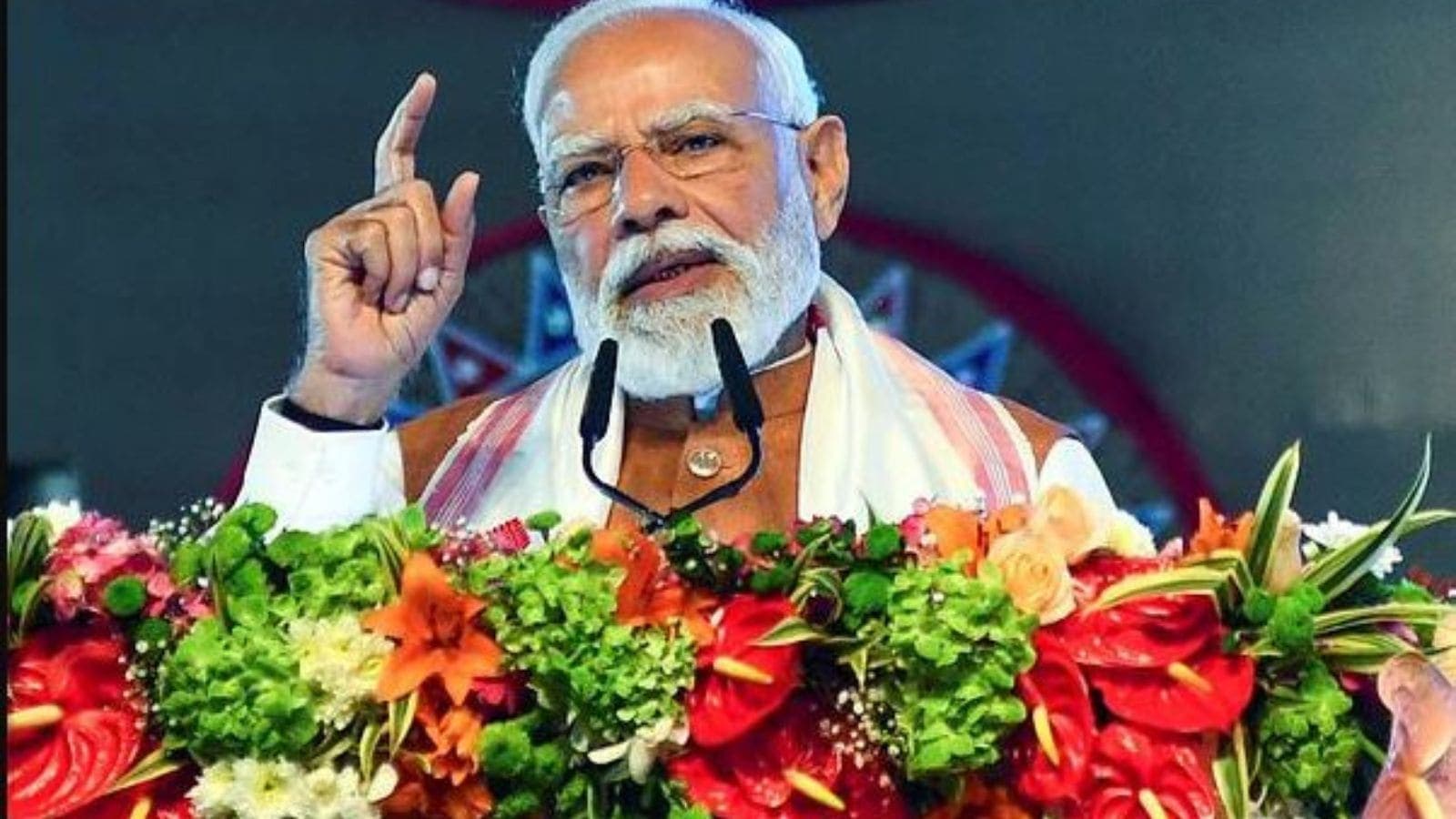


Article content missing; no details on PM Modi's Assam statement on farmers and Congress.
Summary
The provided article lacks content, preventing a detailed summary of Prime Minister Modi's statements in Assam regarding farmers' plight or the alleged role of the Congress. Without specific details, its significance for competitive exams cannot be assessed, as no factual information is available for extraction. Therefore, no exam-relevant facts can be precisely extracted.
Key Points
- 1No specific facts, dates, names, numbers, or percentages are available due to missing article content.
- 2The article title indicates a statement made by Prime Minister Modi.
- 3The location where the statement was made is identified as Assam.
- 4The primary subject of the statement concerns the plight of farmers.
- 5PM Modi reportedly attributed blame for the farmers' situation to the Congress party.
In-Depth Analysis
The statement by Prime Minister Modi in Assam, attributing the plight of farmers to the 'indifference' of the Congress, encapsulates a recurring theme in Indian politics: the blame game surrounding agricultural distress. While the specific content of his speech is unavailable, the title itself provides a rich context for understanding the dynamics of Indian federalism, agricultural policy, and political discourse.
**Background Context:** Indian agriculture, despite its significant contribution to employment (around 45% of the workforce), contributes a smaller, though vital, share to the nation's GDP (approximately 18-20%). Farmers in India have historically faced a myriad of challenges, including dependence on monsoon, fragmented land holdings, lack of access to credit, inadequate irrigation, market price volatility, and increasing input costs. Agrarian distress, manifested in farmer suicides, debt burdens, and protests, has been a persistent socio-economic issue since independence. Successive governments have attempted to address these issues through various policies, but a permanent solution remains elusive. This ongoing vulnerability makes farmers a crucial and often decisive vote bank, ensuring that their welfare remains a central, albeit politicized, topic in electoral campaigns.
**What Happened (Interpreting the Statement):** Prime Minister Modi, representing the Bharatiya Janata Party (BJP), utilized a public platform in Assam to criticize the opposition Congress party. By blaming Congress for the 'plight of farmers' due to their 'indifference,' he engaged in a common political strategy: holding previous administrations accountable for current challenges. This rhetoric serves multiple purposes: it deflects criticism from the current government, mobilizes the party base, and attempts to sway voter sentiment, particularly in states like Assam where rural votes are significant. Such statements are often made in the run-up to elections or to counter opposition narratives, framing the ruling party as the true benefactor of farmers.
**Key Stakeholders Involved:**
* **Farmers:** The primary group whose welfare is ostensibly at the heart of the debate. Their votes, livelihoods, and socio-economic conditions are directly impacted by agricultural policies and political rhetoric.
* **Bharatiya Janata Party (BJP):** The ruling party at the Centre, led by PM Modi. They are the accusers, aiming to highlight their own pro-farmer initiatives and contrast them with the alleged failures of past Congress governments.
* **Indian National Congress:** The principal opposition party, being accused of 'indifference.' They would likely defend their historical record, highlight their own farmer-centric policies (e.g., farm loan waivers), and critique the current government's approach.
* **State Governments (e.g., Assam):** As agriculture falls primarily under the State List, state governments play a crucial role in implementing policies, providing subsidies, and addressing local agrarian issues. The political narrative in Assam would be influenced by the ruling party in the state (currently BJP) and its interaction with the central government's policies.
* **Farmer Unions and Advocacy Groups:** These organizations represent farmers' interests, often staging protests, engaging in dialogues with governments, and influencing public opinion regarding agricultural policies.
**Why This Matters for India:** This political statement underscores several critical aspects for India. Economically, the well-being of farmers is paramount for food security and rural prosperity. Politically, farmer issues are potent electoral tools; parties constantly vie to demonstrate their commitment to farmers. Socially, addressing agrarian distress is crucial for reducing inequality and preventing social unrest. Such blame games, while common, also highlight the need for a sustained, bipartisan approach to agricultural reform rather than short-term political gains. It also brings into focus the effectiveness of various central and state-level schemes like PM-KISAN, Pradhan Mantri Fasal Bima Yojana (PMFBY), and the debate around Minimum Support Price (MSP).
**Historical Context:** India's agricultural journey began with land reforms post-independence, followed by the Green Revolution in the 1960s and 70s, which significantly boosted food production but also led to regional disparities and environmental concerns. Subsequent governments, including those led by the Congress, introduced policies like agricultural credit, subsidies for inputs (fertilizers, power), and institutional support. The liberalization era of the 1990s brought new challenges, exposing farmers to global market fluctuations. Recent years have seen renewed debates on agricultural marketing reforms, exemplified by the now-repealed Farm Laws of 2020, and the continuing demand for a legal guarantee for MSP. The current government's focus on direct benefit transfers (like PM-KISAN) and crop insurance schemes builds upon a long history of state intervention in agriculture.
**Future Implications:** This kind of political rhetoric is likely to intensify, especially as India approaches future elections. Both the ruling party and the opposition will continue to frame farmer welfare as a central plank of their manifestos. This could lead to a renewed focus on agricultural reforms, potentially including enhancements to existing schemes, new policy announcements, or intensified debates on MSP and market access. The federal structure mandates cooperation between the Centre and states on agricultural matters (as per the Seventh Schedule), making effective policy implementation contingent on political will and coordination, rather than mere blame allocation. Ultimately, the success of any government will be judged by its ability to tangibly improve the lives of farmers, moving beyond rhetoric to sustainable solutions.
**Related Constitutional Articles, Acts, or Policies:**
* **Seventh Schedule:** Agriculture is primarily a 'State Subject' (Entry 14, List II), while 'Trade and commerce in, and the production, supply and distribution of foodstuffs' falls under the 'Concurrent List' (Entry 33, List III). This division of powers explains why both central and state governments have roles and sometimes conflicting approaches.
* **Directive Principles of State Policy (DPSP):** Articles 38 and 39 emphasize the state's duty to promote the welfare of the people, secure a social order for justice, and minimize inequalities. Article 48 specifically directs the state to organize agriculture and animal husbandry on modern and scientific lines.
* **Major Policies:** Key central government schemes include the Pradhan Mantri Kisan Samman Nidhi (PM-KISAN), which provides direct income support; Pradhan Mantri Fasal Bima Yojana (PMFBY), a crop insurance scheme; and the e-National Agriculture Market (e-NAM) for online trading of agricultural commodities. State-level Agricultural Produce Market Committee (APMC) Acts regulate agricultural markets, often subject to reform debates.
Exam Tips
This topic falls under GS Paper I (Indian Society & Geography - Agriculture), GS Paper II (Polity - Federalism, DPSP, Government Policies), and GS Paper III (Economy - Agriculture, Food Processing, Subsidies).
Study related topics such as agrarian distress, farmer suicides, Minimum Support Price (MSP) policy, agricultural marketing reforms (e.g., APMC Acts, e-NAM), land reforms, and the impact of climate change on Indian agriculture.
Common question patterns include direct questions on government schemes (e.g., features of PM-KISAN, PMFBY), policy analysis (e.g., effectiveness of MSP), challenges faced by farmers, the role of agriculture in the Indian economy, and critical evaluation of centre-state relations in agricultural policy.