

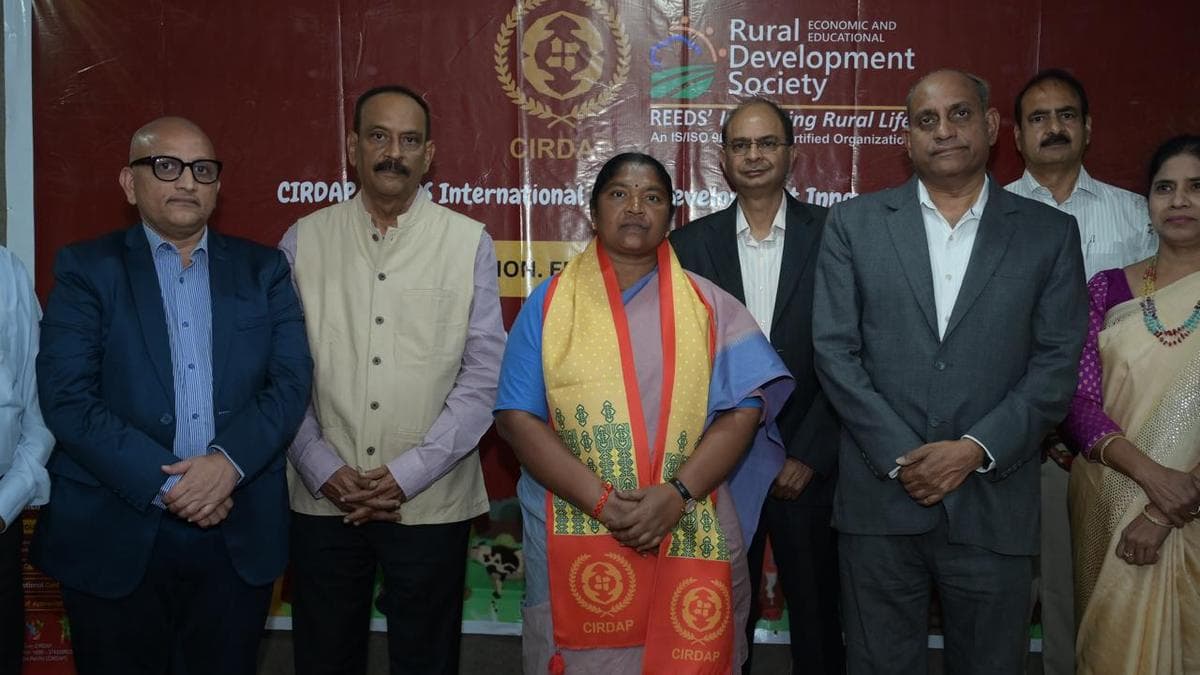


CIRDAP–REEDS International Rural Innovation Challenge 2026: Content Unavailable for Analysis.
Summary
Content for the CIRDAP–REEDS International Rural Innovation Challenge 2026 is unavailable. Without the article's text, a detailed summary explaining the event, its significance, or specific exam relevance cannot be generated. Key facts for competitive exam preparation are missing.
Key Points
- 1Specific details about the launch, objectives, and participants of the CIRDAP–REEDS International Rural Innovation Challenge 2026 are unavailable.
- 2The exact date of the challenge's launch or any associated timelines cannot be determined from the provided information.
- 3No specific names of officials, organizations beyond CIRDAP and REEDS, or locations involved are mentioned.
- 4The precise nature of 'rural innovation' or target areas for the challenge are not detailed in the absence of content.
- 5Any quantitative data, such as funding, number of participants, or expected outcomes, is not extractable.
In-Depth Analysis
The announcement of the CIRDAP–REEDS International Rural Innovation Challenge 2026, even without specific details, highlights a crucial global and national focus: leveraging innovation for sustainable rural development. This initiative brings together an international inter-governmental organization, CIRDAP, and an Indian entity, REEDS (likely Rural Entrepreneurship for Economic Development Society, a common name for NGOs in India), to foster solutions for the challenges faced by rural communities, particularly in the Asia-Pacific region.
**Background Context:**
Rural development has been a cornerstone of development policies worldwide, especially in countries with large agrarian populations like India. The Centre on Integrated Rural Development for Asia and the Pacific (CIRDAP) was established in 1979 by countries of the Asia-Pacific region, at the initiative of the Food and Agriculture Organization (FAO) of the United Nations. Its mandate is to promote integrated rural development through research, training, and information dissemination among its member states. India is a founding member of CIRDAP, underscoring its historical commitment to rural upliftment. In recent decades, the traditional top-down approaches to rural development have evolved, recognizing the need for community participation, local entrepreneurship, and technological innovation to address complex issues like poverty, food security, climate change, and lack of access to services. This shift has paved the way for 'innovation challenges' that seek creative, scalable, and sustainable solutions from a diverse pool of innovators.
**What Happened (Inferred):**
Given the title, the CIRDAP–REEDS International Rural Innovation Challenge 2026 is likely a multi-stage competition designed to identify, nurture, and potentially scale innovative ideas and solutions aimed at improving rural livelihoods and quality of life. Such challenges typically involve a global call for proposals from individuals, startups, NGOs, academic institutions, and social enterprises. The themes would likely revolve around critical areas such as sustainable agriculture, rural entrepreneurship, renewable energy access, digital inclusion, health and sanitation, education, and climate resilience in rural settings. The '2026' in the title suggests a future-oriented initiative, possibly indicating a multi-year program leading up to a grand culmination or implementation phase in that year, or simply the year of the final challenge event.
**Key Stakeholders Involved:**
1. **CIRDAP:** As an inter-governmental body, CIRDAP provides the international platform, legitimacy, technical expertise, and networking opportunities. It can facilitate knowledge sharing among member states and mobilize resources. Its role would be crucial in setting the challenge themes, evaluating proposals, and potentially connecting successful innovations with funding or implementation partners across Asia-Pacific.
2. **REEDS (Rural Entrepreneurship for Economic Development Society/Similar Entity):** As an Indian partner, REEDS would play a pivotal role in grounding the challenge within the Indian context. This would involve local outreach, mobilization of Indian innovators, providing insights into specific rural challenges in India, and potentially facilitating pilot projects or implementation within the country. Their on-ground experience would be invaluable.
3. **Innovators/Entrepreneurs:** These are the core participants – individuals, startups, researchers, and community groups developing novel solutions.
4. **Government of India:** Through ministries like Rural Development, Agriculture, Skill Development, and NITI Aayog, the Indian government would be a silent but significant stakeholder, potentially offering policy support, mentorship, or integration of successful innovations into national programs.
5. **Rural Communities:** The ultimate beneficiaries and often co-creators of these innovations, providing essential feedback and ensuring relevance.
**Why This Matters for India:**
India, with over 65% of its population residing in rural areas and a significant portion dependent on agriculture, stands to benefit immensely from such an initiative. This challenge aligns perfectly with India's national priorities of inclusive growth, poverty alleviation, and sustainable development. It can:
* **Catalyze Rural Transformation:** By bringing in fresh ideas and technological solutions to address persistent issues like low agricultural productivity, lack of non-farm livelihoods, inadequate infrastructure, and digital divide.
* **Promote Entrepreneurship:** Encourage young entrepreneurs and innovators to focus on rural problems, fostering a vibrant rural startup ecosystem, consistent with the 'Startup India' initiative.
* **Strengthen International Cooperation:** Enhance India's role in regional development dialogues and facilitate knowledge exchange with other CIRDAP member countries.
* **Achieve SDGs:** Directly contribute to several Sustainable Development Goals (SDGs), particularly SDG 1 (No Poverty), SDG 2 (Zero Hunger), SDG 8 (Decent Work and Economic Growth), and SDG 9 (Industry, Innovation, and Infrastructure).
* **Policy Learning:** Provide valuable insights for policymakers on effective strategies and successful models for rural development that can be scaled nationwide.
**Historical Context and Constitutional Provisions:**
India's commitment to rural development dates back to its independence, with early initiatives like the Community Development Programme (1952). The **Directive Principles of State Policy (DPSP)** in the Indian Constitution lay the foundational framework. **Article 40** mandates the State to organize village panchayats and endow them with powers and authority to function as units of self-government, making local governance crucial for rural development. **Article 43** directs the State to secure a living wage and a decent standard of life for all workers, including those in rural areas. The **73rd Constitutional Amendment Act of 1992** gave constitutional status to Panchayati Raj Institutions (PRIs), empowering local self-governance bodies to plan and implement schemes for economic development and social justice in rural areas. Subsequent policies and acts, such as the Mahatma Gandhi National Rural Employment Guarantee Act (MGNREGA) and the National Rural Livelihoods Mission (NRLM), reflect a continuous evolution towards empowering rural communities and fostering self-reliance, which innovation challenges directly support.
**Future Implications:**
The success of the CIRDAP–REEDS challenge could lead to the emergence of groundbreaking, scalable innovations that transform rural economies and societies. It could create new models for public-private partnerships in rural development, attract further investment into rural innovation, and establish a robust network of rural innovators across the Asia-Pacific region. For India, it signifies a continued move towards an innovation-driven economy, where solutions for its vast rural population are not just imported but also indigenously developed and shared globally. This initiative could also influence future policy formulation, emphasizing the integration of technology and entrepreneurial spirit in achieving comprehensive rural development targets.
Exam Tips
This topic falls under GS Paper II (Polity & Governance, Social Justice, International Relations) and GS Paper III (Economy, Science & Technology, Environment & Ecology). Focus on understanding the role of international organizations in India's development agenda and the significance of rural development schemes.
Study related topics such as Sustainable Development Goals (SDGs) – especially those related to poverty, hunger, and innovation; the structure and functions of Panchayati Raj Institutions; major government schemes for rural development (e.g., MGNREGA, NRLM, PMGSY); and the concept of social entrepreneurship and innovation ecosystems.
Common question patterns include analytical questions on the challenges of rural development in India, the role of technology and innovation in addressing these challenges, the significance of international cooperation in achieving development goals, and critical assessment of government policies aimed at rural upliftment.