

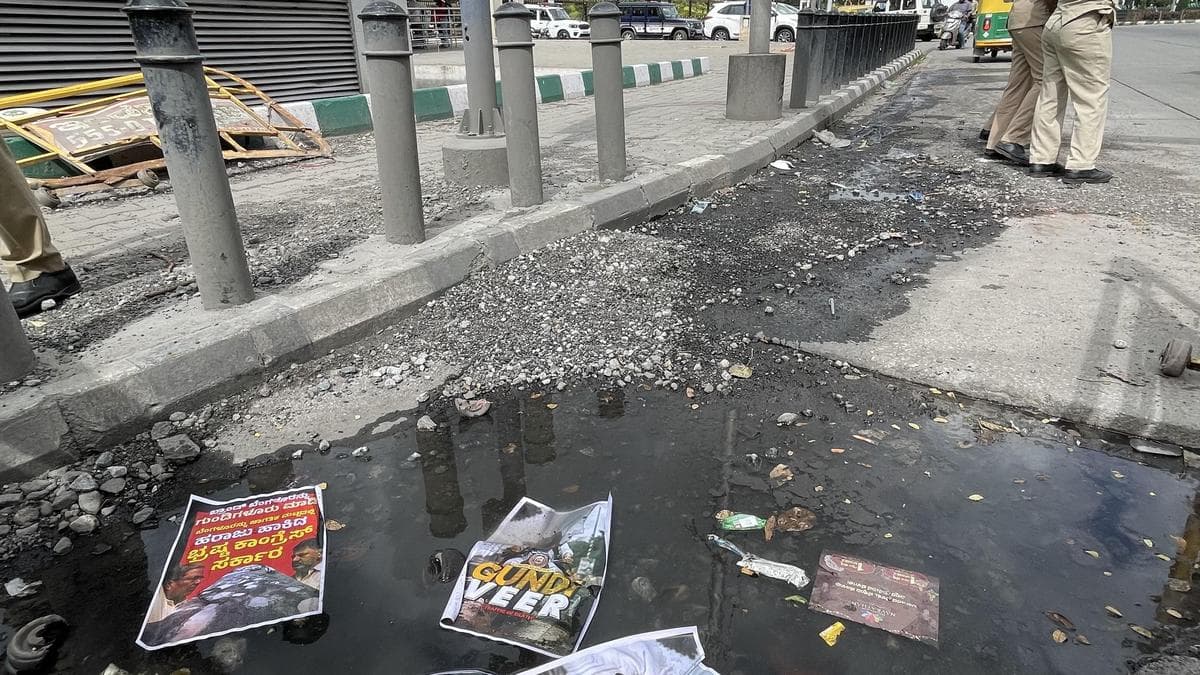


Article on Bengaluru's civic year lacks content, rendering it useless for exam preparation.
Summary
The provided article titled 'Big plans, broken roads: Bengaluru’s civic year in a nutshell' lacked any content, making it impossible to extract specific details regarding urban development, infrastructure projects, or policy decisions. Without factual information, the article holds no direct relevance for competitive exam preparation, as no data, names, or figures can be analyzed or presented.
Key Points
- 1No specific civic projects or policy initiatives related to Bengaluru were detailed due to missing content.
- 2No financial figures or budget allocations for urban development in Bengaluru were provided.
- 3No names of key government officials or civic bodies involved in Bengaluru's administration were mentioned.
- 4No specific dates or timelines concerning Bengaluru's infrastructure development were available.
- 5No data or statistics on urban challenges like road conditions or waste management in Bengaluru could be extracted.
In-Depth Analysis
The article title, "Big plans, broken roads: Bengaluru’s civic year in a nutshell," despite lacking specific content, profoundly encapsulates a recurring narrative in India's rapidly urbanizing landscape. It speaks volumes about the persistent challenges faced by major Indian cities, where ambitious development agendas frequently collide with ground-level realities like crumbling infrastructure and governance deficits. Bengaluru, often hailed as India's Silicon Valley, serves as a prominent microcosm of this national struggle.
**Background Context and What Happened (Thematic Interpretation):**
India is experiencing one of the fastest rates of urbanization globally. Cities like Bengaluru have witnessed explosive population growth, driven by economic opportunities, particularly in the IT and biotechnology sectors. This rapid influx has placed immense pressure on existing infrastructure and civic services. The 'big plans' likely refer to various government initiatives, master plans, and development projects aimed at modernizing the city – perhaps proposals for new flyovers, metro extensions, waste management solutions, or digital governance initiatives. However, the 'broken roads' symbolize the tangible failure in execution, maintenance, and quality control. This gap often stems from systemic issues such as inadequate funding, corruption, lack of inter-agency coordination, poor project management, and a reactive rather than proactive approach to urban planning. Historically, Indian cities have grown organically rather than through meticulous planning, leading to a legacy of infrastructure deficits that current 'big plans' struggle to overcome.
**Key Stakeholders Involved:**
Several entities play crucial roles in Bengaluru's civic life. The primary stakeholder is the **Bruhat Bengaluru Mahanagara Palike (BBMP)**, the municipal corporation responsible for civic administration and infrastructure. Its mandate includes road maintenance, waste management, public health, and urban planning. The **Government of Karnataka** (the state government) is another critical player, providing policy direction, funding, and oversight to the BBMP and other urban development agencies like the Bengaluru Development Authority (BDA) and Bengaluru Metro Rail Corporation Limited (BMRCL). The **Central Government** also influences through schemes like the Smart Cities Mission and Atal Mission for Rejuvenation and Urban Transformation (AMRUT), which provide financial and technical assistance for urban projects. Beyond governmental bodies, **private developers** are significant, often involved in large-scale infrastructure projects through Public-Private Partnerships (PPPs). Finally, **citizens and Resident Welfare Associations (RWAs)** are crucial stakeholders, advocating for better services, holding authorities accountable, and sometimes participating in local civic initiatives.
**Why This Matters for India:**
Bengaluru's situation mirrors the broader urban challenge facing India. Cities are the engines of India's economic growth, contributing over 60% of the GDP. However, if their infrastructure crumbles and quality of life deteriorates, their ability to attract investment and talent will diminish. This has significant economic implications, potentially hindering India's aspiration to become a $5 trillion economy. Politically, civic dissatisfaction over basic amenities like roads, sanitation, and water can lead to public unrest and electoral consequences. Socially, it impacts the health, safety, and productivity of millions, exacerbating inequalities where access to quality infrastructure becomes a privilege. Addressing these issues is vital for India's sustainable development and for realizing the demographic dividend.
**Historical Context and Constitutional Provisions:**
The framework for urban local self-governance in India was significantly strengthened by the **74th Constitutional Amendment Act of 1992**. This amendment granted constitutional status to Urban Local Bodies (ULBs) and inserted Part IXA into the Constitution, dealing with 'The Municipalities.' It mandates the constitution of Nagar Panchayats, Municipal Councils, and Municipal Corporations. **Article 243W** empowers ULBs to function as institutions of self-government, entrusting them with powers and responsibilities related to 18 matters listed in the **Twelfth Schedule** of the Constitution, which includes urban planning, regulation of land use, roads and bridges, public health, sanitation, and solid waste management. However, the effective devolution of powers and finances to ULBs remains a persistent challenge, with state governments often retaining significant control.
**Future Implications and Broader Themes:**
The 'big plans, broken roads' dichotomy highlights the urgent need for comprehensive urban governance reforms. Future implications include a continued focus on sustainable urban planning, moving beyond ad-hoc projects to integrated, long-term strategies. There's a growing emphasis on leveraging technology through initiatives like the Smart Cities Mission, which aims to improve infrastructure and services through digital solutions. Greater financial autonomy for ULBs, perhaps through reforms in property tax collection and other local revenue generation, is crucial. Enhanced public participation and accountability mechanisms, including citizen feedback loops and transparent project monitoring, are essential to bridge the gap between planning and execution. Ultimately, Bengaluru's civic year is a reminder that India's urban future hinges not just on grand visions but on robust implementation, effective governance, and a commitment to quality.
Exam Tips
This topic falls under GS Paper I (Urbanization, Indian Society), GS Paper II (Governance, Local Self-Government, Federalism), and GS Paper III (Infrastructure, Economic Development). Be prepared for analytical questions.
Study the 74th Constitutional Amendment Act thoroughly, including Article 243W and the Twelfth Schedule. Understand the powers, functions, and financial constraints of Urban Local Bodies (ULBs).
Familiarize yourself with flagship urban development schemes like the Smart Cities Mission, AMRUT, and Swachh Bharat Abhiyan. Understand their objectives, implementation challenges, and impact.
Practice essay writing and case study analysis on challenges of rapid urbanization, urban governance, municipal finance, and the role of technology in urban development. Use Bengaluru as a case example for broader issues.
Common question patterns include: 'Discuss the challenges faced by Indian cities in achieving sustainable development,' 'Critically analyze the effectiveness of the 74th Constitutional Amendment Act,' or 'Examine the role of technology in addressing urban infrastructure deficits.'