



Relevant for Exams
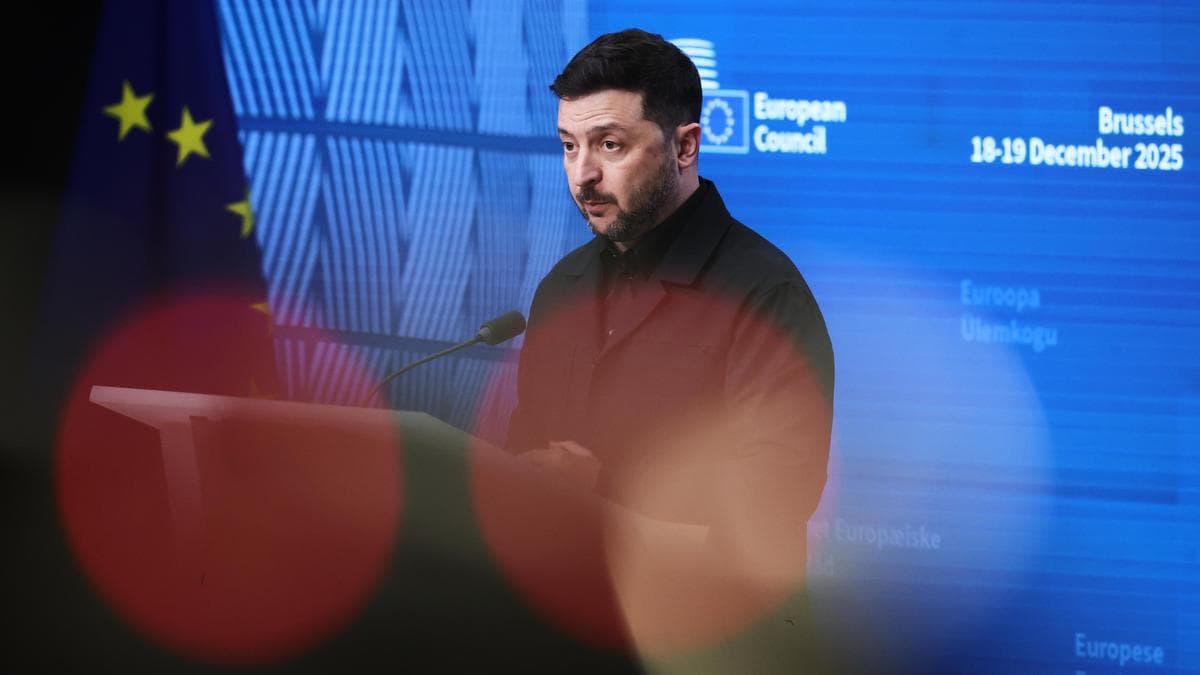
Zelenskyy urges U.S. to exert "full pressure" on Russia, citing Putin's lack of felt pressure.
Summary
Ukrainian President Volodymyr Zelenskyy urged the United States to exert "full pressure" on Russia, stating that Russian President Vladimir Putin does not yet feel sufficient pressure to end the ongoing war. This statement underscores Ukraine's persistent call for stronger international action against Russia and highlights the diplomatic efforts in the ongoing conflict. It is relevant for understanding international relations and current geopolitical dynamics for competitive exams.
Key Points
- 1The statement was made by Ukrainian President Volodymyr Zelenskyy.
- 2Zelenskyy specifically addressed the United States.
- 3He called for the U.S. to apply "full pressure" on Russia.
- 4Zelenskyy stated that Russian President Putin "does not yet feel the kind of pressure that should exist."
- 5The ultimate objective of the pressure is to end the ongoing war.
In-Depth Analysis
The statement by Ukrainian President Volodymyr Zelenskyy, urging the United States to exert "full pressure" on Russia, is a critical reflection of the ongoing geopolitical complexities surrounding the Russia-Ukraine conflict. It underscores Ukraine's desperate plea for more robust international intervention to end a war that has devastated its nation and disrupted global stability.
**Background Context and Historical Roots:**
To truly grasp the significance of Zelenskyy's appeal, one must understand the deep-seated historical and geopolitical tensions that culminated in the current conflict. The roots of the Russia-Ukraine war can be traced back to the dissolution of the Soviet Union in 1991, which saw Ukraine emerge as an independent state. Russia has historically viewed Ukraine as part of its sphere of influence, a buffer state against Western expansion. The eastward expansion of NATO, a military alliance formed to counter the Soviet Union, has been a significant point of contention for Russia. Moscow perceives NATO's presence near its borders as an existential threat, a sentiment that intensified with Ukraine's aspirations for closer ties with the West, including potential NATO membership. The conflict escalated in 2014 when Russia annexed Crimea following a pro-Russian uprising and supported separatists in the Donbas region, leading to a protracted low-intensity conflict. The full-scale invasion launched by Russia on February 24, 2022, marked a drastic escalation, with Russia citing security concerns, 'denazification' of Ukraine, and protection of Russian speakers as justifications.
**What Happened (The Immediate Context):**
Zelenskyy's call to the U.S. for "full pressure" on Russia reflects the current stalemate on the battlefield and in diplomatic efforts. Despite extensive sanctions imposed by Western nations and significant military aid to Ukraine, the war continues. Zelenskyy's assertion that President Putin "does not yet feel the kind of pressure that should exist" highlights Ukraine's belief that existing measures are insufficient to compel Russia to cease hostilities. This statement is a direct appeal for the U.S., as a leading global power, to intensify economic, diplomatic, and perhaps even indirect military pressure to force a resolution.
**Key Stakeholders Involved:**
1. **Ukraine (President Zelenskyy):** The primary victim of the aggression, fighting for its sovereignty, territorial integrity, and democratic future. Zelenskyy's role has been pivotal in rallying international support.
2. **Russia (President Putin):** The aggressor, aiming to achieve its strategic objectives, which include preventing Ukraine's integration into Western alliances and securing its perceived security interests.
3. **United States:** A crucial ally to Ukraine, providing billions in military, financial, and humanitarian aid. The U.S. has led international efforts to impose sanctions on Russia and has been instrumental in coordinating a global response. Its influence is unparalleled in shaping the international response.
4. **NATO:** While not directly involved militarily in Ukraine, NATO members have provided extensive support. The conflict has reinvigorated the alliance and led to increased defence spending and troop deployments in Eastern Europe.
5. **European Union:** Heavily impacted by the conflict, particularly concerning energy security and refugee flows. The EU has imposed significant sanctions and provided substantial aid to Ukraine, while grappling with the economic fallout.
6. **United Nations:** Attempting to play a humanitarian and diplomatic role, but its effectiveness in conflict resolution is often hampered by the veto power of permanent Security Council members, including Russia.
**Why This Matters for India:**
The Russia-Ukraine conflict and the international response to it have profound implications for India across multiple dimensions:
1. **Geopolitical Balancing Act:** India has historical strategic ties with Russia, particularly in defence and energy. Simultaneously, India has a growing strategic partnership with the U.S. and its allies (e.g., QUAD). Maintaining this delicate balance, often termed 'strategic autonomy,' is challenging when major powers are in direct confrontation. India has largely abstained from condemning Russia directly at the UN, emphasizing dialogue and diplomacy, a stance that has drawn scrutiny from Western nations.
2. **Economic Impact:** The conflict has disrupted global supply chains, leading to increased commodity prices, especially crude oil, natural gas, and fertilisers. India, a major importer of crude oil, has faced inflationary pressures, impacting its economic growth and the common citizen. The global food security crisis, exacerbated by disruptions in grain exports from Ukraine and Russia, also concerns India, though it has generally been a net food exporter.
3. **Defence Implications:** India's significant dependence on Russian military hardware makes it vulnerable to potential disruptions caused by Western sanctions on Russia. While India has been diversifying its defence procurement, Russia remains a key supplier.
4. **Multilateralism and International Law:** India, as a proponent of a rules-based international order, faces a dilemma. While upholding sovereignty and territorial integrity, its historical ties and strategic interests prevent it from outright condemning Russia, challenging its traditional foreign policy principles articulated, for instance, in **Article 51 of the Constitution of India**, which promotes international peace and security, and respect for international law.
**Future Implications:**
Zelenskyy's call suggests a potential intensification of pressure on Russia, which could lead to several outcomes:
1. **Escalation or De-escalation:** Increased pressure might compel Russia to seek a diplomatic off-ramp, or it could lead to further escalation if Russia perceives it as an existential threat.
2. **Global Order Reshaping:** The conflict is accelerating a shift towards a multipolar world, challenging the post-Cold War liberal order. Alliances are being tested, and new alignments might emerge.
3. **Energy Transition:** The crisis has highlighted Europe's energy vulnerability, potentially accelerating the global transition towards renewable energy sources.
4. **India's Foreign Policy Evolution:** India will continue to navigate this complex landscape, potentially deepening its engagement with both blocs while prioritizing its national interests. The conflict reinforces the need for self-reliance (Atmanirbhar Bharat) in critical sectors like defence and energy.
In essence, Zelenskyy's plea is not just about Ukraine; it's a stark reminder of the fragility of peace, the complexities of international relations, and the ripple effects of regional conflicts on the global stage, impacting nations like India in profound ways.
Exam Tips
This topic falls under 'International Relations' (GS-II for UPSC Civil Services, General Awareness for SSC/State PSCs). Focus on the geopolitical context, India's foreign policy challenges, and the role of international organizations.
Study related topics like NATO's expansion, the history of Russia-Ukraine relations, India's Non-Aligned Movement (NAM) principles, the concept of strategic autonomy, and the impact of global conflicts on energy and food security.
Expect analytical questions on India's stance in the conflict, the economic implications for India, the effectiveness of international sanctions, and the future of the global order. Be prepared to discuss the pros and cons of India's balancing act.
Familiarize yourself with key international organizations like the UN, NATO, and the G7, and their respective roles and limitations in addressing such conflicts.
Understand the 'Atmanirbhar Bharat' initiative in the context of defence procurement and energy security, as the conflict underscores the importance of reducing external dependencies.
Related Topics to Study
Full Article
America must clearly say: if not diplomacy, then there will be full pressure...Putin does not yet feel the kind of pressure that should exist, says Ukrainian President Volodymyr Zelenskyy