



Relevant for Exams
Prolonged dense fog in Punjab, Haryana, Chandigarh: An analysis of causes and impact.
Summary
The article title indicates a discussion on the prolonged presence of dense fog over Punjab, Haryana, and Chandigarh, persisting even during daylight hours. While specific details are unavailable, such phenomena are crucial for understanding regional climatology and their impact on daily life and infrastructure, making it relevant for geography and environment sections of competitive exams.
Key Points
- 1Dense fog in North India often results from a combination of low temperatures, high humidity, and stable atmospheric conditions.
- 2Factors like stubble burning in Punjab and Haryana contribute to particulate matter, acting as condensation nuclei, exacerbating fog.
- 3Prolonged fog significantly impacts transportation, including road, rail, and air travel, leading to delays and accidents.
- 4The Indo-Gangetic Plains are particularly susceptible to severe fog episodes during the winter months due to geographical features.
- 5Understanding meteorological conditions like western disturbances and anticyclonic circulation is key to analyzing fog persistence.
In-Depth Analysis
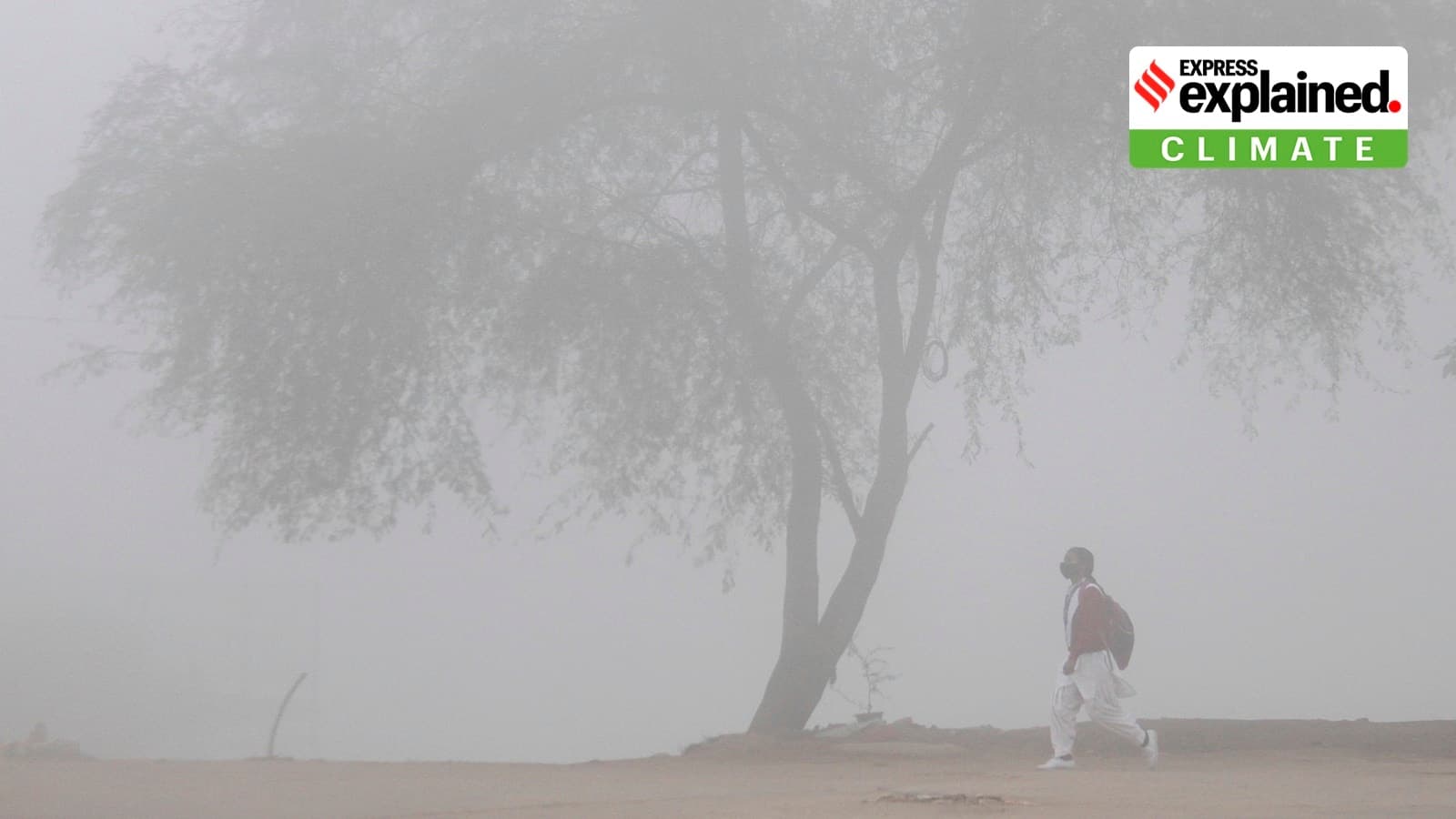
The persistent blanket of dense fog over Punjab, Haryana, and Chandigarh during the winter months is a recurring, yet increasingly concerning, atmospheric phenomenon in North India. This extensive fog, often lingering throughout the day, significantly impacts daily life, economy, and public health in the region. Understanding its causes, implications, and the policy responses is crucial for competitive exam aspirants.
**Background Context and What Happened:**
Dense fog is essentially a cloud that forms at or near the ground, reducing visibility to less than 1,000 meters. In the Indo-Gangetic Plains (IGP), including Punjab, Haryana, and Chandigarh, winter fog is a regular feature, but its intensity and duration have become more pronounced in recent years. This phenomenon is a complex interplay of meteorological and anthropogenic factors. Meteorologically, the region experiences low temperatures during winter, often exacerbated by the passage of Western Disturbances, which bring moisture and then lead to clear skies and radiative cooling. High humidity, derived from the region's extensive irrigation network and river systems, provides ample moisture. Critically, stable atmospheric conditions, often associated with anticyclonic circulation, prevent the vertical mixing of air, trapping moisture and pollutants near the ground. This combination creates an ideal environment for fog formation and persistence.
However, a significant anthropogenic contributor, particularly in late October and November, is stubble burning. Farmers in Punjab and Haryana burn crop residue (stubble) after harvesting paddy to quickly clear fields for the next wheat crop. This practice releases vast quantities of particulate matter (PM2.5, PM10) and other pollutants into the atmosphere. These fine particles act as excellent condensation nuclei, around which water vapor condenses even when relative humidity is less than 100%, thereby promoting the formation of dense fog and converting it into smog (smoke + fog). The geographical funnel-like structure of the IGP then traps this polluted fog, leading to its prolonged presence.
**Key Stakeholders Involved:**
Several key stakeholders are directly or indirectly involved. **Farmers** are central, as their agricultural practices, particularly stubble burning, significantly contribute to the problem. Their economic constraints and lack of viable alternatives often drive this practice. The **general public** in the affected regions bears the brunt, facing health issues due, to poor air quality, and disruptions to daily life. **Government agencies** at both central and state levels (Punjab, Haryana, Chandigarh administration) are crucial. The **India Meteorological Department (IMD)** provides forecasts and warnings. The **Ministry of Environment, Forest and Climate Change (MoEFCC)**, along with state environment departments, is responsible for policy formulation and enforcement regarding air pollution. The **Commission for Air Quality Management (CAQM) in NCR and Adjoining Areas**, established in 2021, plays a pivotal role in coordinating efforts against air pollution, including stubble burning, across the region. The **transportation sector** (railways, airlines, road transport) is directly impacted, leading to delays, cancellations, and increased accident risks.
**Significance for India and Broader Themes:**
This prolonged fog has profound implications for India. **Economically**, it causes significant disruptions to transportation and logistics, impacting supply chains, trade, and even tourism. Agricultural productivity can also suffer due to reduced sunlight. **Socially**, it leads to an increase in road, rail, and air accidents, sometimes with tragic loss of life. The most severe impact is on **public health**. The combination of fog and pollutants creates severe air pollution (smog), leading to a surge in respiratory illnesses, cardiovascular problems, and other health complications, especially among children and the elderly. This puts immense pressure on healthcare infrastructure. Environmentally, it highlights the challenge of balancing agricultural practices with environmental sustainability and public health.
**Historical Context and Constitutional/Policy References:**
While winter fog is not a new phenomenon, its severity and duration, particularly the 'smog' component, have intensified over the past few decades, correlating with increased agricultural activity and urbanization. India's legal framework offers mechanisms to address this. **Article 21** of the Constitution, guaranteeing the Right to Life and Personal Liberty, has been interpreted by the Supreme Court to include the right to a clean environment. **Article 48A**, a Directive Principle of State Policy, mandates the state to protect and improve the environment. Key legislative instruments include the **Environment (Protection) Act, 1986**, which provides a comprehensive framework for environmental protection, and the **Air (Prevention and Control of Pollution) Act, 1981**, specifically designed to prevent, control, and abate air pollution. The government has also launched initiatives like the **National Clean Air Programme (NCAP)** in 2019 to reduce particulate matter concentration. The **CAQM Act, 2021**, specifically targets air quality management in the National Capital Region and adjoining areas, including Punjab and Haryana, with powers to enforce measures against stubble burning and industrial pollution.
**Future Implications:**
Addressing this issue requires a multi-pronged approach. Future strategies must focus on providing viable and economically attractive alternatives to stubble burning for farmers, such as machinery for in-situ crop residue management (e.g., Happy Seeder, Super Seeder) or ex-situ utilization (e.g., biomass power plants). Enhanced inter-state cooperation is critical, as air pollution does not respect administrative boundaries. Investment in better meteorological forecasting and early warning systems can help mitigate some impacts. Ultimately, it ties into India's broader climate change commitments and the pursuit of sustainable development goals, emphasizing the need for a holistic approach to environmental governance and public health. Failure to address this could lead to increased health burdens, economic losses, and societal discontent, undermining regional development.
Exam Tips
This topic primarily falls under 'Geography (Climatology, Indian Geography, Environmental Geography)' and 'Environment & Ecology' sections of UPSC, State PSC, and SSC exams. It also has relevance for 'Disaster Management' and 'Government Policies & Schemes'.
Expect questions on the causes of fog/smog in North India (meteorological vs. anthropogenic factors), the impact of stubble burning, government initiatives (like NCAP, CAQM), and related constitutional provisions (Article 21, 48A). Map-based questions identifying affected regions are also common.
Study related topics like Western Disturbances, Anticyclonic Circulation, Air Quality Index (AQI), National Clean Air Programme, and the various methods for crop residue management. Understanding the difference between fog and smog is crucial.
For Mains exams, be prepared to discuss the socio-economic and health impacts, the challenges in implementing anti-stubble burning measures, and potential solutions involving technology, policy, and farmer engagement. Quote relevant Acts and Articles.
Practice analyzing data related to AQI and atmospheric conditions. Understand the role of different pollutants (PM2.5, PM10) in exacerbating fog into smog.