



Relevant for Exams
No content provided to detail last Indian Railways passenger fare hike for analysis.
Summary
The article's title, 'When did Indian Railways last hike passenger fares', addresses a relevant topic for competitive exams concerning economic and transport policy. However, the provided content is entirely absent, making it impossible to extract any specific details regarding the date, amount, or rationale behind the last fare revision by Indian Railways. This lack of information prevents a factual analysis crucial for exam preparation.
Key Points
- 1The provided article content is explicitly stated as 'No content available'.
- 2Due to the absence of content, no specific date for the last Indian Railways passenger fare hike can be extracted.
- 3Details regarding the magnitude, reasons, or policy changes related to railway fares are not present in the given input.
- 4The article's title highlights a significant topic for competitive exams, particularly for Railway and General Awareness sections.
- 5Without content, this input cannot provide factual data on Indian Railways fare revisions for exam preparation.
In-Depth Analysis
The question of when Indian Railways last hiked passenger fares delves into a critical aspect of India's economic policy, public service delivery, and the financial health of one of the world's largest railway networks. While the specific article content is unavailable, understanding the dynamics of railway fare revisions is crucial for competitive exam aspirants.
**Background Context: A Lifeline and a Financial Tightrope**
Indian Railways, established in 1853, is not just a mode of transport but the lifeline of the nation, connecting remote corners and facilitating the movement of millions daily. It is the fourth-largest railway network in the world, operating over 1.2 lakh km of track and carrying over 8 billion passengers annually. Its dual mandate – to operate as a commercial entity while fulfilling a significant social service obligation – often places it on a financial tightrope. For decades, passenger fares have been kept artificially low, primarily due to political sensitivity and the aim to provide affordable travel to the masses, particularly the economically weaker sections. This policy of cross-subsidization, where freight revenue largely subsidizes passenger services, has been a cornerstone of Indian Railways' financial model.
**What Happened: Infrequent Hikes and Policy Adjustments**
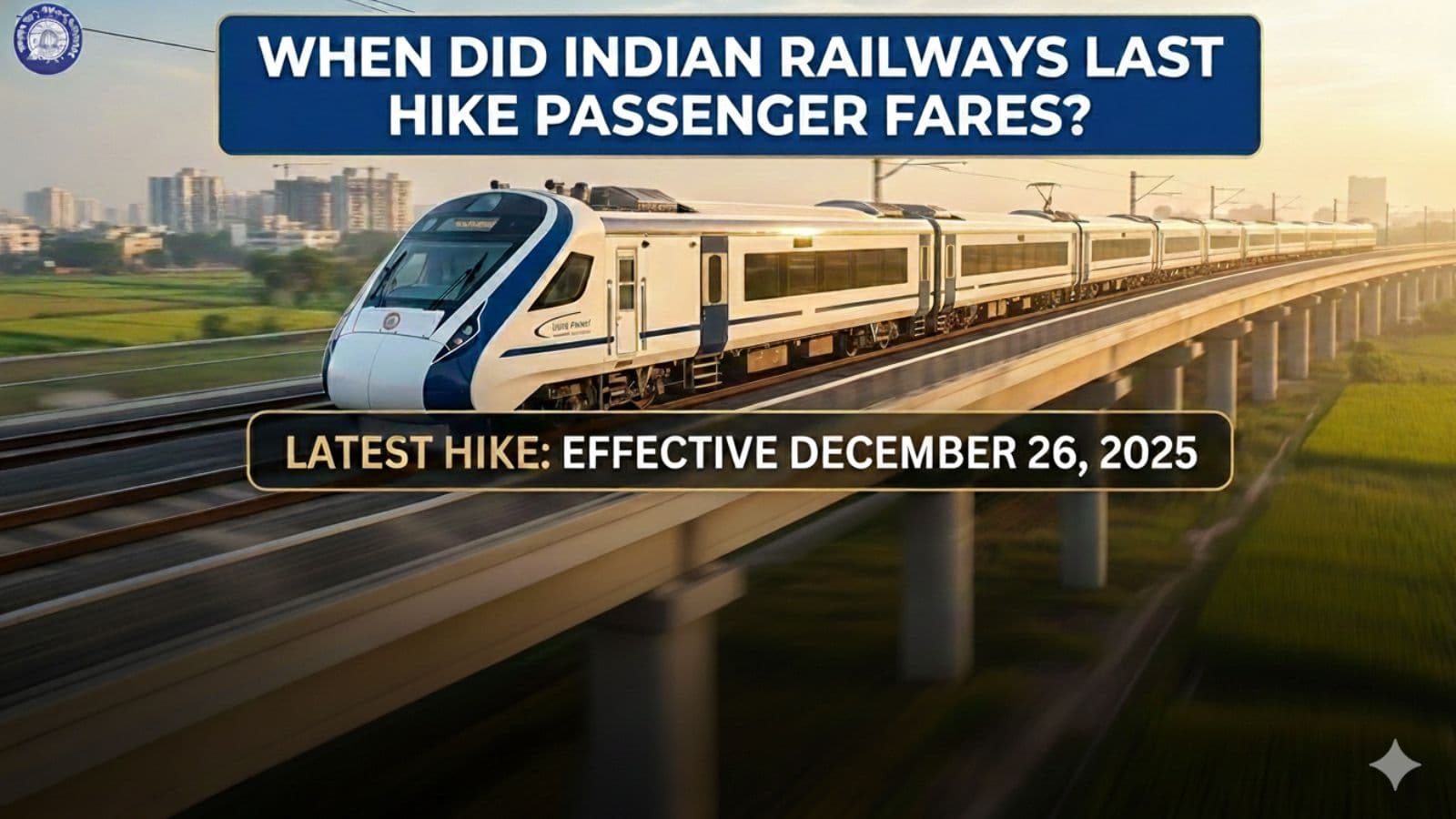
Historically, broad-based passenger fare hikes have been infrequent and politically challenging. The last significant general fare hike for most passenger classes, excluding suburban trains, occurred in December 2019, when the Ministry of Railways announced an increase in passenger fares by 1 paisa per kilometre for ordinary non-AC classes, 2 paisa per kilometre for Mail/Express non-AC classes, and 4 paisa per kilometre for AC classes. This revision aimed to address the increasing operational costs and the need for funds for modernization and safety upgrades. Prior to this, a significant fare rationalization was undertaken in 2014, followed by the introduction of 'flexi-fare' or dynamic pricing in premium trains like Rajdhani, Shatabdi, and Duronto in September 2016, which allowed fares to increase based on demand. During the COVID-19 pandemic, special fares were introduced, and some concessions were temporarily withdrawn, indicating a continuous, albeit often piecemeal, adjustment approach rather than a single, large-scale hike.
**Key Stakeholders Involved:**
1. **Ministry of Railways/Railway Board:** The primary decision-making body responsible for setting policies, including fare structures, and overseeing the operation of Indian Railways.
2. **Government of India (especially the Ministry of Finance):** Influences railway policy through budgetary allocations, financial support, and overall economic direction. Since 2017, the Railway Budget has been merged with the Union Budget, bringing railway finances under direct parliamentary scrutiny as part of the broader national fiscal policy.
3. **Passengers:** The ultimate beneficiaries and payers. Daily commuters, long-distance travelers, and various segments like students, senior citizens, and physically challenged individuals are directly impacted by fare changes, often leading to public discourse and political reactions.
4. **Parliament and Political Parties:** Railway fares are a sensitive political issue. Fare hikes often lead to debates in Parliament and can become electoral talking points, given the vast number of citizens reliant on railways.
5. **Railway Employees and Unions:** While not directly involved in fare setting, the financial health of Indian Railways, influenced by fare policies, directly impacts employee welfare, salaries, and working conditions.
**Why This Matters for India:**
Passenger fare hikes have profound implications for India. Economically, they are crucial for the financial sustainability of Indian Railways, enabling investments in infrastructure, safety upgrades, new technologies (like Kavach anti-collision system), and expansion projects (like Dedicated Freight Corridors and High-Speed Rail). Without adequate revenue, the network risks stagnation and deterioration. Socially, fare affordability directly impacts the common person's ability to travel for work, education, and social purposes. Keeping fares low helps maintain inclusivity, but at the cost of service quality and modernization. Politically, fare revisions are often unpopular, leading to public protests and opposition criticism, forcing governments to balance economic necessity with political expediency.
**Historical Context and Broader Themes:**
The history of Indian Railways post-independence is marked by a tension between its role as a commercial enterprise and its social welfare mandate. The policy of subsidizing passenger fares has its roots in the socialist planning era, aiming to make travel accessible to all. The merger of the Railway Budget with the Union Budget in 2017 was a significant reform, ending a 92-year-old practice. This move aimed to streamline financial planning, allow the Ministry of Finance to take a holistic view of the nation's infrastructure spending, and potentially depoliticize fare decisions to some extent, allowing for more rational economic choices. This connects to broader themes of governance, public sector reform, and infrastructure development.
**Related Constitutional Articles, Acts, or Policies:**
* **Seventh Schedule, Article 246 (Union List, Entry 22):** Railways fall under the exclusive legislative competence of the Union Government.
* **Article 112 (Annual Financial Statement):** Since 2017, the financial proposals for Indian Railways are presented as part of the Union Budget.
* **Indian Railways Act, 1890 (and subsequent amendments):** The principal legislation governing the construction, maintenance, and operation of railways in India, including aspects related to tariffs and charges.
* **Railway Reform Committees:** Various committees, such as the Bibek Debroy Committee (2015), have consistently recommended fare rationalization, greater autonomy for Indian Railways, and separation of its social and commercial roles to improve its financial health.
* **National Rail Plan (2030):** A long-term vision document aimed at creating a future-ready railway system by 2030, emphasizing capacity enhancement, modernization, and financial sustainability, which inherently requires a review of fare structures.
**Future Implications:**
The future of Indian Railways' fare policy will likely involve a continuous effort to balance financial viability with social responsibility. We might see more dynamic pricing mechanisms, targeted subsidies for specific passenger segments, and a gradual rationalization of fares to reflect increasing operational costs and the need for investment. The push for modernization, high-speed rail, and world-class stations necessitates substantial capital, making fare revisions an inevitable part of the journey towards a 'New India's Railways'. Private sector participation in certain operations and investment in infrastructure could also influence future fare policies, as commercial viability becomes a stronger driver.
Exam Tips
This topic primarily falls under General Studies Paper 3 (Economy - Infrastructure, Public Sector) and General Studies Paper 1 (Geography - Transport) for UPSC. For SSC, Banking, Railway, and State PSC exams, it's crucial for General Awareness and Current Affairs sections.
Study related topics such as the history of Indian Railways, the merger of the Railway Budget with the Union Budget (2017), key railway reform committees (e.g., Bibek Debroy Committee), major infrastructure projects (Dedicated Freight Corridors, Bullet Trains), and the financial performance of Public Sector Undertakings (PSUs).
Common question patterns include factual questions (e.g., year of last major fare hike, date of Railway Budget merger), analytical questions (e.g., 'Discuss the challenges faced by Indian Railways in balancing commercial viability and social obligation'), and policy-oriented questions (e.g., 'Critically analyze the impact of fare rationalization on Indian Railways' modernization efforts').
Focus on understanding the concept of cross-subsidization in Indian Railways and its implications. Also, be aware of the difference between general fare hikes and specific adjustments like dynamic pricing or premium charges.
Keep abreast of recent government policies and initiatives related to railway infrastructure development, financing models, and any future announcements regarding fare revisions or new pricing mechanisms.