



Relevant for Exams
No content provided for 'What is a superkilonova?', preventing fact extraction.
Summary
The article's content regarding 'What is a superkilonova?' was not provided, making it impossible to extract specific details or summarize the event, its significance, or its relevance for competitive exams. A superkilonova generally refers to an astronomical phenomenon, likely a powerful transient event, but no further information can be derived without the actual text. Therefore, no exam-relevant facts can be presented.
Key Points
- 1No specific facts available due to missing article content.
- 2Article text for 'What is a superkilonova?' was not provided for analysis.
- 3Unable to identify key points, dates, or names without content.
- 4Extraction of exam-relevant information is not possible from an empty article.
- 5Details regarding the definition or implications of a superkilonova are absent.
In-Depth Analysis
Even without the specific content of the article 'What is a superkilonova?', we can delve into this fascinating astronomical phenomenon, as it represents a cutting-edge area of scientific research highly relevant for competitive exams under the Science and Technology section. A 'superkilonova' would imply an event even more powerful or distinct than a standard kilonova, which is itself a relatively new and exciting discovery in astrophysics.
**Background Context and What Happened:**
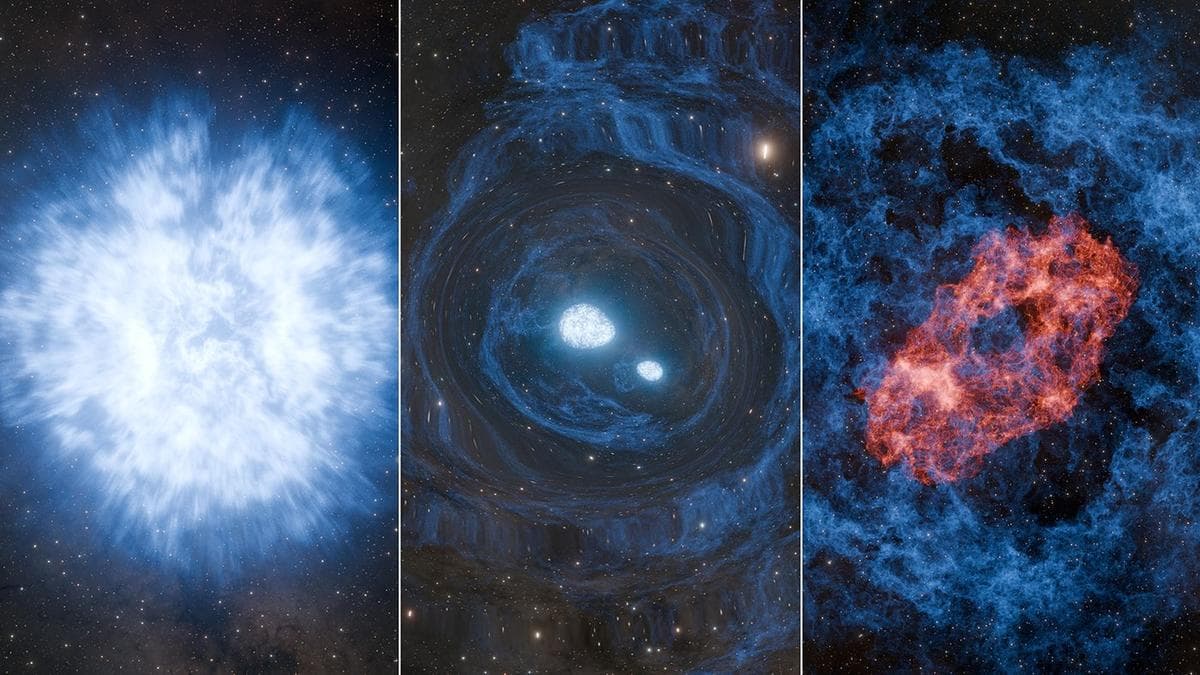
To understand a superkilonova, we first need to grasp what a kilonova is. A kilonova is a transient astronomical event that occurs when two neutron stars, or a neutron star and a black hole, merge. These mergers are among the most energetic events in the universe, releasing immense amounts of energy in the form of gravitational waves and electromagnetic radiation. The gravitational waves were first directly detected in 2015 by the LIGO experiment, opening the era of multi-messenger astronomy. The first kilonova associated with a gravitational wave event (GW170817) was observed on August 17, 2017. This event confirmed that kilonovae are the primary cosmic factories for the rapid neutron-capture process (r-process), responsible for creating approximately half of all elements heavier than iron, including precious metals like gold, platinum, and rare earth elements. The merging neutron stars eject neutron-rich material, which then undergoes rapid radioactive decay, producing these heavy elements and glowing brightly in visible and infrared light for days to weeks.
A 'superkilonova' would hypothetically represent a more extreme version of this phenomenon. While the exact definition might still be evolving in the scientific community, it could refer to a kilonova that is significantly more luminous, longer-lasting, or perhaps arises from a different progenitor system than the typical neutron star-neutron star merger. Possibilities could include mergers involving more massive neutron stars, or even scenarios that push the boundaries of current astrophysical models. Such an event would provide unprecedented insights into extreme gravitational environments, the properties of nuclear matter at incredibly high densities, and the origins of the heaviest elements in the cosmos.
**Key Stakeholders Involved:**
The primary stakeholders in the study of kilonovae and potential superkilonovae are international scientific collaborations and space agencies. These include:
1. **Gravitational Wave Observatories:** The LIGO (Laser Interferometer Gravitational-Wave Observatory) in the USA, Virgo in Italy, and KAGRA in Japan, which form a global network for detecting gravitational waves. India is a crucial future partner with the planned LIGO-India project.
2. **Astronomical Observatories:** A vast network of ground-based telescopes (e.g., VLT, Gemini, Hubble Space Telescope, James Webb Space Telescope) and space-based observatories (e.g., Chandra, Swift, AstroSat) that conduct follow-up electromagnetic observations across various wavelengths.
3. **Research Institutions and Universities:** Thousands of scientists and researchers globally from universities and research institutions are involved in theoretical modeling, data analysis, and observational campaigns.
4. **Governments and Funding Agencies:** Bodies that provide the substantial funding required for building and operating these large-scale scientific instruments and supporting research.
**Why This Matters for India:**
While a superkilonova is an astronomical event, its study has profound significance for India, primarily in the realm of scientific advancement, technological development, and international standing. India's active participation in global astronomy, notably through the upcoming **LIGO-India project**, places it at the forefront of multi-messenger astronomy. This collaboration enhances India's scientific reputation, fosters cutting-edge research, and provides opportunities for Indian scientists and engineers to contribute to and lead global scientific endeavors. Furthermore, the development of advanced instrumentation and data analysis techniques for such projects has potential spin-off benefits for other technological sectors. It also inspires a new generation of scientists, aligning with the **Fundamental Duty under Article 51A(h) of the Indian Constitution** to "develop the scientific temper, humanism and the spirit of inquiry and reform." India's **Science, Technology and Innovation Policy (STIP) 2020** also emphasizes promoting fundamental research and international collaboration.
**Historical Context and Future Implications:**
The observation of GW170817 and its kilonova in 2017 marked a watershed moment, confirming theories about neutron star mergers and the origin of heavy elements. Before this, the r-process was theoretically understood but lacked direct observational confirmation of its cosmic sites. The 'superkilonova' concept pushes this frontier further.
The future implications are immense. Continued detection of kilonovae and the potential discovery of superkilonovae will refine our understanding of extreme astrophysical phenomena, the equation of state of nuclear matter, and the cosmic inventory of heavy elements. It will also test the limits of general relativity and open new avenues for fundamental physics research. India's role in this, particularly with LIGO-India becoming operational, will be critical in expanding the global gravitational wave network, improving localization of sources, and enhancing detection rates. This will strengthen India's position as a significant contributor to global scientific research and innovation.
**Related Constitutional Articles, Acts, or Policies:**
* **Article 51A(h) (Fundamental Duty):** Emphasizes the duty to "develop the scientific temper, humanism and the spirit of inquiry and reform," directly supporting investment in scientific research like astrophysics.
* **Science, Technology and Innovation Policy (STIP) 2020:** Aims to promote scientific research, innovation, and international collaboration, which aligns perfectly with India's participation in projects like LIGO-India and astronomical research.
* **Department of Space (DoS) and Indian Space Research Organisation (ISRO):** These governmental bodies are key to India's space and astronomical research endeavors, including missions like AstroSat and future contributions to global observatories.
Exam Tips
This topic primarily falls under the 'Science and Technology' section of UPSC Civil Services (GS Paper III), SSC CGL (General Awareness), and State PSC exams. Focus on understanding the fundamental concepts of astrophysics, multi-messenger astronomy, and India's contributions.
Study related topics like gravitational waves (LIGO, Virgo, KAGRA), neutron stars, black holes, supernovae, nucleosynthesis (r-process), and India's space program (ISRO, AstroSat, upcoming LIGO-India project). Understand the 'why' and 'how' of these phenomena.
Common question patterns include definitions (What is a kilonova/superkilonova?), significance (Why are they important for understanding the universe?), India's role in global scientific projects (e.g., LIGO-India), and the link between these events and the formation of heavy elements. Be prepared for both factual and conceptual questions.
Pay attention to recent discoveries and advancements in astronomy and space technology, as these are frequently updated and tested. For instance, the first detection of gravitational waves (GW150914) and the first multi-messenger observation of a kilonova (GW170817) are landmark events.