



Relevant for Exams
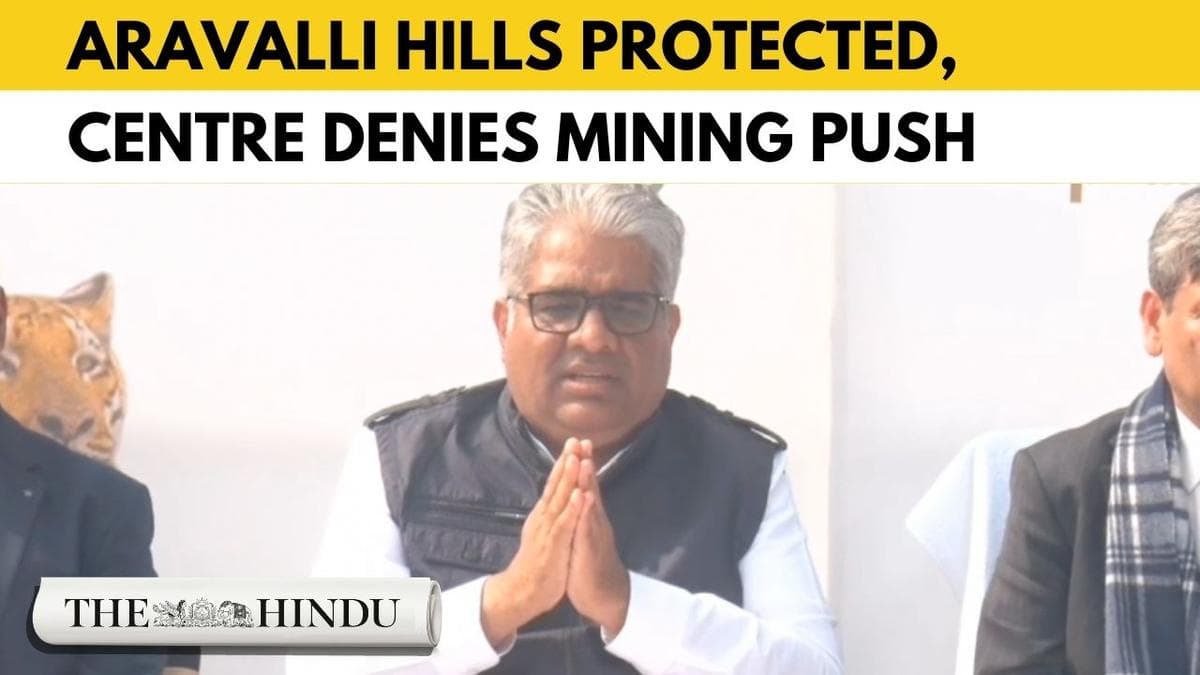
Centre rejects Aravalli mining claims, cites Supreme Court freeze and maintains protection.
Summary
The Centre has dismissed reports alleging a change in the Aravalli hills' definition to facilitate large-scale mining, reaffirming the Supreme Court-ordered freeze on new leases. This clarification addresses controversy surrounding a '100-metre' criterion for defining hills, emphasizing the continued protection of the ecologically sensitive Aravalli range. This is crucial for competitive exams focusing on environmental law, geography, and government policy.
Key Points
- 1The Centre explicitly rejected reports claiming a change in the definition of Aravalli hills for mining purposes.
- 2The rejection cited an existing Supreme Court-ordered freeze on new mining leases in the Aravalli region.
- 3Controversy had arisen over a '100-metre' criterion used to define hills across various states.
- 4The Aravalli hills are a crucial geological feature, and their protection from large-scale mining remains a priority.
- 5The government's clarification reinforces the legal safeguards in place for the Aravalli range.
In-Depth Analysis
The recent clarification by the Centre, rejecting claims of a changed definition for the Aravalli hills to permit large-scale mining, underscores a critical and long-standing environmental battle in India. This issue is not merely about a technical definition but represents a larger conflict between economic development imperatives and ecological preservation, a theme frequently tested in competitive exams.
**Background and Historical Context:** The Aravalli Range, one of the oldest fold mountain systems in the world, stretching approximately 692 km across Gujarat, Rajasthan, Haryana, and Delhi, is an ecological lifeline for the region. Geologically ancient, predating the Himalayan range, it acts as a crucial green lung, a barrier against the eastward march of the Thar Desert, and a vital groundwater recharge zone for millions. Historically, the Aravallis have been subjected to intense mining activities, particularly for minerals like marble, granite, sandstone, and various construction materials. This exploitation, often unregulated, led to significant environmental degradation, including deforestation, biodiversity loss, soil erosion, and depletion of water tables. The dire situation prompted significant judicial intervention. A landmark ruling by the Supreme Court in 2002, in the M.C. Mehta v. Union of India case, imposed a freeze on mining activities in a significant portion of the Aravalli region, particularly in Haryana and Rajasthan, recognizing its ecological fragility and importance.
**What Happened and the Recent Controversy:** Recent reports suggested that the government was considering a '100-metre' criterion to define hills across states, leading to fears that this redefinition could exclude large parts of the Aravallis from protected status and open them up for mining. This sparked considerable alarm among environmentalists and concerned citizens, who viewed it as a potential rollback of decades of conservation efforts and Supreme Court directives. The Centre, through the Ministry of Environment, Forest and Climate Change (MoEF&CC), swiftly rejected these reports. It explicitly stated that there has been no change in the definition of the Aravalli hills for mining purposes and reaffirmed the existing Supreme Court-ordered freeze on new mining leases in the region. This clarification aims to quell the controversy and reiterate the government's commitment to protecting the range.
**Key Stakeholders Involved:** Several key players are involved in this ongoing saga. The **Central Government**, particularly the MoEF&CC, is responsible for environmental policy, regulation, and enforcement, balancing conservation with developmental needs. **State Governments** of Rajasthan, Haryana, Gujarat, and Delhi, while having jurisdiction over land and mineral resources, are bound by central environmental laws and Supreme Court pronouncements. The **Supreme Court of India** has been a pivotal stakeholder, acting as a guardian of environmental laws through its various judgments and directives, often employing judicial activism to protect ecologically sensitive areas. **Environmental activists and Non-Governmental Organizations (NGOs)** play a crucial role in advocacy, monitoring, and bringing environmental concerns to public and judicial attention. Local communities, often tribal populations, depend on the Aravallis for their livelihoods and water, making them direct beneficiaries or victims of environmental policies. Lastly, the **mining lobby and industry** represent economic interests, often pushing for relaxed regulations to access mineral wealth.
**Significance for India:** The protection of the Aravallis holds immense significance for India. **Ecologically**, it is a biodiversity hotspot, home to diverse flora and fauna, and acts as a crucial water recharge zone for Delhi and surrounding areas. Its degradation would exacerbate water scarcity and increase the risk of desertification, impacting agriculture and human settlements. **Economically**, while mining offers short-term revenue and employment, the long-term ecological services provided by the Aravallis (water security, climate regulation, biodiversity) far outweigh these benefits. Its destruction would lead to irreversible economic losses in agriculture, tourism, and public health. **Socially**, the health and well-being of millions, including indigenous communities, are directly linked to the health of the Aravallis. **Politically and legally**, this issue tests India's environmental governance framework, the effectiveness of judicial pronouncements, and the federal balance between central and state powers in environmental matters.
**Constitutional and Legal Framework:** The protection of the Aravallis is enshrined in India's legal architecture. **Article 48A** of the Constitution, a Directive Principle of State Policy, mandates that the State shall endeavor to protect and improve the environment and to safeguard the forests and wildlife of the country. **Article 51A(g)**, a Fundamental Duty, obligates every citizen to protect and improve the natural environment including forests, lakes, rivers and wildlife, and to have compassion for living creatures. Key legislation includes the **Environment (Protection) Act, 1986**, which provides for the protection and improvement of the environment; the **Forest (Conservation) Act, 1980**, which regulates the diversion of forest land for non-forest purposes; and the **Mines and Minerals (Development and Regulation) Act, 1957**, which governs mining activities. Supreme Court judgments, like the M.C. Mehta case, have further strengthened these protections by introducing principles like the 'polluter pays' and 'precautionary principle'.
**Future Implications:** The Centre's clarification is a positive step, reaffirming existing protections. However, the vigilance against illegal mining and attempts to circumvent environmental regulations must continue. Future implications involve the need for a more comprehensive and integrated Aravalli management plan that considers the entire range as a single ecological unit, irrespective of state boundaries. This would require greater inter-state cooperation and robust enforcement mechanisms. Balancing the legitimate demands for development with the imperative of environmental conservation will remain a perpetual challenge, requiring strong political will, transparent governance, and continued judicial oversight. The debate also highlights the importance of accurate environmental impact assessments (EIAs) and public participation in decision-making processes to ensure sustainable resource management.
Exam Tips
This topic falls under the 'Environment & Ecology' and 'Indian Geography' sections for UPSC CSE, State PSCs, and SSC exams. Be prepared to answer questions on the geological significance of Aravallis, its ecological role, and the threats it faces.
Study related legal provisions: Articles 48A and 51A(g) of the Constitution, Environment (Protection) Act, 1986, Forest (Conservation) Act, 1980, and the role of the Supreme Court in environmental governance. Understand concepts like judicial activism and sustainable development.
Familiarize yourself with key environmental movements and landmark judgments related to conservation in India, as questions often connect current events to historical legal precedents. For instance, the M.C. Mehta cases are highly relevant.
For descriptive exams, prepare to write essays or analytical answers on the conflict between development and environment, the role of various stakeholders, and policy solutions for sustainable resource management.
Expect factual questions (MCQs) on the states covered by the Aravallis, its highest peak (Guru Shikhar), and the primary environmental threats to the range.
Related Topics to Study
Full Article
The Centre has rejected reports that the definition of the Aravalli hills was changed to permit large-scale mining, citing a Supreme Court-ordered freeze on new leases. The clarification follows controversy over the “100-metre” criterion used to define hills across states.