



Relevant for Exams
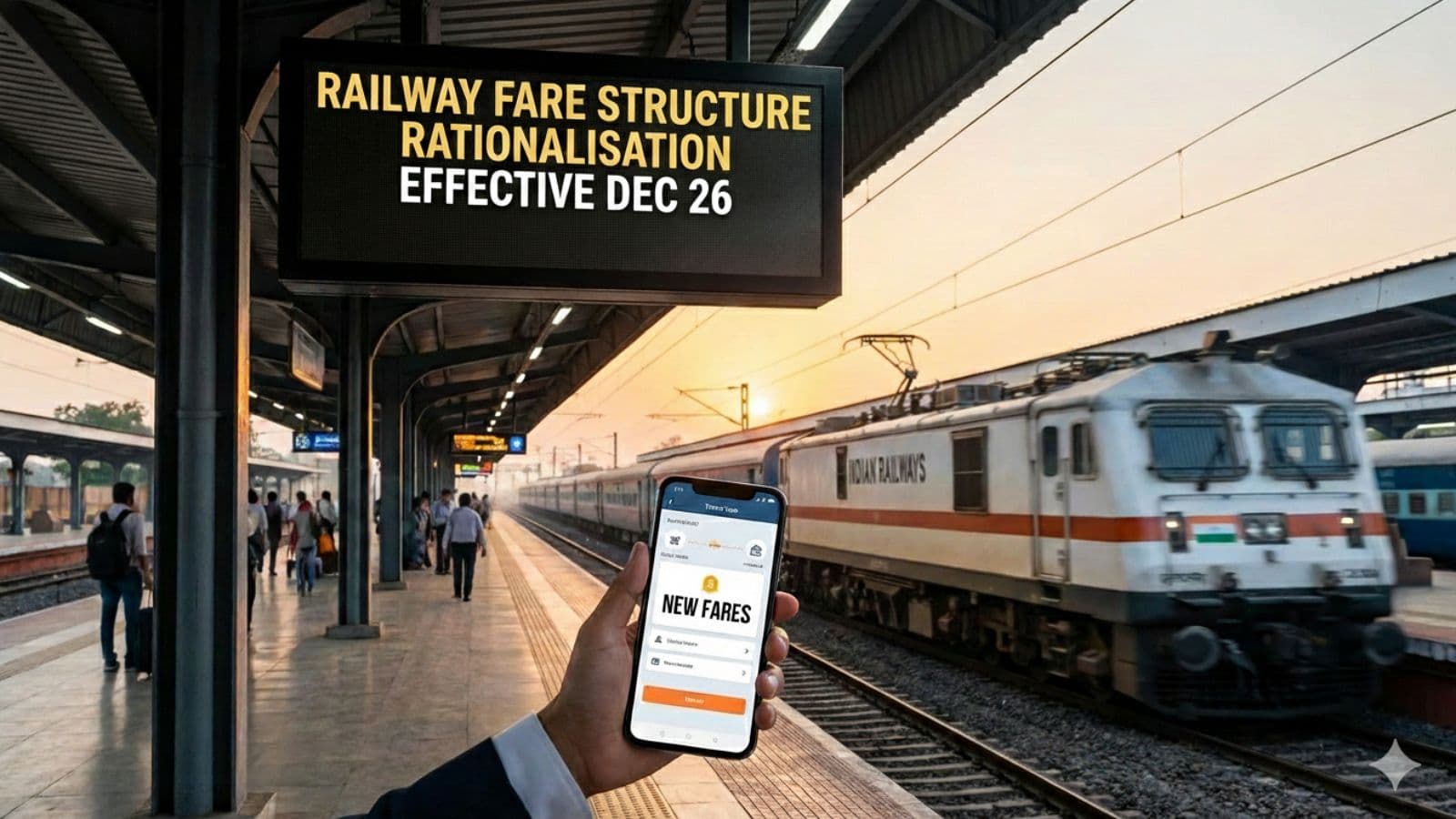
Railways hikes fares from Dec 26; non-AC passengers pay Rs 10 extra for 500 km.
Summary
Indian Railways has announced a fare rationalisation, leading to a hike effective from December 26. Non-AC passengers will now incur an additional charge of Rs 10 for journeys covering up to 500 km. This policy change is significant for competitive exams as it reflects government decisions impacting public transport, economic policy, and the daily lives of millions of commuters across India.
Key Points
- 1Indian Railways announced a fare hike effective from December 26.
- 2The fare change is termed as 'rationalisation of fares' by the Railways.
- 3Non-AC passengers will be required to pay an additional Rs 10.
- 4The extra charge of Rs 10 applies to journeys covering a distance of up to 500 km.
- 5The decision impacts a large segment of train travelers across the country.
In-Depth Analysis
Indian Railways, often termed the "lifeline of the nation," plays an indispensable role in India's economic and social fabric, connecting remote corners and facilitating the movement of millions of passengers and vast quantities of freight daily. The announcement of a fare rationalisation, effective from December 26, is a strategic move reflecting the government's ongoing efforts to balance the social obligations of a public utility with the economic realities of maintaining and modernising a vast railway network. This specific change, where non-AC passengers incur an additional Rs 10 for journeys up to 500 km, while seemingly minor, underscores broader policy shifts.
The background to such fare adjustments is rooted in the perennial financial challenges faced by Indian Railways. Despite being one of the world's largest railway networks, it has historically struggled with a high operating ratio (expenses as a percentage of revenue), often exceeding 95%, indicating thin margins. This is exacerbated by the cross-subsidisation model, where freight revenues largely subsidise passenger fares, particularly in the unreserved and non-AC segments. The need for significant capital investment in infrastructure upgrades, safety enhancements, electrification, and introduction of modern trains like Vande Bharat necessitates robust revenue streams. Previous committees and expert groups have consistently recommended rationalising fares to reflect the actual cost of services and to generate resources for development.
What precisely happened was a targeted fare adjustment. The term 'rationalisation' implies an effort to align fares more closely with the cost of service delivery, or to simplify the fare structure. While the headline focuses on the Rs 10 hike for non-AC passengers for distances up to 500 km, such adjustments are part of a broader strategy to optimise revenue. While the specific details of the full 'rationalisation' are not available in the quick summary, such moves often aim to reduce the financial burden on the exchequer and enable self-sufficiency for the Railways.
Key stakeholders in this decision are numerous. First and foremost is the **Ministry of Railways** and the **Indian Railways Board**, which conceptualises and implements such policy changes. Their objective is to ensure the financial viability and operational efficiency of the railway system. The **Government of India** provides overall policy direction, often balancing economic imperatives with political and social considerations. **Commuters**, especially the vast majority who rely on non-AC coaches and often belong to lower-income groups, are directly impacted. While Rs 10 might seem small, for daily wage earners or frequent travellers, it adds to the cost of living. **Freight operators and industries** are indirectly affected, as fare policies for passengers can influence the overall financial health of the Railways, potentially impacting freight rates in the long run. **Railway employees and unions** also have a stake, as the financial health of the organisation directly impacts their welfare and future prospects.
The significance for India is multi-faceted. Economically, even a small hike across millions of passengers can generate substantial revenue, which is crucial for funding ongoing and planned projects, reducing dependency on budgetary support, and improving the operating ratio. Socially, such hikes, especially in non-AC segments, raise concerns about affordability and accessibility for the common person, potentially increasing the burden on vulnerable sections. Politically, fare hikes are often sensitive, as they directly affect a large electorate. From a governance perspective, this move reflects a continued shift towards making public sector enterprises more self-reliant and commercially oriented, moving away from a purely welfare-centric model where services are heavily subsidised. This aligns with broader economic reforms aimed at fiscal prudence and infrastructure development.
Historically, railway fare policies have been a subject of intense debate. For decades, the Railway Budget was presented separately in Parliament, highlighting its distinct economic and social significance. This practice was discontinued in 2017, when the Railway Budget was merged with the General Budget, aiming for a more holistic approach to national finances and allowing for greater budgetary flexibility. The **Indian Railways Act, 1890**, along with subsequent amendments, forms the legal framework governing railway operations, including fare fixation, though specific fare decisions are executive functions. The subject of 'Railways' falls under **Entry 22 of the Union List** in the **Seventh Schedule of the Constitution of India**, underscoring the central government's exclusive legislative and executive powers over this vital infrastructure.
Future implications suggest a continued trajectory towards modernisation and financial sustainability. We can anticipate more targeted fare rationalisations, increased investment in high-speed rail corridors, dedicated freight corridors (DFCs), and station redevelopment through Public-Private Partnerships (PPPs). The focus will likely remain on improving passenger amenities, safety, and efficiency to justify future fare adjustments. The National Rail Plan 2030, which envisions making Indian Railways future-ready, self-sustainable, and capable of meeting freight and passenger demands, provides a roadmap for these changes. The balance between commercial viability and social equity will remain a critical challenge for policymakers, requiring careful calibration of fare policies and government subsidies.
Exam Tips
This topic falls under the 'Indian Economy' section of the UPSC Civil Services Exam (GS Paper III) and State PSCs, specifically under 'Infrastructure' and 'Government Budgeting & Fiscal Policy'. For SSC and Railway exams, it's relevant for General Awareness/Current Affairs.
Study related topics like the Indian Railway's Operating Ratio, the concept of cross-subsidisation, major railway infrastructure projects (e.g., Dedicated Freight Corridors, High-Speed Rail), and the National Rail Plan 2030. Also, understand the historical context of the Railway Budget merger with the General Budget.
Common question patterns include factual questions (e.g., 'When was the Railway Budget merged with the General Budget?', 'Which constitutional entry deals with Railways?'), analytical questions on the economic and social impact of fare hikes, and policy-oriented questions on the government's vision for railway modernisation and financial sustainability.