



Relevant for Exams
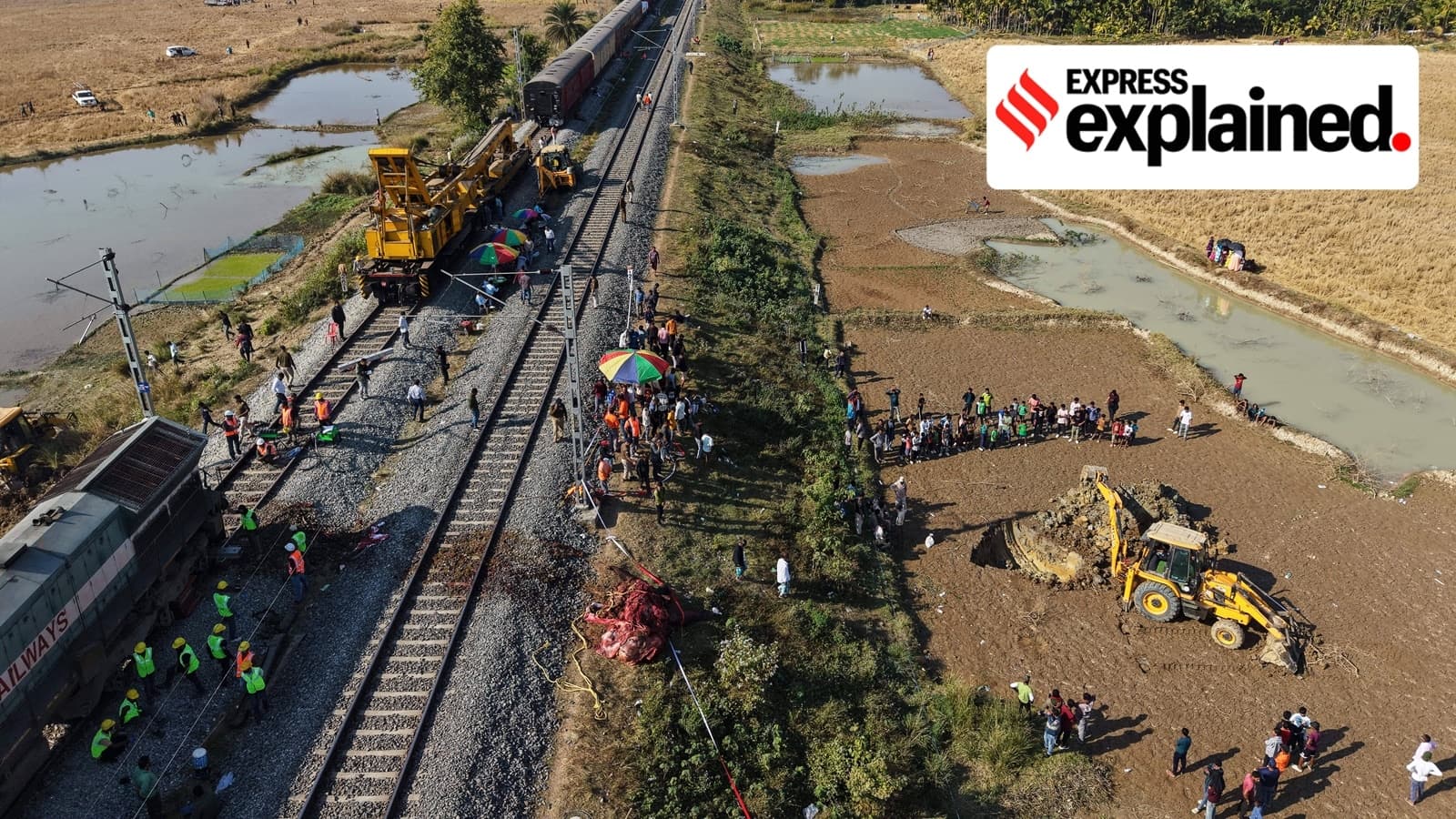
Seven elephants killed by train in Assam, raising concerns over wildlife safety and prevention strategies.
Summary
Seven elephants died in Assam after being hit by a train, highlighting the critical issue of human-wildlife conflict in railway corridors. This incident underscores the urgent need for robust prevention strategies, including habitat protection and inter-departmental coordination, to mitigate elephant mortality. For competitive exams, this event is significant for environment, geography, and infrastructure planning topics, emphasizing wildlife conservation and railway safety measures.
Key Points
- 1Seven elephants died in Assam due to a train collision, marking a significant wildlife fatality event.
- 2The incident highlights the critical issue of human-wildlife conflict, particularly concerning elephant movement across railway lines.
- 3Prevention strategies often involve identifying and securing elephant corridors and implementing train speed restrictions in such zones.
- 4Legal frameworks like the Wildlife (Protection) Act, 1972, are crucial for elephant conservation and habitat protection.
- 5The event underscores the importance of inter-departmental coordination between Forest and Railway Ministries for effective mitigation measures.
In-Depth Analysis
The tragic death of seven elephants in Assam due to a train collision serves as a stark reminder of the escalating human-wildlife conflict in India, particularly at the interface of critical wildlife habitats and rapidly expanding infrastructure. This incident is not isolated but part of a disturbing pattern, highlighting systemic challenges in conservation and development.
**Background Context and What Happened:** India is home to over 60% of the world's Asian elephant population, making their conservation crucial. However, rapid urbanization, industrialization, and expansion of linear infrastructure like railway lines and highways have led to severe habitat fragmentation and encroachment upon traditional elephant corridors. These corridors are vital pathways that elephants use for seasonal migration, foraging, and breeding, connecting larger forest patches. When these ancient routes are blocked or bisected by human development, elephants are forced to navigate through human-dominated landscapes, often leading to conflict. The recent incident in Assam, where a herd of elephants was struck by a speeding train, underscores this tragic reality. Assam, with its rich biodiversity and significant elephant population, frequently witnesses such unfortunate events due to railway lines passing through or adjacent to key elephant habitats and corridors.
**Key Stakeholders Involved:** The issue involves multiple critical stakeholders. The **Ministry of Environment, Forest and Climate Change (MoEFCC)**, along with state forest departments, is responsible for wildlife conservation, habitat protection, and implementing laws like the Wildlife (Protection) Act, 1972. The **Ministry of Railways** and its zonal divisions are responsible for the safe and efficient operation of trains, but also bear a responsibility to minimize their impact on wildlife. Local communities living near forest fringes and railway lines are often directly affected by human-wildlife interactions and play a crucial role in prevention and reporting. Non-governmental organizations (NGOs) and wildlife conservationists advocate for policy changes, conduct research, and implement on-ground mitigation measures.
**Why This Matters for India:** This issue holds immense significance for India. Firstly, elephants are a Schedule I species under the Wildlife (Protection) Act, 1972, granting them the highest level of protection. They are also India's National Heritage Animal and a keystone species, playing a vital role in maintaining forest ecosystems. Their deaths represent a significant loss to India's biodiversity. Secondly, these incidents highlight the broader challenge of balancing development with conservation. India's economic growth necessitates infrastructure development, but it must be sustainable and wildlife-friendly. Thirdly, human-wildlife conflict has social and economic repercussions, impacting local livelihoods, public safety, and sometimes leading to retaliatory killings. The global community also watches India's conservation efforts, as the Asian elephant is listed as 'Endangered' by the IUCN, and India is a signatory to international conventions like CITES and the Convention on Biological Diversity (CBD).
**Historical Context and Policy Response:** The problem of train-elephant collisions is not new. Over the past two decades, hundreds of elephants have died on railway tracks across India. In response, the Indian government launched **Project Elephant in 1992** to protect elephants, their habitat, and corridors, and to address human-elephant conflict. The MoEFCC and Ministry of Railways have collaborated to identify vulnerable stretches, impose speed restrictions in identified elephant corridors (often called 'Elephant Speed Zones'), install signages, build ramps, and clear vegetation along tracks. The **National Board for Wildlife (NBWL)**, a statutory body under the Wildlife (Protection) Act, 1972, plays a crucial advisory role in policy formulation and project clearances that may impact wildlife. Despite these efforts, effective implementation remains a challenge, often hampered by inter-departmental coordination gaps and funding issues.
**Related Constitutional Articles, Acts, and Future Implications:** The Indian Constitution implicitly supports environmental protection. **Article 48A** of the Directive Principles of State Policy mandates the state to 'endeavour to protect and improve the environment and to safeguard the forests and wildlife of the country.' Similarly, **Article 51A(g)**, a Fundamental Duty, enjoins every citizen 'to protect and improve the natural environment including forests, lakes, rivers and wildlife, and to have compassion for living creatures.' Beyond the Wildlife (Protection) Act, 1972, the **Forest (Conservation) Act, 1980**, regulates the diversion of forest land for non-forest purposes, which is crucial for protecting corridors. The **Environmental (Protection) Act, 1986**, also provides a framework for environmental safeguards.
Looking ahead, preventing such tragedies requires a multi-pronged approach. This includes enhanced technological solutions like thermal imaging cameras, AI-based early warning systems, and sensor-based intrusion detection along vulnerable stretches. Improved habitat management, including reforestation and securing existing corridors, is paramount. Better inter-ministerial coordination, with regular joint drills and shared data between the Forest and Railway Ministries, is essential. Furthermore, community engagement and awareness programs can foster a sense of shared responsibility. Ultimately, sustainable infrastructure planning that incorporates wildlife impact assessments from the initial stages, rather than as an afterthought, is the key to ensuring both development and conservation can coexist harmoniously in India.
Exam Tips
**UPSC CSE (General Studies Paper III - Environment & Ecology, Disaster Management):** Focus on the causes and consequences of human-wildlife conflict, specific conservation projects like Project Elephant, the role of constitutional provisions (Article 48A, 51A(g)), and legal frameworks (Wildlife Protection Act, 1972, Forest Conservation Act, 1980). Expect questions on policy measures, technological solutions, and inter-departmental coordination.
**SSC & State PSC Exams (General Awareness/Environmental Science):** Understand the basic facts of elephant conservation in India, the status of elephants (National Heritage Animal, Schedule I species), and major initiatives like Project Elephant. Questions might be direct, asking about the year Project Elephant was launched or the constitutional articles related to environmental protection.
**Railway & Defence Exams (General Knowledge/Environmental Awareness):** Pay attention to the specific challenges faced by the railway sector in wildlife zones, mitigation strategies implemented by Indian Railways (speed restrictions, signage), and the importance of safety measures for both humans and wildlife. Knowledge of key elephant corridors and vulnerable railway stretches can also be relevant.
**Common Question Patterns:** Expect questions in the form of case studies on human-wildlife conflict, analysis of government policies and their effectiveness, critical evaluation of mitigation strategies, and direct questions on relevant acts, articles, and projects. Practice writing answers that integrate constitutional, legal, and policy aspects with practical solutions.
**Related Topics to Study Together:** When studying this topic, concurrently review Project Elephant, the Wildlife (Protection) Act, 1972, different types of protected areas (National Parks, Wildlife Sanctuaries, Elephant Reserves), the concept of 'linear infrastructure' and its environmental impact, and the broader issue of climate change and habitat loss.