



Relevant for Exams
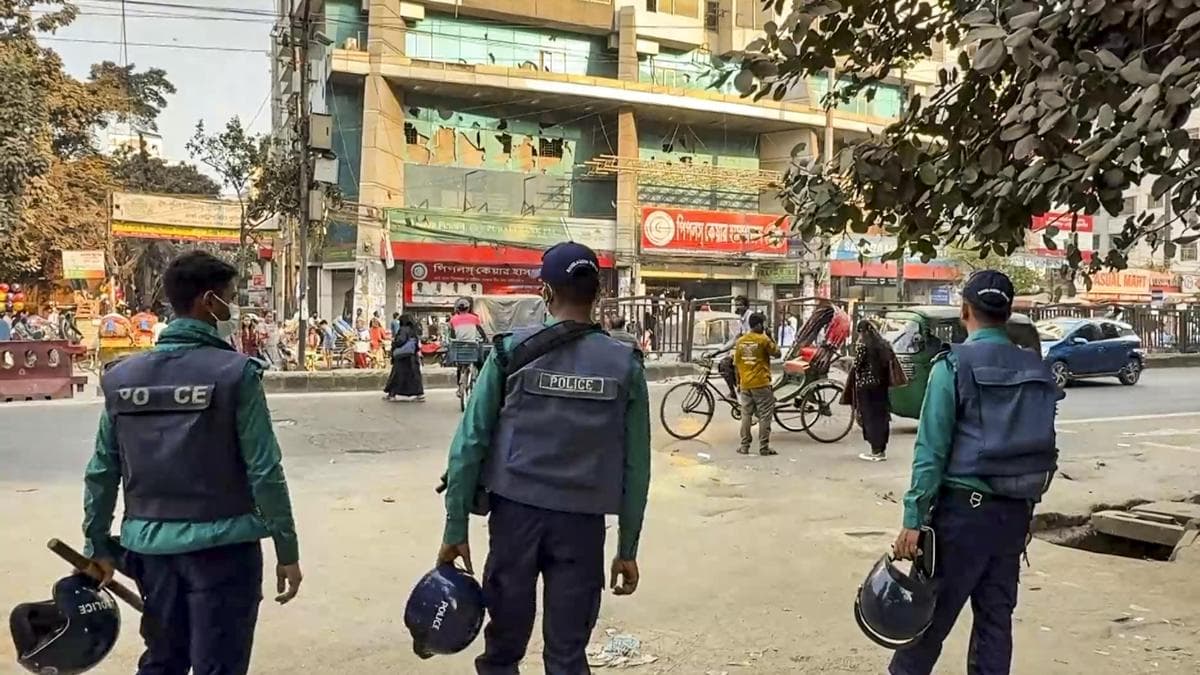
Security tightened at Indian mission and visa centre in Sylhet, Bangladesh, amid protests.
Summary
Security has been significantly enhanced at the Indian Assistant High Commission Office and its visa centre in Sylhet, Bangladesh. This measure was implemented amid ongoing protests in the region, with authorities aiming to prevent any third-party exploitation of the situation. While specific details of the protests are not provided, such incidents are relevant for understanding India-Bangladesh diplomatic relations and regional security dynamics for competitive exams.
Key Points
- 1Enhanced security measures were implemented at the Indian Assistant High Commission Office in Sylhet, Bangladesh.
- 2The security tightening also extends to the Indian visa centre located in Sylhet.
- 3The decision was taken amid ongoing protests in the region of Bangladesh.
- 4The stated purpose of the enhanced security is to ensure that "no third party can exploit the situation".
- 5The statement regarding the security measures was attributed to Saiful Islam, Additional Deputy Commissioner (Media) of the Sylhet Metropolitan Police.
In-Depth Analysis
The tightening of security at the Indian Assistant High Commission Office and its visa centre in Sylhet, Bangladesh, amid ongoing protests, is a critical incident that sheds light on the intricacies of India-Bangladesh bilateral relations and regional security dynamics. This precautionary measure, aimed at preventing "third-party exploitation," underscores the vulnerability of diplomatic missions during periods of local unrest and the host country's responsibility to ensure their safety.
To understand the full context, one must appreciate the deep historical ties between India and Bangladesh. India played a pivotal role in Bangladesh's War of Liberation in 1971, providing political, military, and humanitarian support that led to the birth of an independent nation. This shared history forms the bedrock of their relationship, often referred to as 'Sonali Adhyay' (Golden Chapter). However, despite this strong foundation, the relationship has faced periods of strain, influenced by domestic politics in both countries, border issues, water sharing disputes (like the Teesta River), and occasional anti-India sentiments fueled by certain groups within Bangladesh.
While the specific nature of the current protests in Sylhet is not detailed in the provided snippet, protests in Bangladesh can stem from a variety of socio-political and economic grievances. These might include local political rivalries, economic hardship, communal tensions, or even broader national issues. The statement by the Sylhet Metropolitan Police's Additional Deputy Commissioner (Media), Saiful Islam, about preventing "third-party exploitation" is significant. It suggests an apprehension that external elements, possibly extremist groups or those with vested interests in destabilizing India-Bangladesh relations, could hijack the protests to target Indian diplomatic facilities. Such incidents have historical precedents globally, where diplomatic missions become targets during local unrest, necessitating heightened security measures.
Key stakeholders in this situation include the Government of India, particularly the Ministry of External Affairs (MEA), which is responsible for the safety and security of its diplomatic personnel and missions abroad. The Indian Assistant High Commission in Sylhet is the primary on-ground representative. On the Bangladeshi side, the Government of Bangladesh, its law enforcement agencies like the Sylhet Metropolitan Police, and the local administration are crucial. They bear the primary responsibility, as per the Vienna Convention on Diplomatic Relations, 1961, to protect diplomatic missions and their staff from any intrusion or damage and to prevent any disturbance of the peace of the mission or impairment of its dignity. The protesting groups, though unspecified, are also stakeholders, as their actions directly necessitated the security response. The 'third parties' mentioned are potential spoilers, often non-state actors or hostile elements.
This incident matters significantly for India. Firstly, the security of its diplomatic missions and personnel is paramount. Any threat can undermine India's ability to conduct its foreign policy effectively. Secondly, Sylhet's geographical proximity to India's North-Eastern states (Assam and Meghalaya) means that instability in the region can have spillover effects, impacting border security and regional stability. Thirdly, Bangladesh is a cornerstone of India's 'Neighbourhood First' policy and a key partner in its 'Act East Policy'. Robust and stable relations with Bangladesh are vital for regional connectivity projects, trade, and energy cooperation. The visa centre, in particular, facilitates crucial people-to-people exchanges, including medical tourism, education, and business, which are vital components of the bilateral relationship. Any disruption there affects thousands of Indian and Bangladeshi citizens.
From a constitutional perspective, while there isn't a direct article governing the security of foreign missions, Article 51 of the Indian Constitution directs the state to 'endeavour to foster respect for international law and treaty obligations in the dealings of organized peoples with one another.' The Vienna Convention on Diplomatic Relations, 1961, which India is a signatory to, falls under these international treaty obligations. The MEA's operations are guided by the overall foreign policy objectives, which include ensuring the safety of Indian citizens and assets abroad.
Looking ahead, this event underscores the need for continuous vigilance and robust intelligence sharing between India and Bangladesh. It could lead to enhanced security cooperation protocols between the two nations to address potential threats from extremist elements or those aiming to disrupt bilateral ties. The incident serves as a reminder that while India-Bangladesh relations are strong, they are not immune to local disturbances or attempts by hostile actors to exploit such situations. Sustaining strong diplomatic engagement, promoting economic interdependence, and fostering cultural ties will be crucial in mitigating such risks and ensuring the long-term stability and growth of this vital partnership. The ability of the Bangladeshi authorities to swiftly and effectively manage such protests and protect foreign missions will be a test of their commitment to international obligations and bilateral friendship.
In conclusion, the security enhancement in Sylhet is more than a mere law and order situation; it's a barometer of the underlying socio-political climate in Bangladesh and a critical point of attention for India's foreign policy and regional security strategy. It highlights the constant need for diplomatic vigilance and robust security cooperation in a complex geopolitical landscape.
Exam Tips
This topic falls under the 'International Relations' and 'Internal Security' sections of UPSC Civil Services Exam (General Studies Paper-II and Paper-III respectively), and similar sections for State PSCs and SSC CGL. Focus on India's foreign policy objectives.
Study related topics such as India's 'Neighbourhood First' policy, 'Act East Policy', India-Bangladesh bilateral agreements (e.g., Land Boundary Agreement, Teesta water dispute), and the role of diplomatic missions (e.g., Vienna Convention on Diplomatic Relations, 1961).
Expect questions on the significance of Bangladesh for India's regional strategy, challenges in India-Bangladesh relations, and the role of international conventions in diplomatic protection. Factual questions on border states or key projects might also appear.
Related Topics to Study
Full Article
The enhanced security measures were put in place to ensure that "no third party can exploit the situation", Additional Deputy Commissioner (Media) of the Sylhet Metropolitan Police Saiful Islam was quoted as saying