



Relevant for Exams
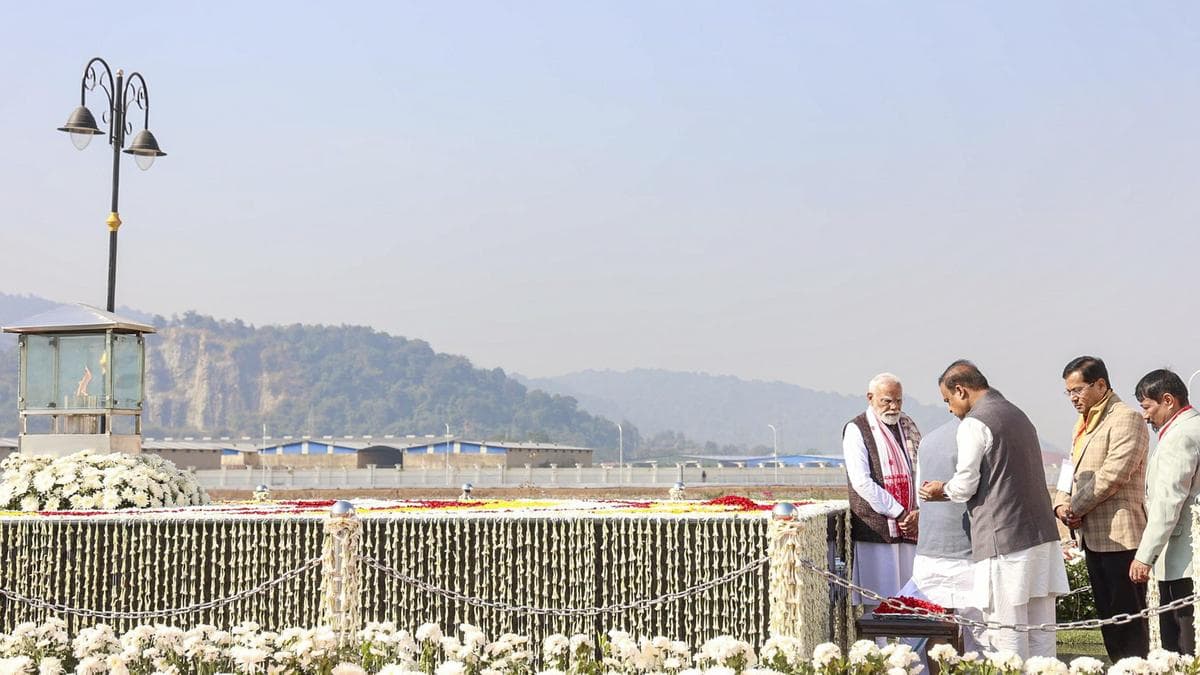
PM pays tribute to Assam Agitation martyrs at new Guwahati memorial, honoring first martyr Khargeswar Talukdar.
Summary
Prime Minister paid tribute to the martyrs of the Assam Agitation at a newly inaugurated memorial in Guwahati. This event highlights the historical significance of the Assam Agitation (1979-1985) for competitive exams, particularly its causes, key figures, and the Assam Accord. The memorial's inauguration coincided with the death anniversary of Khargeswar Talukdar, recognized as the agitation's first martyr, making it relevant for history and current affairs sections.
Key Points
- 1Prime Minister paid tribute to the martyrs of the Assam Agitation.
- 2The tribute was made at a memorial located in Guwahati.
- 3The memorial was inaugurated earlier this month.
- 4Its inauguration coincided with the death anniversary of Khargeswar Talukdar.
- 5Khargeswar Talukdar is recognized as the first martyr of the Assam Agitation.
In-Depth Analysis
The recent tribute paid by the Prime Minister to the martyrs of the Assam Agitation at a newly inaugurated memorial in Guwahati serves as a poignant reminder of a pivotal movement in India's post-independence history. This act not only honors those who sacrificed their lives but also underscores the enduring significance of the issues that fueled the agitation from 1979 to 1985. For competitive exam aspirants, understanding this period is crucial, as it touches upon themes of federalism, citizenship, regional identity, and ethnic harmony.
The Assam Agitation, often termed the 'Anti-Foreigners Movement', was a six-year-long civil disobedience movement driven by the indigenous Assamese population's deep-seated anxieties over large-scale illegal immigration from Bangladesh (then East Pakistan). The background to this agitation is rooted in historical demographic shifts. Following the Partition of India in 1947, and more significantly after the 1971 Bangladesh Liberation War, Assam experienced a massive influx of migrants, primarily from East Pakistan/Bangladesh. This immigration led to fears among the Assamese of losing their cultural, linguistic, and political identity, coupled with concerns about economic marginalization and pressure on land and resources. The discovery of a large number of foreign nationals on the electoral rolls in the Mangaldoi Lok Sabha constituency in 1979 ignited the agitation, spearheaded by the All Assam Students' Union (AASU) and the All Assam Gana Sangram Parishad (AAGSP).
What happened during the agitation was a sustained period of protests, bandhs, satyagrahas, and boycotts, often peaceful but sometimes turning violent. The primary demand was the detection, deletion of names from electoral rolls, and deportation of all illegal immigrants who entered Assam after 1951. The movement saw immense public participation, particularly from students and youth, and resulted in significant disruption to normal life. Khargeswar Talukdar, recognized as the first martyr, symbolized the sacrifices made during this turbulent period, becoming a rallying figure for the cause.
Key stakeholders involved included the indigenous Assamese population, represented primarily by AASU and AAGSP, who articulated the grievances and led the movement. The Central Government of India, under various Prime Ministers during this period (Morarji Desai, Charan Singh, Indira Gandhi, Rajiv Gandhi), was a crucial stakeholder, tasked with finding a resolution. The immigrant communities, both documented and undocumented, were also directly affected, often becoming targets of suspicion and hostility. Regional and national political parties played complex roles, some supporting the agitation's demands, others opposing them or seeking political mileage.
The significance of the Assam Agitation for India is multifaceted. Politically, it highlighted the challenges of managing internal migration and identity politics within a federal structure. It eventually led to the signing of the Assam Accord on August 15, 1985, between the Central Government, the Assam State Government, and the leaders of the agitation. The Accord set March 25, 1971, as the cut-off date for the detection and deportation of illegal immigrants, promised economic development for Assam, and provided safeguards for the cultural, social, and linguistic identity of the Assamese people. Socially, the agitation brought to the forefront tensions between different ethnic and linguistic groups, demonstrating the fragility of social cohesion when demographic shifts are perceived as threats. Economically, the prolonged period of unrest severely impacted Assam's development.
Historically, the Assam Agitation is a direct consequence of the unresolved issues of Partition and the subsequent geopolitical events in the subcontinent. The Citizenship Act, 1955, and its subsequent amendments, including the provisions introduced by the Assam Accord, are central to understanding the legal framework. The Illegal Migrants (Determination by Tribunals) Act, 1983 (IMDT Act), enacted specifically for Assam, made it difficult to deport illegal immigrants and was widely resented by the agitators. The Supreme Court declared the IMDT Act unconstitutional in 2005, a landmark judgment that acknowledged the concerns of the Assamese people. Constitutional provisions like Article 6 (citizenship at the commencement of the Constitution), Article 19 (freedom of movement and residence, subject to reasonable restrictions), and Article 29 (protection of interests of minorities, also interpreted to protect indigenous groups) are relevant. Furthermore, the Sixth Schedule, which provides for autonomous administrative divisions in certain tribal areas of Assam, reflects the constitutional recognition of diverse regional identities.
The future implications of the Assam Agitation continue to shape policy and politics in India. The updating of the National Register of Citizens (NRC) in Assam, mandated by the Supreme Court, is a direct outcome of the Accord's promise to identify illegal immigrants. The Citizenship (Amendment) Act, 2019 (CAA), which seeks to grant citizenship to non-Muslim persecuted minorities from Pakistan, Bangladesh, and Afghanistan, has also stirred debates in Assam, with many fearing it might undermine the Assam Accord's cut-off date and further alter the state's demography. The challenge of border management, ensuring ethnic harmony, and balancing the rights of indigenous populations with humanitarian concerns for migrants remain critical issues for India, particularly in its northeastern region. The memorial serves as a constant reminder of the complex interplay of history, identity, and governance that defines this sensitive region.
Exam Tips
This topic falls under Indian History (Post-Independence), Indian Polity (Citizenship, Federalism), and Current Affairs (NRC, CAA). Understand the chronology of events from 1971 to the present day.
Focus on key acts and agreements: Assam Accord (1985), Citizenship Act (1955) and its amendments, and the repeal of the IMDT Act (2005). Memorize the cut-off date of March 25, 1971.
Be prepared for questions on the causes and consequences of the agitation, the demands of the agitators, key figures (like Khargeswar Talukdar), and the provisions of the Assam Accord. Also, understand the connection between the Assam Agitation, NRC, and CAA.
Study the roles of key stakeholders like AASU, AAGSP, and the Supreme Court. Questions might test your understanding of their objectives and impact.
Analyze the broader themes: regionalism, identity politics, federal-state relations, and immigration challenges. Comparative questions with other regional movements in India are possible.
Related Topics to Study
Full Article
The memorial was inaugurated earlier this month, coinciding with the death anniversary of Khargeswar Talukdar, the first martyr of the Assam Agitation