



Relevant for Exams
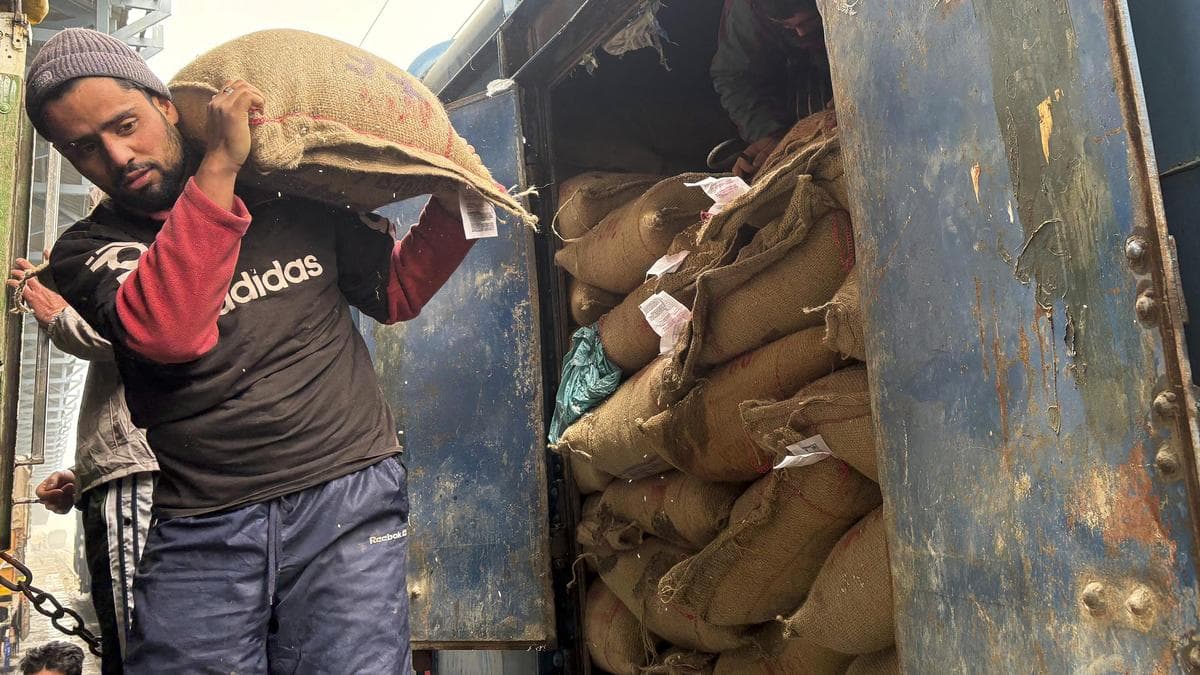
FCI freight train delivers 1,384 tonnes of foodgrains to Kashmir, a first for rail logistics.
Summary
In a significant development, a Food Corporation of India (FCI) freight train delivered 1,384 tonnes of foodgrains to the Kashmir Valley, marking a first-of-its-kind rail-based logistics operation. This initiative is crucial for enhancing food security and improving supply chain efficiency in the region, especially given the challenging terrain. It signifies a major milestone for infrastructure development and connectivity, relevant for questions on regional logistics and government initiatives.
Key Points
- 1A Food Corporation of India (FCI) freight train delivered foodgrains to the Kashmir Valley for the first time.
- 2The train transported a total of 1,384 tonnes of foodgrains.
- 3This event was termed a 'major milestone for rail-based logistics in the Kashmir Valley' by an FCI spokesman.
- 4The initiative aims to enhance food security and streamline supply chain operations in the region.
- 5The Food Corporation of India (FCI) is the government agency responsible for this logistics operation.
In-Depth Analysis
The arrival of an FCI freight train carrying 1,384 tonnes of foodgrains in the Kashmir Valley marks a truly significant moment for India's logistics, food security, and national integration efforts. Termed a "major milestone" by an FCI spokesman, this event is not merely about a train carrying food; it symbolizes the overcoming of decades-long geographical challenges and the realization of a long-cherished dream of seamless connectivity to the region.
Historically, the Kashmir Valley has faced formidable challenges in terms of connectivity. Its mountainous terrain, especially the Pir Panjal range, and harsh winter conditions often led to the closure of the primary road link, National Highway 44 (NH-44), which is vital for transporting essential supplies. This dependence on a single, often unreliable, road link has historically resulted in supply chain disruptions, price volatility, and concerns over food security for the local population. For decades, the vision of an all-weather rail link to Kashmir remained a complex engineering and strategic ambition, fraught with technical difficulties and immense costs.
The key to this breakthrough lies in the Udhampur-Srinagar-Baramulla Rail Link (USBRL) project. Conceived in 1997 and declared a 'National Project' in 2002, the USBRL is an engineering marvel designed to connect Kashmir with the rest of India's railway network. While sections like Banihal-Baramulla were operational for passenger services within the valley, the crucial Katra-Banihal section, involving numerous tunnels and bridges through treacherous terrain, was the missing link. The recent completion and operationalization of significant portions of this project, including the world's highest railway bridge over the Chenab River and extensive tunneling, have finally made the dream of direct rail freight connectivity a reality. This particular freight train utilized the newly completed sections, allowing it to reach the valley directly.
Several key stakeholders are integral to this development. The **Food Corporation of India (FCI)**, established under the Food Corporations Act, 1964, is the nodal agency for procurement, storage, and distribution of foodgrains under various government schemes, including the Public Distribution System (PDS). Their role was crucial in ensuring the timely dispatch and delivery of the foodgrains. The **Indian Railways**, through its various construction arms and operational divisions, is the primary executor of the USBRL project and the logistics provider for the freight movement. The **Ministry of Consumer Affairs, Food & Public Distribution** oversees the FCI, while the **Government of Jammu & Kashmir (UT Administration)** plays a vital role in local coordination for distribution and last-mile connectivity. Ultimately, the **citizens of Kashmir** are the primary beneficiaries, gaining improved access to essential food supplies.
This event carries immense significance for India. Firstly, it substantially enhances **food security** in the Kashmir Valley. By providing an all-weather, reliable, and cost-effective mode of transport, it reduces dependence on the vulnerable NH-44, ensuring consistent availability of foodgrains, especially during adverse weather conditions. This aligns with the principles of the **National Food Security Act (NFSA), 2013**, which guarantees access to adequate quantities of quality food at affordable prices, recognizing food as a legal right. Secondly, it fosters greater **economic integration and development**. Reduced logistics costs mean lower prices for essential commodities and better market access for local produce like horticulture and handicrafts, boosting the regional economy. Thirdly, it strengthens **national unity and strategic importance**. An integrated rail network reduces the sense of isolation and contributes to mainstreaming the region, while also offering strategic advantages for military logistics and disaster response. The project also exemplifies India's prowess in infrastructure development under challenging conditions, aligning with broader initiatives like PM Gati Shakti.
Constitutionally, the state's obligation to ensure food security can be linked to **Article 21 (Right to Life)**, which has been interpreted by the Supreme Court to include the right to live with human dignity, encompassing the right to food. Furthermore, the **Directive Principles of State Policy (DPSP)**, particularly **Article 39(a)**, which directs the state to secure for all citizens the right to an adequate means of livelihood, and **Article 47**, which mandates the state to raise the level of nutrition and the standard of living, underscore the government's responsibility. The establishment and functioning of FCI are governed by the **Food Corporations Act, 1964**, derived from the Union's legislative power over
Exam Tips
This topic falls under GS Paper III (Economy: Infrastructure, Food Security, Logistics) and GS Paper I (Geography: Transport, Resources) for UPSC. For SSC/Banking/Railway exams, focus on factual aspects related to FCI, Indian Railways, and the USBRL project.
Study related topics such as the National Food Security Act (NFSA) 2013, Public Distribution System (PDS), the role of FCI, major infrastructure projects (e.g., Dedicated Freight Corridors, PM Gati Shakti), and the Udhampur-Srinagar-Baramulla Rail Link (USBRL) in detail.
Expect questions on the strategic importance of the USBRL project, the challenges of infrastructure development in mountainous regions, the impact of improved connectivity on regional economies (especially J&K), and the government's efforts towards food security and logistics efficiency. Factual questions might include the year FCI was established or key features of NFSA.
Understand the constitutional provisions related to food security (Article 21, DPSP Articles 39(a), 47) and the legislative backing for bodies like FCI (Food Corporations Act, 1964) and railways (Seventh Schedule, Union List).
Prepare for analytical questions on how such infrastructure projects contribute to national integration, economic growth, and address regional disparities. Link it to broader themes of governance and sustainable development.
Related Topics to Study
Full Article
An FCI spokesman termed it as “a major milestone for rail-based logistics in the Kashmir Valley”.