



Relevant for Exams
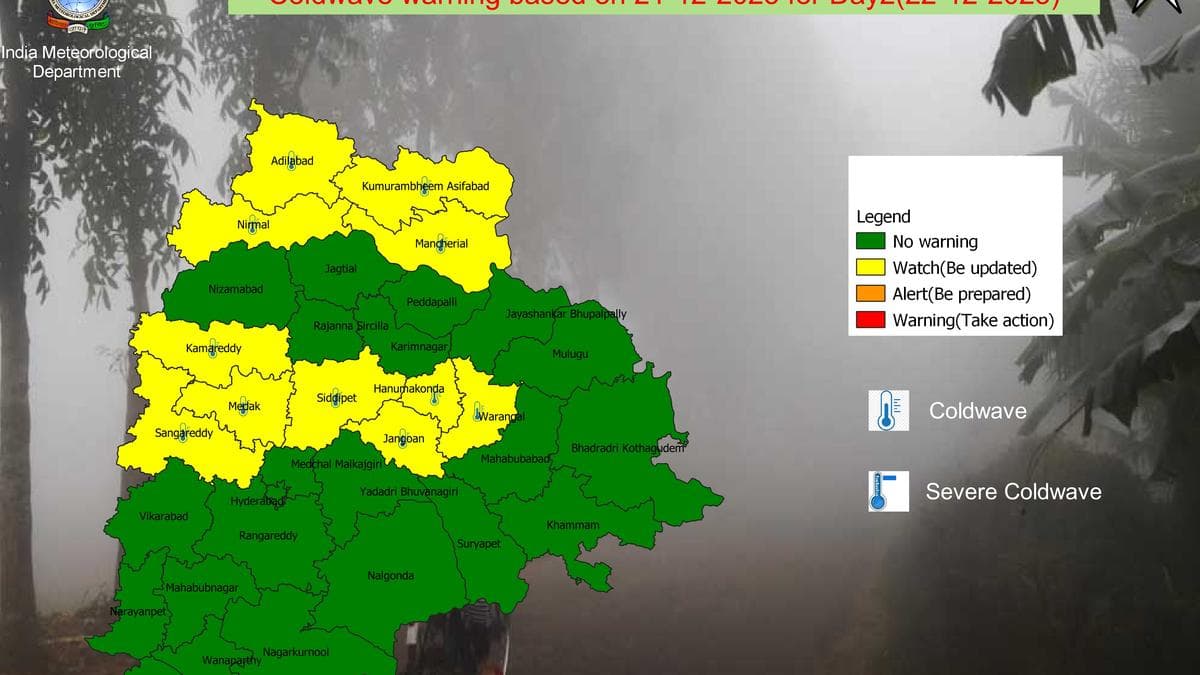
Cold wave alert in 11 Telangana districts on Dec 22; 14 districts already below 10°C.
Summary
Telangana issued a cold wave alert for 11 of its districts on December 22, 2023, based on data indicating significant temperature drops. Between December 20 and 21, 14 out of the state's 33 districts recorded temperatures below 10°C, according to the Telangana Development Planning Society (TGDPS). This event is relevant for competitive exams as general awareness, particularly for state-specific facts, geographical information, and the role of state planning bodies in disaster preparedness.
Key Points
- 1A cold wave alert was issued for 11 districts in Telangana.
- 2The cold wave alert was specifically for December 22.
- 3Between December 20 and 21, 14 out of 33 districts in Telangana recorded temperatures below 10°C.
- 4The data for the cold wave alert was provided by the Telangana Development Planning Society (TGDPS).
- 5Telangana comprises a total of 33 districts.
In-Depth Analysis
The cold wave alert issued for 11 districts in Telangana on December 22, 2023, with 14 out of 33 districts recording temperatures below 10°C between December 20 and 21, highlights a significant meteorological event with broader implications for India. While cold waves are common in North India during winter, their increasing intensity and reach into peninsular states like Telangana underscore evolving climate patterns and the critical need for robust disaster preparedness.
**Background Context:**
Cold waves in India are primarily influenced by the southward movement of cold, dry air masses originating from the Himalayas and Central Asia, often intensified by Western Disturbances. The India Meteorological Department (IMD) defines a cold wave as a condition where the minimum temperature is 4.5°C to 6.4°C below normal, or the minimum temperature drops below 4.5°C in plains. For Telangana, a southern state generally experiencing milder winters, temperatures consistently below 10°C, especially across a significant number of districts, represent a deviation from the norm. This particular event in December 2023, a month typically marking the onset of winter, indicates a stronger-than-usual cold air intrusion or prolonged clear sky conditions aiding radiative cooling.
**What Happened and Key Stakeholders:**
According to data from the Telangana Development Planning Society (TGDPS), a state-level body responsible for planning and development, 14 of Telangana's 33 districts experienced minimum temperatures below 10°C. This prompted a cold wave alert for 11 specific districts. The TGDPS, by collecting and analyzing real-time meteorological data, played a crucial role in providing the scientific basis for the alert. Other key stakeholders include the India Meteorological Department (IMD), which provides national and regional forecasts and issues advisories. The State Disaster Management Authority (SDMA) and district administrations are responsible for translating these alerts into actionable measures, such as issuing public advisories, preparing for health emergencies, and ensuring relief for vulnerable populations. The state's Health Department and Agriculture Department also become critical in managing the health impacts and advising farmers on protecting crops and livestock.
**Significance for India:**
This event carries significant implications across various sectors in India. **Public Health** is a primary concern, as prolonged exposure to low temperatures can lead to hypothermia, frostbite, and exacerbate respiratory illnesses, especially among the elderly, children, and homeless populations. **Agriculture**, a backbone of India's economy, is also vulnerable. While some rabi crops might benefit from the cold, others, particularly sensitive horticultural crops, can suffer frost damage, leading to economic losses for farmers. The **economy** can be indirectly affected by disruptions in daily life, reduced outdoor work, and increased energy demand for heating. More broadly, such extreme weather events highlight India's vulnerability to **climate change**. Scientists predict an increase in the frequency and intensity of extreme weather phenomena, including both heatwaves and cold waves, making robust **disaster preparedness and climate adaptation strategies** indispensable for all states.
**Constitutional and Policy Framework:**
The response to such events is guided by India's constitutional and policy framework. **Public health and sanitation, agriculture, and relief of the disabled and unemployed** fall under the State List (Entry 6, 14, 28) of the Seventh Schedule, making state governments primarily responsible for managing the local impact of cold waves. The **Directive Principles of State Policy (DPSP)**, particularly Article 47, which mandates the State to raise the level of nutrition and the standard of living and to improve public health, and Article 48A, focusing on the protection and improvement of the environment, provide guiding principles for state action. Operationally, the **Disaster Management Act, 2005**, provides the legal framework for disaster management in India, establishing the National Disaster Management Authority (NDMA) at the national level and State Disaster Management Authorities (SDMAs) and District Disaster Management Authorities (DDMAs) at state and district levels. These bodies are tasked with developing disaster management plans, capacity building, and coordinating response and relief efforts.
**Future Implications:**
The Telangana cold wave underscores the need for enhanced **early warning systems** that are more precise and localized, leveraging advanced meteorological forecasting and remote sensing technologies. States must strengthen their **disaster management infrastructure**, including shelters, medical facilities, and communication networks, particularly in regions not traditionally prone to severe cold. Developing **climate-resilient agricultural practices** and crop varieties becomes crucial for farmers. Furthermore, continuous **public awareness campaigns** are essential to educate citizens on preventive measures during cold waves. As India grapples with the escalating impacts of climate change, these localized extreme weather events serve as critical reminders for integrated, multi-sectoral approaches to build resilience and protect lives and livelihoods across the nation.
Exam Tips
**Geography & Environment (UPSC Mains GS-I, GS-III; State PSCs):** Focus on meteorological phenomena like cold waves, Western Disturbances, and the role of topography. Understand the impact of climate change on extreme weather events.
**Current Affairs & State-Specific GK (State PSCs, SSC, Railway):** Be aware of specific details like the number of districts affected, temperatures, and the names of relevant state agencies (e.g., Telangana Development Planning Society). Questions can test factual knowledge.
**Disaster Management (UPSC Mains GS-III):** Study the Disaster Management Act, 2005, and the institutional framework (NDMA, SDMA, DDMA). Understand the steps involved in disaster preparedness, mitigation, and response, and the roles of various stakeholders.
**Indian Polity & Governance (UPSC Prelims/Mains GS-II; State PSCs):** Familiarize yourself with the Seventh Schedule (State List entries related to public health, agriculture, disaster relief) and Directive Principles of State Policy (e.g., Article 47, 48A) that guide state action in such scenarios.
**Essay Writing (UPSC Mains, State PSCs):** This topic can be a part of an essay on climate change impacts, disaster preparedness in India, or public health challenges, allowing you to demonstrate a comprehensive understanding of interconnected issues.
Related Topics to Study
Full Article
According to data from Telangana Development Planning Society (TGDPS), between December 20 and 21, a total of 14 out of 33 districts recorded temperatures below 10°C