



Relevant for Exams
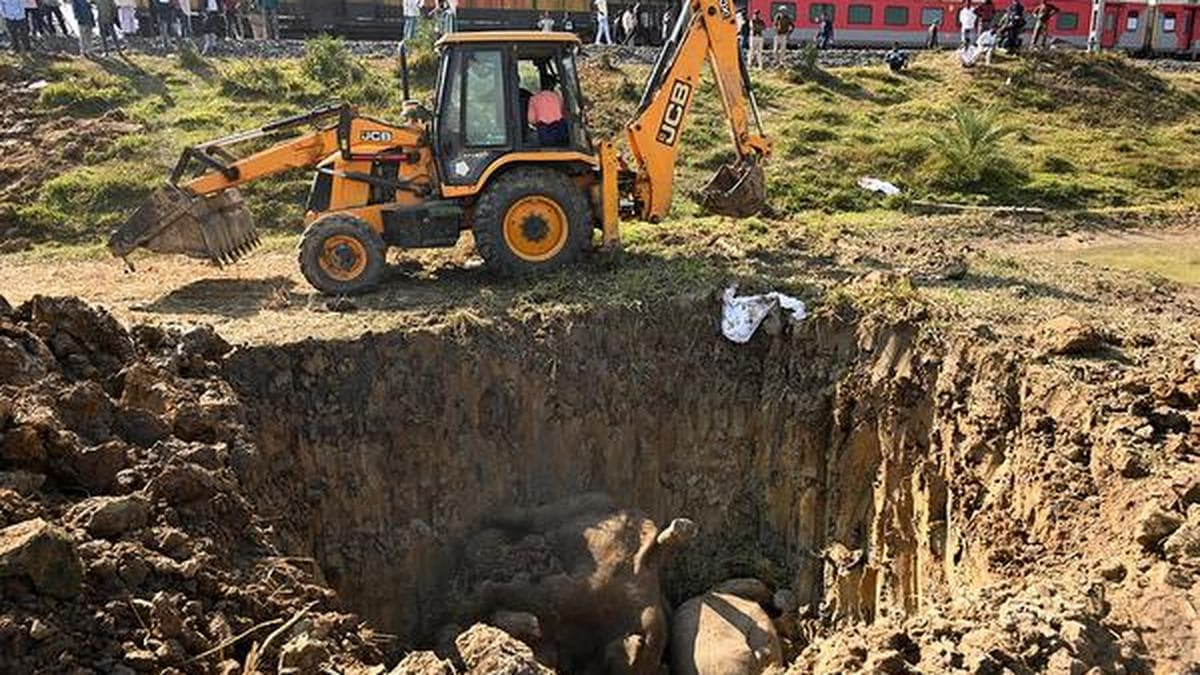
Centre seeks report on elephant deaths on railway tracks in Assam's Hojai; states to monitor movement.
Summary
The Centre, through Union Minister Bhupender Yadav, has sought a report regarding the death of elephants on railway tracks in Assam's Hojai district. This action highlights the ongoing human-wildlife conflict, particularly concerning elephants and railway infrastructure. All states have been directed to monitor elephant movement along railway tracks, emphasizing the government's focus on mitigating such incidents and promoting wildlife conservation, which is crucial for environmental sections in competitive exams.
Key Points
- 1Union Minister Bhupender Yadav sought a report on elephant deaths.
- 2The report pertains to incidents of elephant deaths on railway tracks.
- 3The specific location mentioned for elephant deaths is Hojai, Assam.
- 4All States have been directed by the Centre to monitor elephant movement.
- 5Elephant movement monitoring is specifically required along railway tracks.
In-Depth Analysis
The Union Minister for Environment, Forest and Climate Change, Bhupender Yadav, seeking a report on elephant deaths on railway tracks in Assam's Hojai district is a stark reminder of the escalating human-wildlife conflict in India. This incident, while localized, represents a pervasive national challenge, particularly concerning the conservation of India's iconic Asian elephants.
**Background Context and What Happened:**
India is home to the largest population of Asian elephants, accounting for approximately 60% of the species' global wild population. However, their habitats are increasingly fragmented and encroached upon by human development. The expansion of linear infrastructure like railway lines and highways through crucial elephant corridors and forest areas has become a significant threat. Elephants, being migratory animals, often follow traditional routes for food and water. When these routes intersect with railway tracks, the consequences can be fatal. The specific incident in Hojai, Assam, where elephants were killed on railway tracks, is not an isolated event. Such tragedies are regularly reported from various elephant range states, including West Bengal, Odisha, Uttarakhand, and Tamil Nadu. Despite numerous guidelines and interventions over the years, the problem persists, highlighting systemic issues in safeguarding these magnificent creatures.
**Historical Context and Significance for India:**
The issue of elephants being killed by trains dates back decades. Project Elephant, launched in 1992 by the Government of India, aimed at providing financial and technical support to elephant range states for the protection of elephants, their habitats, and corridors. However, rapid infrastructure development, often without adequate environmental impact assessments or mitigation measures, has continued to put pressure on wildlife. The loss of elephants is not merely a conservation concern; it has profound ecological, social, and economic implications for India. Elephants are a keystone species, playing a crucial role in maintaining forest ecosystems through seed dispersal and habitat modification. Their decline impacts biodiversity and ecological balance. Socially, human-elephant conflict leads to loss of human lives, crop damage, and property destruction, fueling resentment among local communities. Economically, such incidents can affect eco-tourism and demonstrate a failure in sustainable development practices. India, as a signatory to international conventions like CITES (Convention on International Trade in Endangered Species of Wild Fauna and Flora), has a global responsibility to protect its biodiversity.
**Key Stakeholders Involved:**
Several entities are directly involved in addressing this challenge. The **Ministry of Environment, Forest and Climate Change (MoEFCC)**, headed by Minister Bhupender Yadav, is the primary policymaking and regulatory body for wildlife conservation. Its role involves setting guidelines, providing funding, and coordinating with states. The **Ministry of Railways** is a critical stakeholder, as railway infrastructure is directly responsible for many elephant deaths. Their cooperation is essential in implementing speed restrictions, creating underpasses/overpasses, and installing early warning systems. **State Forest Departments** (like the Assam Forest Department in this case) are on the front lines, responsible for monitoring elephant movements, managing habitats, and responding to incidents. **Local communities** living near forests and railway lines are also key, as their awareness and cooperation are vital for effective mitigation. Finally, **Wildlife Conservation NGOs and Experts** play a crucial role in research, advocacy, and providing technical support for conservation efforts.
**Related Constitutional Articles, Acts, and Policies:**
India's commitment to wildlife protection is enshrined in its Constitution and various acts. The **Wildlife (Protection) Act, 1972**, is the cornerstone of wildlife conservation in India. Asian elephants are listed under Schedule I of this Act, granting them the highest level of legal protection. Furthermore, **Article 48A** of the Directive Principles of State Policy mandates that "The State shall endeavour to protect and improve the environment and to safeguard the forests and wild life of the country." This is complemented by **Article 51A(g)**, a Fundamental Duty, which states that it shall be the duty of every citizen of India "to protect and improve the natural environment including forests, lakes, rivers and wild life, and to have compassion for living creatures." Beyond these, specific policies like **Project Elephant (1992)** and the **National Wildlife Action Plan** provide frameworks for conservation. The Railway Board has also issued guidelines, including speed restrictions in identified elephant corridors and the construction of ramps and underpasses.
**Future Implications:**
The Centre's directive for all states to monitor elephant movement along railway tracks signifies a renewed focus on this critical issue. Future strategies must involve a multi-pronged approach: enhanced inter-ministerial coordination (MoEFCC and Railways), adoption of advanced technologies (thermal imaging, AI-based detection systems, early warning sensors), habitat restoration and creation of dedicated elephant corridors, and community engagement through awareness campaigns. There's a need for strict enforcement of existing guidelines and accountability for non-compliance. The long-term goal is to achieve coexistence between humans and wildlife, ensuring that development is sustainable and sensitive to the needs of India's precious biodiversity. This incident underscores the urgent need to move beyond reactive measures to proactive, integrated conservation planning.
Exam Tips
This topic falls under the 'Environment & Ecology' section of the UPSC Civil Services Exam (GS-III), State PSCs, and SSC exams. Be prepared for questions on human-wildlife conflict, conservation efforts, and environmental policies.
Study related topics such as Project Elephant (its objectives, achievements, and challenges), the Wildlife (Protection) Act, 1972 (especially Schedule I animals), the concept of elephant corridors, and various mitigation strategies for human-wildlife conflict.
Common question patterns include direct questions on constitutional provisions related to environment (Articles 48A, 51A(g)), policy initiatives (Project Elephant), and case studies on specific conflicts (like elephant-train collisions). Map-based questions on elephant reserves or corridors are also possible. For Mains exams, be ready to analyze the causes, impacts, and solutions to human-wildlife conflict, including policy recommendations.
Related Topics to Study
Full Article
Mr. Yadav also said all States have been asked to monitor elephant movement along the railway tracks