



Relevant for Exams
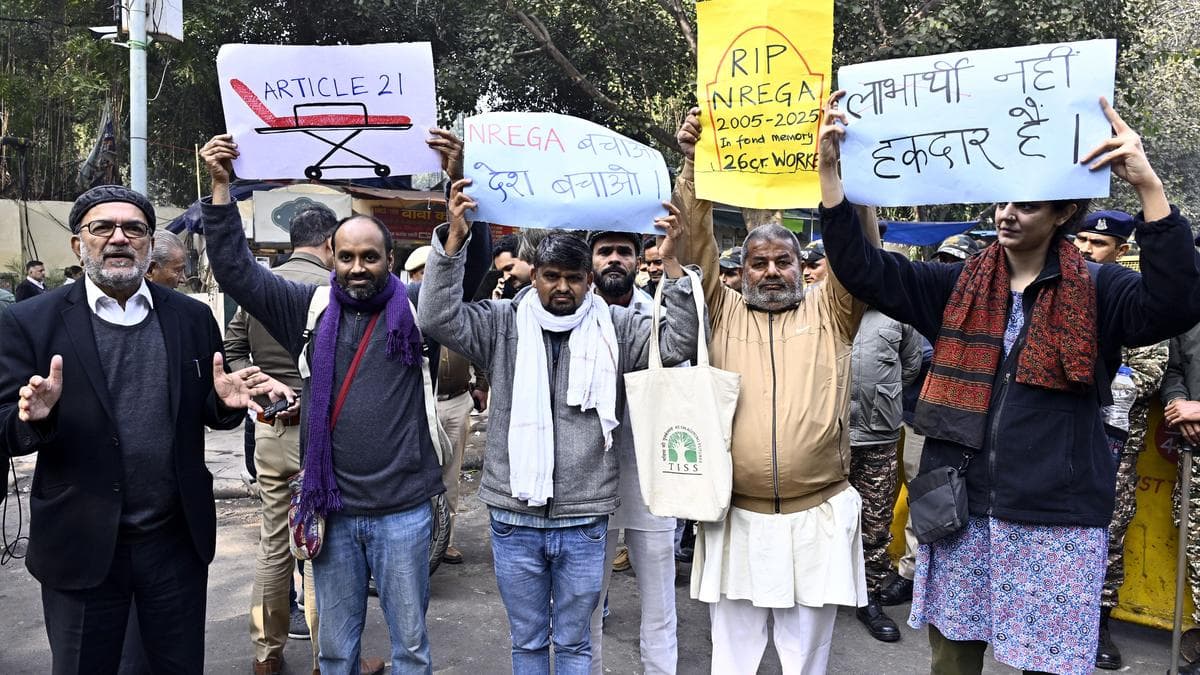
Parliament passes 'VB-G RAM G Bill' amid protests, alleged to end MGNREGA and burden states.
Summary
Parliament passed the 'VB-G RAM G Bill' during its Winter session amidst strong opposition protests. The main points of contention included the alleged removal of Mahatma Gandhi's name from the scheme and the increased financial burden placed on States. Advocate Prashant Bhushan critically stated that this bill has "practically ended MGNREGA," making it a significant development for competitive exams focusing on governance, social welfare schemes, and legislative changes.
Key Points
- 1The 'VB-G RAM G Bill' was passed by Parliament during its Winter session.
- 2Opposition parties protested the bill over the alleged removal of Mahatma Gandhi's name.
- 3The bill is also criticized for placing an increased financial burden on States.
- 4Advocate Prashant Bhushan stated that the bill has "practically ended MGNREGA."
- 5The passage of this bill highlights legislative changes impacting a major social welfare scheme.
In-Depth Analysis
The passage of the 'VB-G RAM G Bill' in Parliament during its Winter session has ignited significant debate and controversy, particularly concerning its alleged impact on the Mahatma Gandhi National Rural Employment Guarantee Act (MGNREGA), 2005. Advocate Prashant Bhushan's assertion that the new bill has "practically ended MGNREGA" underscores the gravity of this legislative development, which holds profound implications for India's social welfare framework and federal structure.
**Background Context of MGNREGA:**
To understand the significance of the 'VB-G RAM G Bill', it's crucial to revisit MGNREGA. Enacted in 2005, MGNREGA is a landmark social security scheme that guarantees 100 days of wage employment in a financial year to adult members of any rural household willing to do unskilled manual work. Its core objectives are to enhance livelihood security in rural areas, reduce distress migration, and create durable assets (like roads, ponds, irrigation canals). Rooted in the Directive Principles of State Policy, particularly Article 41 which speaks of the right to work, MGNREGA has been a critical safety net for millions of rural poor, especially during economic downturns and crises like the COVID-19 pandemic. Over the years, it has faced challenges related to timely wage payments, administrative inefficiencies, and adequate funding, but its fundamental role as a demand-driven legal entitlement to work has remained intact.
**What Happened with the 'VB-G RAM G Bill':**
During the recent Winter session, the 'VB-G RAM G Bill' was passed amidst strong protests from opposition parties. The primary points of contention revolved around two major aspects. Firstly, the opposition alleged that the new bill sought to remove Mahatma Gandhi's name from the scheme, a move seen as a significant symbolic and ideological affront to the scheme's founding principles and its identity. Mahatma Gandhi's name is intrinsically linked to rural development and self-reliance, and its removal, even if indirect, is perceived as an attempt to dilute the historical and moral grounding of the programme. Secondly, the bill is criticized for imposing an increased financial burden on state governments. While the original MGNREGA mandates the Centre to bear the major cost of wages (90-100%) and a significant portion of material costs, any shift in this funding pattern or the introduction of new cost-sharing mechanisms for administrative or material components could strain state finances, particularly for those with limited fiscal space.
**Key Stakeholders Involved:**
* **Central Government:** As the proposer and enactor of the bill, the central government's rationale likely includes enhancing efficiency, streamlining administration, or perhaps realigning fiscal responsibilities. Its stated aim would be to improve the scheme's effectiveness. However, it faces criticism regarding the perceived dilution of the scheme's spirit.
* **State Governments:** Directly impacted by the increased financial burden, states are key stakeholders. Their ability to implement the scheme effectively relies heavily on central funding. Any additional financial strain could lead to reduced work provision or delays, affecting beneficiaries.
* **Opposition Parties:** They have vociferously protested the bill, arguing against the alleged name change and the increased burden on states. Their stance is rooted in safeguarding social welfare, federal principles, and the legacy of Mahatma Gandhi.
* **Rural Workers/Beneficiaries:** These are the most critical stakeholders. Any changes that reduce the scope of work, delay wage payments, or make access to employment difficult directly impact their livelihoods and food security.
* **Civil Society Organizations and Activists:** Figures like Prashant Bhushan represent a broader network of civil society actors who have long advocated for MGNREGA's robust implementation. They monitor the scheme and raise concerns about any legislative or policy changes that might undermine its objectives.
**Significance for India and Future Implications:**
The passage of this bill carries significant implications for India. Socially, it could weaken a crucial safety net for the rural poor, potentially leading to increased poverty, distress migration, and rural unemployment if the scheme's scope or funding is curtailed. Economically, a reduced MGNREGA could dampen rural demand and economic activity. Politically, the controversy highlights the ongoing tension in Centre-State financial relations and the broader debate on federalism, particularly regarding social welfare schemes listed under the Concurrent List of the Seventh Schedule. The symbolic aspect of Mahatma Gandhi's name also holds immense political weight.
Looking ahead, the 'VB-G RAM G Bill' could lead to further legal challenges, increased friction between the Centre and states, and a re-evaluation of India's approach to social security. It prompts a critical examination of whether the government aims to reform, restructure, or fundamentally alter the nature of one of the world's largest public works programmes. The debate also touches upon the future direction of welfare policies and the balance between fiscal prudence and social equity in India.
Exam Tips
This topic falls under GS Paper II (Governance, Social Justice, Polity) and GS Paper III (Indian Economy, Development) for UPSC Civil Services Exam. Understand the original MGNREGA Act (2005) thoroughly, including its objectives, features, funding patterns, and achievements.
Prepare for questions on Centre-State financial relations (Article 280, Finance Commission, Seventh Schedule), federalism, and the role of social welfare schemes in poverty alleviation. Analyze the arguments for and against the changes proposed by the 'VB-G RAM G Bill'.
Expect questions in both Prelims (factual, e.g., 'When was MGNREGA enacted?', 'Which constitutional article is related to right to work?') and Mains (analytical, e.g., 'Critically analyze the impact of recent legislative changes on MGNREGA and its implications for rural livelihoods and federalism in India.').
Related Topics to Study
Full Article
The VB-G RAM G Bill was passed by Parliament in the Winter session amid strong protests by the opposition over the removal of Mahatma Gandhi's name and the financial burden being put on States