



Relevant for Exams
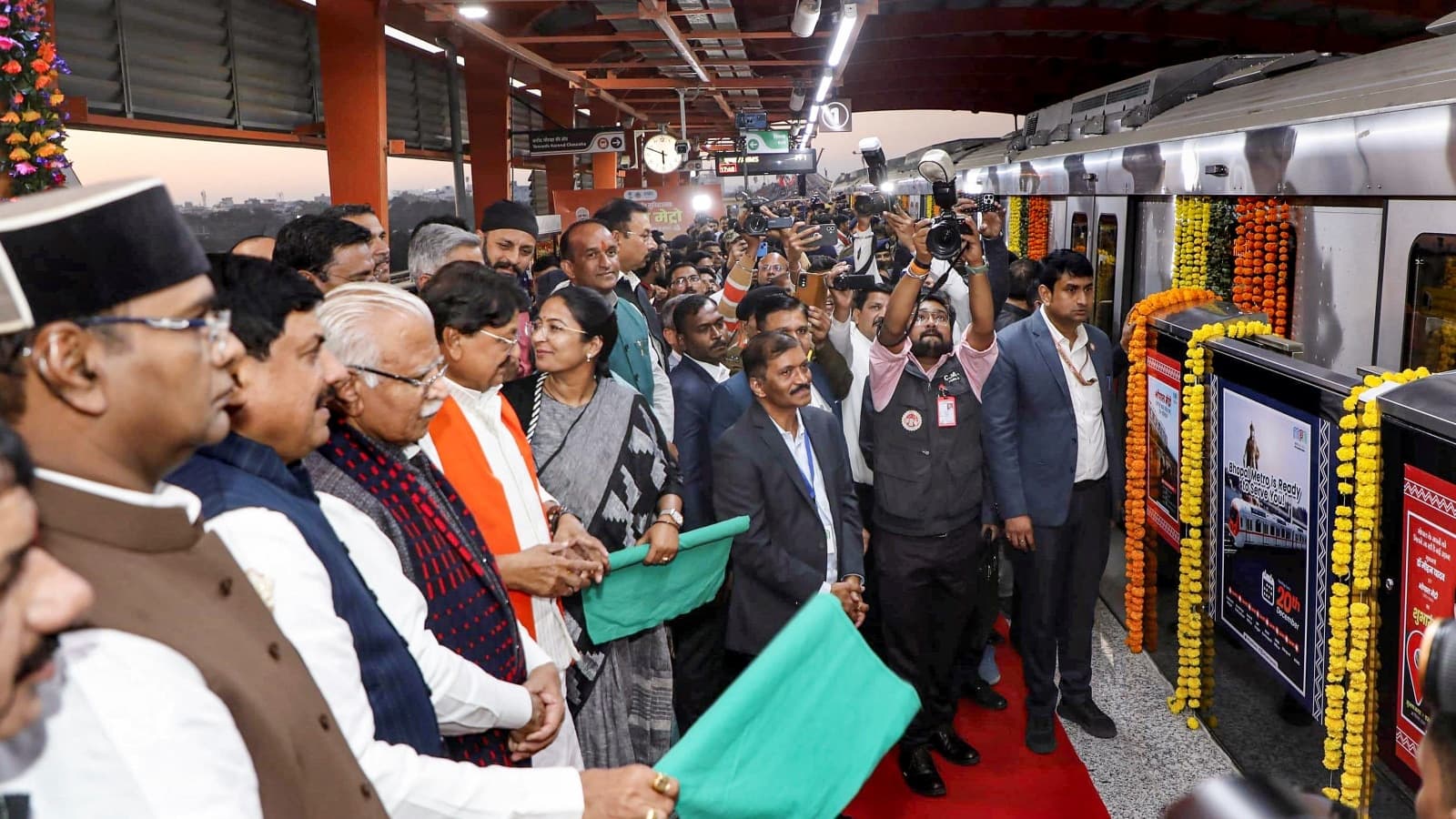
Bhopal Metro's Orange Line priority corridor begins commercial operations, adding Bhopal to India's metro map.
Summary
Bhopal is set to commence commercial operations on its Metro's Orange Line priority corridor today, officially marking its entry onto India's metro map. This development signifies a crucial upgrade in urban infrastructure, aiming to enhance public transportation and connectivity within the city. For competitive exams, this highlights significant urban development projects and regional infrastructure initiatives, particularly for Madhya Pradesh.
Key Points
- 1Commercial operations for the Bhopal Metro's "Orange Line priority corridor" commenced today.
- 2This event officially integrates Bhopal into India's operational metro network map.
- 3The project focuses on enhancing urban public transportation infrastructure in Bhopal, Madhya Pradesh.
- 4The "Orange Line" is the specific corridor where commercial operations have begun.
- 5This development is significant for improving urban connectivity and development in Madhya Pradesh's capital city.
In-Depth Analysis
The inauguration of commercial operations on the Bhopal Metro's Orange Line priority corridor marks a significant milestone in India's urban infrastructure development, officially integrating Bhopal into the nation's expanding metro network. This event is not merely about a new transport line; it reflects a broader national commitment to enhancing urban mobility, tackling congestion, and fostering sustainable growth in Tier-2 cities.
**Background and Necessity:**
Bhopal, the capital of Madhya Pradesh, has experienced rapid urbanization and population growth over the past few decades. This expansion, while indicative of economic progress, brought with it familiar urban challenges: increasing traffic congestion, rising pollution levels, and a strained public transport system. The existing bus network, while functional, struggled to keep pace with the city's growing demands, leading to longer commute times and decreased quality of life for residents. Recognizing these issues, the Government of Madhya Pradesh, in alignment with the Central Government's focus on urban development, initiated the Bhopal Metro Rail Project. The project received formal approval in October 2018, with an estimated cost of around ₹6,941.40 crore, signaling a strategic shift towards modern, high-capacity urban transit systems.
**The Project and its Commencement:**
The Orange Line, specifically its priority corridor, represents the first operational segment of the Bhopal Metro. This corridor is designed to connect key areas of the city, providing a swift and efficient mode of transport. The commencement of commercial operations signifies that after years of planning, construction, and rigorous testing, a part of the network is now ready to serve the public. This achievement is crucial not only for easing daily commutes but also for setting a precedent for the timely completion and operationalization of future phases.
**Key Stakeholders Involved:**
Several entities played pivotal roles in bringing the Bhopal Metro to fruition. The **Government of India**, through the Ministry of Housing and Urban Affairs, provides policy guidance, financial assistance, and regulatory oversight for metro projects across the country, often holding equity stakes. The **Government of Madhya Pradesh** is a crucial stakeholder, responsible for state-level planning, land acquisition, and contributing its share to the project's funding. The **Madhya Pradesh Metro Rail Corporation Limited (MPMRCL)**, a Special Purpose Vehicle (SPV) jointly owned by the Central and State governments, is the implementing agency, tasked with the execution, operation, and maintenance of the metro system. International financial institutions, such as the **European Investment Bank (EIB)**, have also been significant stakeholders, providing substantial loans to support the capital-intensive project, reflecting global confidence in India's infrastructure ambitions. Finally, the **citizens of Bhopal** are the ultimate beneficiaries and stakeholders, whose daily lives will be directly impacted by improved connectivity.
**Significance for India:**
Bhopal's entry into the metro map holds immense significance for India. Firstly, it underscores the nation's commitment to **sustainable urban development** and the **Smart Cities Mission**, which aims to improve infrastructure and provide a clean and sustainable environment to its citizens. Metro systems are vital components of sustainable mobility, reducing reliance on private vehicles, thereby cutting down carbon emissions and air pollution. Secondly, such projects are powerful engines of **economic growth**, generating employment during construction and operation, boosting real estate values along the corridor, and facilitating business activities due to enhanced connectivity. Thirdly, it significantly contributes to the **'Ease of Living'** for urban dwellers by providing a fast, safe, and comfortable commuting option, saving time and reducing stress. As more Tier-2 cities like Bhopal adopt metro systems, it signifies a decentralization of high-quality infrastructure, moving beyond mega-cities and fostering more balanced regional development across the country.
**Historical Context and Policy Framework:**
India's metro journey began with the Kolkata Metro in 1984, but it was the Delhi Metro, operationalized in 2002, that truly revolutionized urban transport and set a benchmark for efficiency and scale. Since then, metro networks have rapidly expanded to several cities, including Bengaluru, Hyderabad, Mumbai, Chennai, Lucknow, and now Bhopal. This expansion is guided by robust legal and policy frameworks. The **74th Constitutional Amendment Act of 1992** empowered Urban Local Bodies (ULBs) to plan for economic development and social justice, with urban transport falling under their purview (Entry 13 of the Twelfth Schedule). Specific laws like the **Metro Railways (Construction of Works) Act, 1978**, and the **Metro Railways (Operation and Maintenance) Act, 2002**, provide the legal backbone for metro projects. Furthermore, the **National Urban Transport Policy (NUTP), 2006**, explicitly promotes sustainable urban transport systems, including metro rail, as a preferred mode of mass transit.
**Future Implications:**
The successful launch of the Orange Line is just the beginning for Bhopal. It paves the way for the expansion of the metro network, with future phases expected to cover more extensive areas of the city, including the crucial Blue Line. This expansion will lead to greater integration of public transport, potentially linking with existing bus routes and railway stations to create a truly multi-modal transport system. The metro is also expected to catalyze further urban development, attracting investments, stimulating real estate growth, and encouraging the establishment of commercial hubs along its corridors. Environmentally, a fully operational metro network will contribute significantly to reducing the city's carbon footprint, aligning with India's climate change commitments. Moreover, Bhopal's success can serve as a model and inspiration for other Tier-2 and Tier-3 cities contemplating similar large-scale infrastructure projects, demonstrating the feasibility and benefits of modern mass transit systems.
Exam Tips
This topic falls under 'Indian Economy' (Infrastructure, Urbanization) and 'Indian Polity & Governance' (Urban Local Bodies, Public Policy) sections of competitive exams. Focus on the role of government schemes like Smart Cities Mission and National Urban Transport Policy.
Study related topics such as the 74th Constitutional Amendment Act, Public-Private Partnerships (PPP) in infrastructure, and the funding mechanisms for large-scale projects (e.g., role of international banks like EIB, ADB).
Expect factual questions (e.g., 'Which city recently launched its metro?', 'Which line in Bhopal Metro became operational first?', 'Which international bank funded the project?'). Also, prepare for analytical questions on the socio-economic and environmental impact of metro projects, and policy questions on urban transport strategies in India.
Understand the evolution of metro systems in India, from Kolkata to Delhi, and now to Tier-2 cities. Know the key differences in funding and operational models.
Be aware of the 'Make in India' component and technology aspects related to metro rail construction and rolling stock manufacturing, as these are often highlighted in government initiatives.