



Relevant for Exams
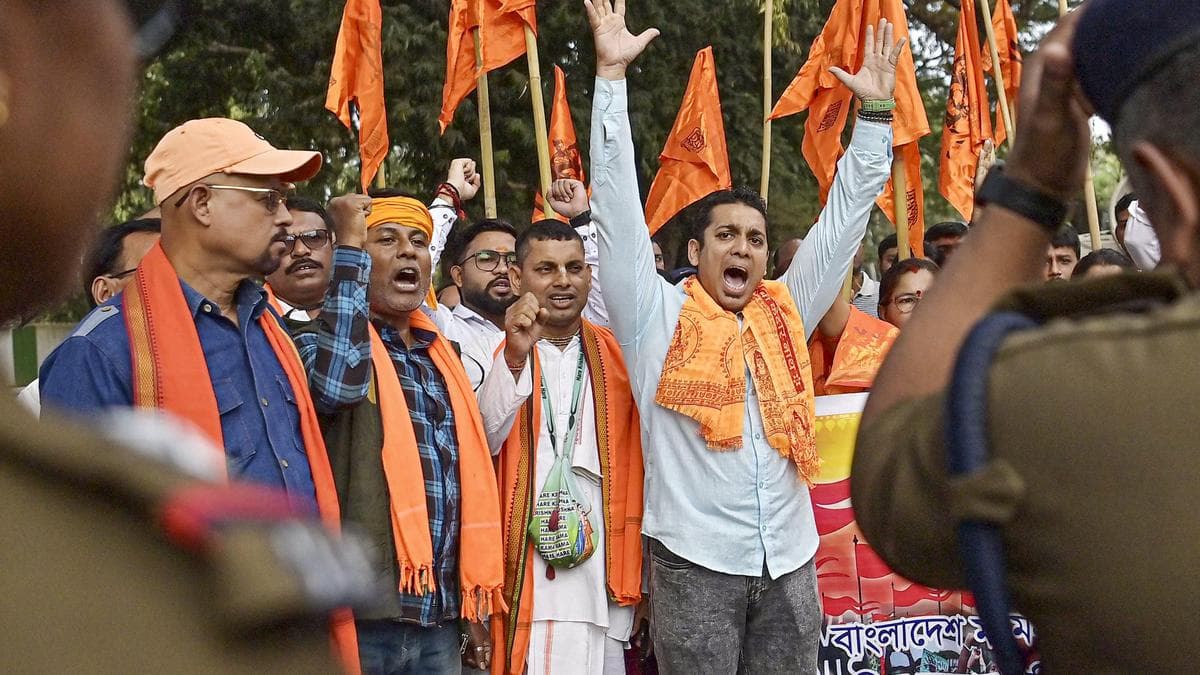
Bengal police warn against communalizing Murshidabad lynching and Bangladesh murder incidents.
Summary
West Bengal police issued a warning against communalizing criminal incidents, specifically addressing BJP leaders who drew parallels between a lynching in Murshidabad (April 2025) and a murder in Bangladesh (Dipu Chandra Das). This action highlights the state's efforts to maintain law and order and prevent the politicization of criminal cases, which is significant for understanding governance and internal security challenges in India.
Key Points
- 1West Bengal police warned against communalizing criminal incidents.
- 2The warning was issued following references made by several BJP leaders.
- 3One incident in question was the lynching of a father-son duo in Murshidabad, West Bengal.
- 4This Murshidabad incident was referenced against the recent murder of Dipu Chandra Das in Bangladesh.
- 5The lynching of the father-son duo in Murshidabad reportedly occurred in April 2025.
In-Depth Analysis
The warning issued by the West Bengal police against communalizing criminal incidents, specifically the Murshidabad lynching and its attempted comparison to a murder in Bangladesh, offers a critical lens into the complex interplay of law and order, political narratives, and social harmony in India. This incident, while seemingly localized, carries significant implications for internal security, federalism, and the integrity of public discourse.
**Background Context:**
West Bengal has a history of intense political competition and, at times, communal undertones, particularly in regions bordering Bangladesh. The state's demographic composition and socio-economic dynamics often become fertile ground for political parties to mobilize support along identity lines. Communalization of crime, where a criminal act is portrayed as a religiously motivated one, is a dangerous trend observed across India. It often serves to polarize communities, incite hatred, and gain political mileage, thereby undermining the rule of law and the constitutional principles of secularism. The region of Murshidabad, in particular, shares a long, porous border with Bangladesh, leading to frequent cross-border movements and interactions, which can sometimes be exploited for political narratives.
**What Happened:**
According to the report, the West Bengal police issued a stern warning against individuals attempting to communalize criminal incidents. This directive came in response to several leaders from the Bharatiya Janata Party (BJP) who reportedly drew parallels between the lynching of a father-son duo in Murshidabad (mentioned as April 2025, likely a typo for April 2024 or a recent past event, as it's referenced in the present context) and the recent murder of Dipu Chandra Das in Bangladesh. The police's intervention aimed to prevent the politicization of these distinct criminal cases and to maintain peace and order within the state, highlighting a proactive stance against divisive narratives.
**Key Stakeholders Involved:**
1. **West Bengal Police:** As the primary law enforcement agency, their role is crucial in maintaining peace, investigating crimes impartially, and preventing communal flare-ups. Their warning underscores their commitment to upholding the rule of law and preventing the spread of misinformation or hate speech.
2. **West Bengal State Government:** The state government, led by the Trinamool Congress, has a vested interest in maintaining law and order and preventing communal tensions, especially given the state's volatile political landscape. Their policies often reflect a desire to counter narratives that could destabilize social harmony.
3. **Bharatiya Janata Party (BJP) Leaders:** As the primary opposition in West Bengal, the BJP often seeks to highlight perceived failures of the state government and to consolidate its support base. Drawing parallels between incidents, particularly those with communal overtones, can be a strategy to galvanize a particular section of the electorate. However, this carries the risk of exacerbating communal divisions.
4. **Local Communities in Murshidabad:** These communities are directly affected by such incidents and the subsequent political narratives. The communalization of crime can sow distrust, fear, and animosity among different religious groups, impacting the social fabric.
5. **Victims and their Families:** Irrespective of the political narratives, the victims of the Murshidabad lynching and the murder in Bangladesh are central. Their right to justice must remain paramount, free from political manipulation.
**Why This Matters for India:**
This incident is significant for India on multiple fronts. Firstly, it touches upon **Internal Security** challenges, where the spread of communal narratives can lead to social unrest, violence, and a breakdown of law and order. Such incidents test the capacity of state police forces to act decisively and impartially. Secondly, it highlights the challenges to **Federalism**, as state police forces operate under the state government, but national political parties often try to influence discourse across state lines. Thirdly, it underscores the persistent problem of **Political Polarization** in India, where criminal incidents are frequently weaponized for electoral gains, often at the cost of social cohesion. The attempt to link a domestic crime with one from a neighboring country, Bangladesh, also subtly impacts **India-Bangladesh relations** by potentially fueling xenophobic sentiments or raising questions about cross-border influences, even if indirectly. Ultimately, it is a challenge to the **Rule of Law**, emphasizing that crimes must be investigated and prosecuted based on evidence, not communal interpretations.
**Historical Context and Future Implications:**
Historically, West Bengal has witnessed periods of communal tension, particularly during partition and post-partition eras, and later during political transitions. The porous border with Bangladesh has always been a sensitive point, with issues like illegal immigration and cattle smuggling occasionally taking communal or political dimensions. The police's warning, in this context, serves as a crucial preventive measure to avoid a recurrence of past communal strife.
The future implications are significant. Continued communalization of crime could lead to deeper societal divisions, making governance more challenging. It could also set a dangerous precedent where fact-finding and justice are overshadowed by political agendas. Conversely, strong and impartial action by law enforcement, as seen in this case, can reinforce public trust in institutions and deter future attempts at communal incitement. It emphasizes the need for responsible political discourse and media reporting, especially in a diverse democracy like India.
**Related Constitutional Articles, Acts, and Policies:**
Several constitutional provisions and legal acts are pertinent here:
* **Article 15** of the Indian Constitution prohibits discrimination on grounds of religion, race, caste, sex, or place of birth, reinforcing the secular fabric that is threatened by communalization.
* **Article 19(1)(a)** guarantees freedom of speech and expression, but **Article 19(2)** allows for reasonable restrictions, including those imposed in the interests of public order, decency, morality, or for incitement to an offense. This is crucial when dealing with hate speech or incitement to communal violence.
* **Article 21** ensures the right to life and personal liberty, which includes the right to a dignified existence and justice, fundamental aspects undermined by mob violence and communal prejudice.
* **Indian Penal Code (IPC):** Sections like **153A** (promoting enmity between different groups on grounds of religion, race, place of birth, residence, language, etc., and doing acts prejudicial to maintenance of harmony) and **295A** (deliberate and malicious acts, intended to outrage religious feelings of any class by insulting its religion or religious beliefs) are directly relevant. Other sections related to criminal conspiracy, public mischief, and rioting may also apply. These provisions empower the police to take action against those attempting to communalize incidents.
* The **Code of Criminal Procedure (CrPC)** outlines the powers and procedures for police investigations, arrests, and maintenance of public order.
* Government policies and initiatives aimed at **National Integration and Communal Harmony** are also relevant, as they seek to counter divisive forces and foster social cohesion. The National Integration Council, though not always active, is an example of a policy body to address such issues.
Exam Tips
This topic falls under GS-II (Indian Polity & Governance – Law & Order, Federalism, Centre-State Relations, Constitutional Provisions) and GS-III (Internal Security – Communalism, Border Management) for UPSC Mains. For Prelims, focus on relevant IPC sections and Constitutional Articles.
Study related topics like the role of state police, challenges of communalism in India, the concept of hate speech versus freedom of speech, and India's relations with Bangladesh (especially border issues).
Expect questions on the constitutional validity of restrictions on speech (Article 19(2)), the role of the state in maintaining public order, legislative measures to combat communalism (e.g., IPC Sections 153A, 295A), and the impact of political polarization on internal security. Analyze case studies where communal narratives have escalated tensions.
Related Topics to Study
Full Article
The police warn of action against those attempting to communalise criminal incidents. Several BJP leaders had made references to the lynching of a father-son duo in Murshidabad in April 2025, against the backdrop of the recent murder of Dipu Chandra Das in Bangladesh.