

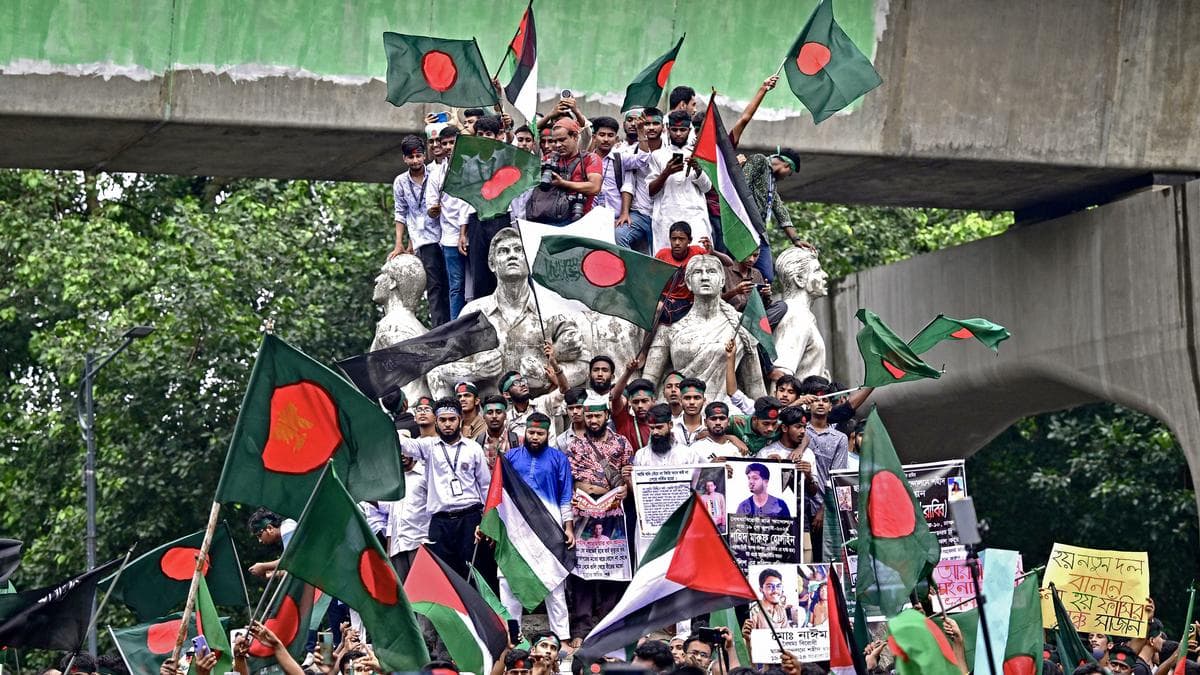


Relevant for Exams
The Hindu covers Bangladesh's 'troubled' political scenario ahead of 2026 elections.
Summary
The Hindu is covering Bangladesh's political situation in the lead-up to the 2026 elections, highlighting the current state of affairs in the 'troubled' nation. This analysis is crucial for understanding regional geopolitics and India's neighbourhood policy, making it highly relevant for competitive exams focusing on international relations and current events. The detailed coverage provides insights into potential challenges and developments affecting bilateral relations.
Key Points
- 1The news pertains to the political situation in Bangladesh.
- 2The focus is on the period leading up to the upcoming Bangladesh Elections in 2026.
- 3The article describes Bangladesh's current state of affairs as 'troubled'.
- 4The source of this in-depth analysis is The Hindu newspaper.
- 5Understanding Bangladesh's political developments is crucial for India's neighbourhood policy and regional stability.
In-Depth Analysis
Bangladesh, a crucial neighbour for India, is once again drawing international attention as it gears up for its General Elections in 2026. The recent coverage by The Hindu highlighting the 'troubled' state of affairs signals a period of political uncertainty and heightened scrutiny, which has significant implications for regional stability and India’s foreign policy objectives.
**Background Context and Historical Rivalry:**
Bangladesh's political landscape has historically been dominated by two formidable parties: the Awami League (AL), led by Prime Minister Sheikh Hasina, and the Bangladesh Nationalist Party (BNP), founded by late President Ziaur Rahman and now led by his widow, Khaleda Zia (currently under house arrest for corruption charges). This rivalry dates back to the very foundation of Bangladesh, with the AL championing secularism and a pro-India stance, while the BNP often leans towards a more Islamist-nationalist ideology and has historically been perceived as less friendly towards India. The country gained independence in 1971 through a bloody liberation war, with significant support from India. However, its post-independence history has been marked by political assassinations, military coups, and periods of democratic instability. The 2014 and 2018 general elections were controversial, with the BNP boycotting the 2014 polls and alleging widespread rigging in 2018, leading to questions about the fairness and inclusivity of the democratic process.
**Current State of Affairs and Key Stakeholders:**
As the 2026 elections approach, Bangladesh is indeed in a 'troubled' state, primarily due to deepening political polarization. The main opposition, BNP, along with its allies, has been demanding the resignation of the Awami League government and the establishment of a neutral, non-partisan caretaker government to oversee the elections. They argue that free and fair elections are impossible under the incumbent government. The AL, conversely, maintains that elections will be held according to the constitution, under the Election Commission, and rejects the caretaker government demand, citing a Supreme Court ruling from 2011 that abolished the provision. Key stakeholders include the ruling **Awami League**, keen to maintain power; the **Bangladesh Nationalist Party**, seeking to regain political relevance and ensure a level playing field; the **Bangladesh Election Commission**, tasked with conducting the polls impartially but often criticized by the opposition; **Civil Society and Media**, advocating for democratic rights and transparency; and **International Actors** like India, China, the United States, and the European Union, all with vested interests in Bangladesh's stability and democratic health. The military, historically influential, has largely remained out of electoral politics in recent years, but its role in maintaining law and order during periods of unrest remains crucial.
**Significance for India and Future Implications:**
Bangladesh's political stability is paramount for India, directly impacting its 'Neighbourhood First' policy and 'Act East Policy'. A stable Bangladesh ensures effective **border management** (India shares a 4,096 km border, the longest with any country), crucial for tackling illegal immigration, smuggling, and cross-border terrorism. A friendly government in Dhaka is vital for **security cooperation**, particularly in counter-terrorism and curbing insurgent groups operating in India's Northeast. Economically, Bangladesh is India's largest trade partner in South Asia. Political instability could disrupt **economic ties**, including crucial connectivity projects like the BBIN (Bangladesh, Bhutan, India, Nepal) Motor Vehicle Agreement, transit routes, and energy cooperation. India’s strategic interest also lies in preventing Bangladesh from becoming overly reliant on other powers, especially China, which has significantly increased its economic and military engagement in the country. Geopolitically, a stable and democratic Bangladesh is essential for regional groupings like BIMSTEC.
Looking ahead, the 2026 elections will be a critical test for Bangladesh's democratic institutions. The outcome will determine whether the country moves towards greater political reconciliation or deeper division. For India, continued political stability in Bangladesh, irrespective of who governs, is crucial for maintaining regional peace, advancing its economic and strategic interests, and ensuring the success of its connectivity initiatives. A prolonged period of instability could lead to economic stagnation in Bangladesh, potential refugee flows, and create security challenges for India. India will likely continue its policy of engaging with the democratically elected government while subtly encouraging dialogue and inclusive political processes.
**Related Constitutional Articles, Acts, and Policies:**
From an Indian perspective, this situation relates to several key aspects. India's **Neighbourhood First Policy** explicitly prioritizes friendly relations and cooperation with its immediate neighbours, with Bangladesh being a cornerstone. The **Act East Policy** also leverages Bangladesh as a gateway to Southeast Asia. Constitutionally, **Article 51** of the Indian Constitution, which mandates the state to promote international peace and security, maintain just and honourable relations between nations, and encourage settlement of international disputes by arbitration, underpins India's diplomatic efforts in the region. **Article 253** empowers Parliament to make laws for implementing any international treaty, agreement, or convention, which is relevant for bilateral and regional agreements with Bangladesh. While specific Bangladeshi constitutional articles on elections are beyond the scope of Indian competitive exams, understanding the *democratic framework* and the *importance of free and fair elections* as enshrined in democratic constitutions globally is key.
Exam Tips
This topic primarily falls under GS Paper 2 (International Relations: India and its Neighbourhood) and can also touch upon GS Paper 1 (Modern Indian History for the context of Bangladesh Liberation War).
Study India-Bangladesh bilateral relations comprehensively, covering trade, connectivity, security, water sharing (Teesta issue), and cultural ties, as questions often link internal politics of neighbours to bilateral dynamics.
Be prepared for analytical questions on the impact of political instability in neighbouring countries on India's security, economy, and foreign policy objectives. Understand the nuances of India's 'Neighbourhood First' policy.
Familiarize yourself with regional groupings like BIMSTEC and SAARC (though SAARC is less active) and how Bangladesh's political environment affects their effectiveness and India's role within them.
Expect questions on the role of external powers (e.g., China, USA) in Bangladesh and how India balances its strategic interests in the region.
Related Topics to Study
Full Article
Read exclusive, in-depth articles from The Hindu on the current state of affairs in troubled Bangladesh, and more