

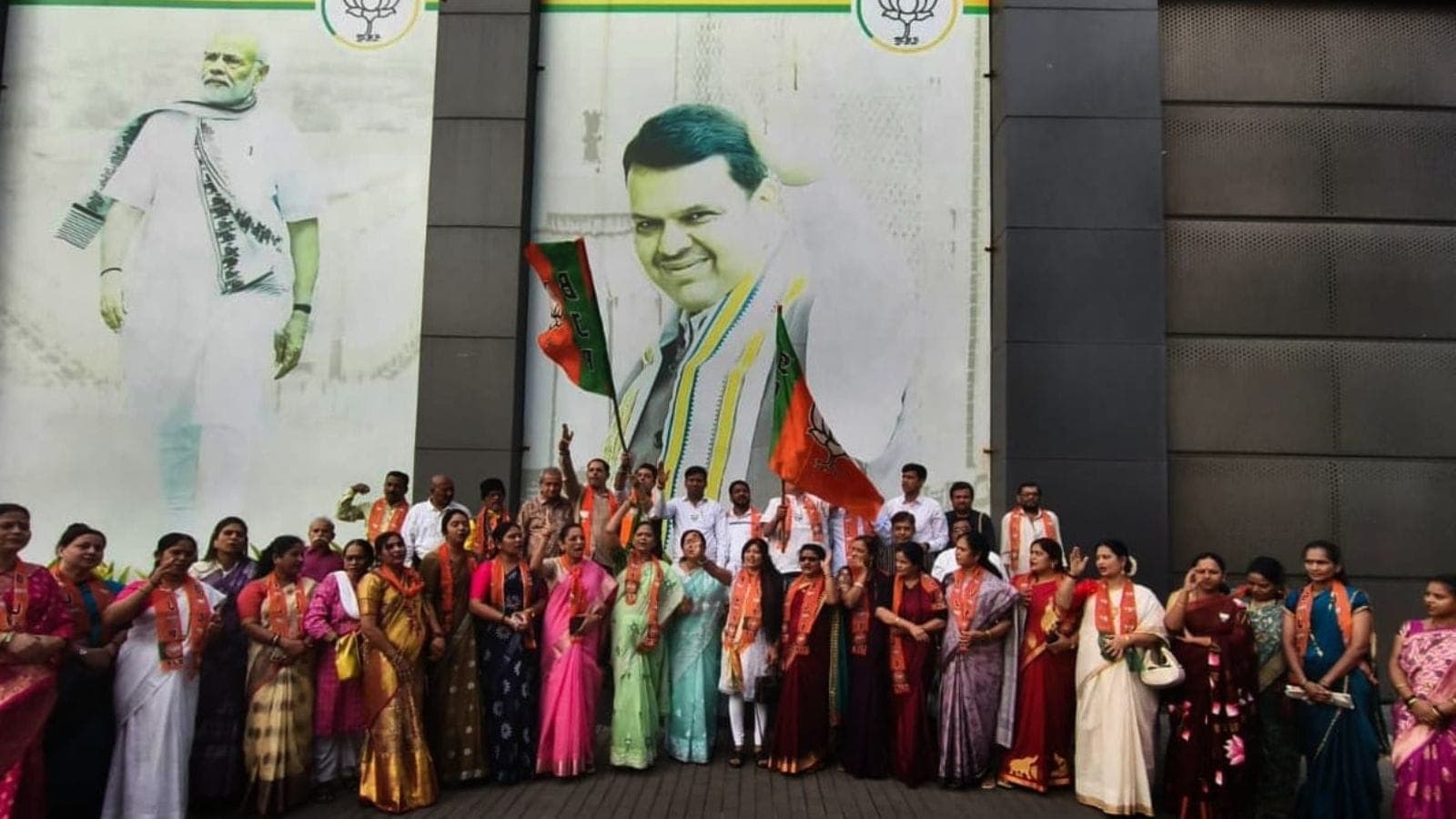


Maharashtra local polls: BJP's performance discussed, but no content available for details.
Summary
The article's title suggests a discussion on the BJP's performance in Maharashtra local polls and its implications for both allies and the opposition. However, the provided content explicitly states "No content available," making it impossible to extract any specific facts, figures, or detailed analysis crucial for competitive exam preparation. Therefore, no exam-relevant information can be derived from this article.
Key Points
- 1No specific election results, vote shares, or seat counts for BJP in Maharashtra local polls are provided.
- 2The article lacks details on the names of specific local bodies or regions where polls were held.
- 3No information is available regarding the political implications for BJP's allies or opposition parties.
- 4Specific dates of the local polls or the publication date of results are not mentioned.
- 5No constitutional provisions or legal frameworks related to local body elections are discussed in the content.
In-Depth Analysis
The reported success of the Bharatiya Janata Party (BJP) in Maharashtra local polls, as suggested by the article's title, even without specific content details, provides a crucial lens through which to examine the dynamics of Indian politics at the grassroots level. Local body elections, encompassing Gram Panchayats, Municipal Councils, and Municipal Corporations, are often considered a barometer of public sentiment and a precursor to state assembly and national parliamentary elections. Understanding their significance requires delving into Maharashtra's recent political history, the constitutional framework governing these bodies, and the broader implications for India's federal structure.
**Background Context and Recent Political Landscape:**
Maharashtra has witnessed significant political upheaval in recent years. The 2019 state assembly elections resulted in a fractured mandate, leading to the formation of the Maha Vikas Aghadi (MVA) coalition comprising the Shiv Sena (undivided), Nationalist Congress Party (NCP), and Indian National Congress. This unlikely alliance governed for over two and a half years before being destabilized by a rebellion within the Shiv Sena in June 2022, led by Eknath Shinde. This ultimately led to the collapse of the MVA government and the formation of a new alliance government with Eknath Shinde as Chief Minister, backed by the BJP. Following this, the NCP also experienced a split, with a significant faction aligning with the BJP-led government. In such a volatile environment, local body elections become critical tests of public support for the various factions and alliances. A strong performance by the BJP in these polls would suggest a consolidation of its position and an endorsement of the new political alignment.
**What a 'Big Score' Implies:**
While specific results are unavailable from the article, a 'big score' for the BJP typically implies gaining a significant number of seats, potentially securing control of key urban and rural local bodies. This strengthens the party's organizational network at the ground level, mobilizes its cadre, and provides a platform for implementing state and central government policies more effectively. It also signals that the party's narrative and leadership are resonating with the local populace, potentially overcoming the fragmentation caused by recent political realignments within its allies.
**Key Stakeholders Involved:**
1. **Bharatiya Janata Party (BJP):** The primary beneficiary of the reported success, aiming to expand its footprint and consolidate power. Its performance reflects its organizational strength and public acceptance of its agenda.
2. **Shiv Sena (Eknath Shinde Faction):** As BJP's key ally in the state government, their performance in conjunction with the BJP is crucial. A strong BJP showing might reinforce its dominant position within the alliance, potentially influencing future seat-sharing negotiations.
3. **Nationalist Congress Party (Ajit Pawar Faction):** Another ally in the current government, their performance alongside BJP is also relevant for the stability and future of the alliance.
4. **Opposition Parties (MVA constituents):** This includes the Shiv Sena (Uddhav Thackeray faction), NCP (Sharad Pawar faction), and Indian National Congress. A strong BJP performance would be a setback for them, necessitating a re-evaluation of their strategies and alliances ahead of the crucial 2024 Lok Sabha and state assembly elections.
5. **Local Voters:** Their mandate is the ultimate determinant, reflecting their preferences for local governance and indirectly, their views on state and national politics.
**Significance for India and Maharashtra:**
Local body elections are the bedrock of India's decentralized governance. A strong showing by a national party like the BJP in a crucial state like Maharashtra has several implications:
* **Political Barometer:** It acts as a significant indicator of the political mood, often predicting trends for upcoming larger elections. A BJP surge suggests their strategy is working and public support is shifting.
* **Grassroots Governance:** Control over local bodies enables better implementation of central and state government schemes (e.g., Swachh Bharat Abhiyan, PM Awas Yojana) and improves service delivery at the local level. This directly impacts the quality of life for citizens.
* **Coalition Dynamics:** It can alter the power balance within the ruling alliance, potentially giving the BJP more leverage in policy decisions and seat distribution for future elections.
* **Opposition Strategy:** Forces the opposition to introspect and potentially forge stronger alliances or modify their electoral strategies to counter the dominant party.
* **Economic Impact:** Stable local governance can attract investment and facilitate development projects, impacting local economies.
**Historical Context and Constitutional Provisions:**
Local self-governance in India has deep historical roots, from ancient village republics to the reforms under British rule (e.g., Lord Ripon's Resolution of 1882). However, it was the **73rd and 74th Constitutional Amendment Acts of 1992** that truly institutionalized Panchayati Raj Institutions (PRIs) and Urban Local Bodies (ULBs), respectively, providing them constitutional status and a uniform framework. These amendments mandated the establishment of three-tier Panchayats (Article 243B) and various types of Municipalities (Article 243Q) and ensured their regular elections. Key articles include:
* **Article 243K (for Panchayats) and Article 243ZA (for Municipalities):** Empower the State Election Commission (SEC) to conduct, superintend, direct, and control the preparation of electoral rolls and the conduct of all elections to these local bodies.
* **Schedule XI (Panchayats) and Schedule XII (Municipalities):** List the 29 and 18 functional items, respectively, devolved to these bodies, highlighting their roles in local development and administration.
Maharashtra, like other states, has its own specific acts, such as the Maharashtra Municipal Corporations Act, 1949, and the Maharashtra Village Panchayats Act, 1958, which operationalize these constitutional provisions.
**Future Implications:**
A strong performance by the BJP in Maharashtra local polls would likely boost the confidence of the ruling alliance (BJP + Shinde-led Shiv Sena + Ajit Pawar-led NCP) heading into the 2024 Lok Sabha and Maharashtra Assembly elections. It would put immense pressure on the MVA opposition to present a united front and a compelling alternative narrative. The results could also influence candidate selection and seat-sharing agreements within both the ruling and opposition alliances. Furthermore, it could lead to renewed focus on grassroots development initiatives by the state government, leveraging the newly secured local bodies for better scheme implementation and public outreach. Conversely, it might intensify political rivalries and debates over the future direction of the state's politics, with implications for governance and policy-making.
In essence, while specific figures are absent, the very notion of a 'big score' for the BJP in Maharashtra local polls underscores the continuous political churn in the state and the critical role of local elections in shaping the larger political narrative and future trajectory of India's most economically powerful state.
Exam Tips
This topic falls under 'Indian Polity and Governance' (UPSC Mains GS-II, State PSCs) and 'Current Events of National Importance'. Focus on the structure, powers, and functions of local self-government bodies (73rd & 74th Amendment Acts).
Study the constitutional provisions related to Panchayati Raj and Urban Local Bodies thoroughly, including Articles 243 to 243ZG, the Eleventh and Twelfth Schedules, and the role of the State Election Commission and State Finance Commission.
Be prepared for questions on the significance of local elections as political barometers, the challenges faced by local self-government (e.g., financial autonomy, capacity building), and the impact of state-level political dynamics on local bodies. Case studies of specific state election results can be asked.
Understand the distinction between mandatory and voluntary provisions of the 73rd and 74th Amendment Acts. Also, be aware of recent government initiatives related to strengthening local self-governance (e.g., SVAMITVA Scheme).
Practice analyzing the implications of election results on coalition politics, party strategies, and federalism. Questions might involve assessing the role of regional parties versus national parties in local polls.