



Relevant for Exams
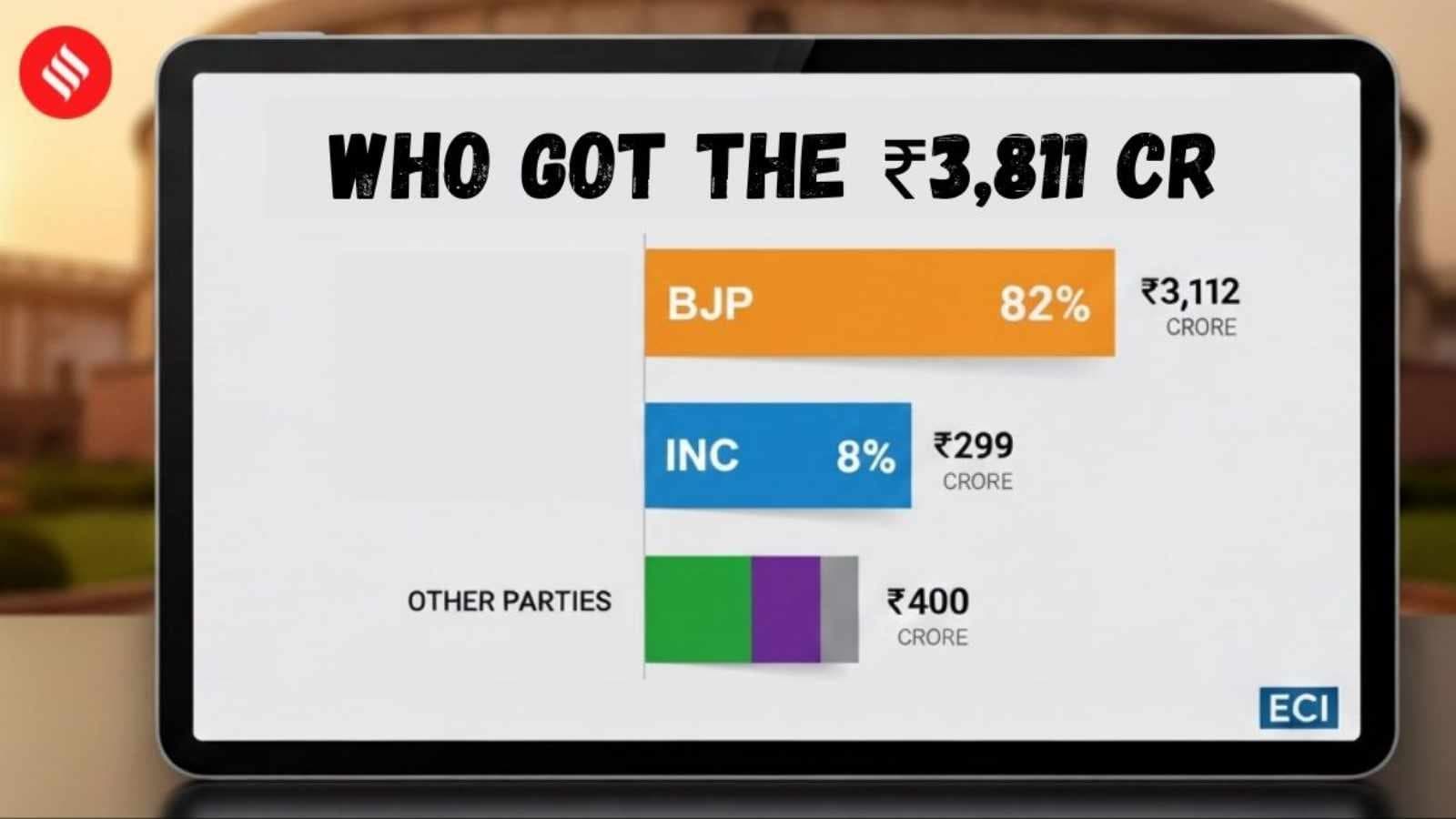
Corporate trusts donated Rs 3,811 cr to parties post-poll bond scrapping, impacting political funding.
Summary
The news indicates that corporate trusts donated Rs 3,811 crore to political parties subsequent to the Supreme Court's decision to scrap the Electoral Bond scheme. This development signifies a notable change in political funding sources after the controversial bond system was abolished. It is crucial for understanding ongoing electoral reforms, political finance, and transparency issues in India, making it highly relevant for competitive exam preparation.
Key Points
- 1Corporate trusts contributed Rs 3,811 crore to political parties after the Electoral Bond scheme was scrapped.
- 2This shift in funding occurred following the Supreme Court's judgment on the Electoral Bond scheme.
- 3The Supreme Court declared the Electoral Bond scheme unconstitutional on February 15, 2024.
- 4The Electoral Bond scheme, introduced in 2017, allowed anonymous donations to political parties.
- 5The data highlights a new trend in political funding, moving from electoral bonds to corporate trusts.
In-Depth Analysis
The recent revelation that corporate trusts donated a staggering Rs 3,811 crore to political parties after the Supreme Court's decision to scrap the Electoral Bond scheme marks a critical juncture in India's ongoing struggle for transparency in political funding. This development is not merely a statistical anomaly but a significant shift in how political parties are financed, carrying profound implications for India's democratic health and governance.
To truly grasp the significance, let's first delve into the background context. Political funding in India has long been a contentious issue, plagued by allegations of black money, lack of transparency, and quid pro quo arrangements. Various committees, such as the Dinesh Goswami Committee (1990) and the Indrajit Gupta Committee (1998), have highlighted the need for electoral reforms, particularly concerning campaign finance. In an attempt to address these concerns, the government introduced the Electoral Bond scheme through the Finance Act, 2017. This scheme allowed individuals and corporate entities to donate to political parties anonymously via bonds purchased from the State Bank of India. The stated objective was to cleanse political funding by moving away from cash donations, yet critics argued it merely institutionalized anonymity, benefiting ruling parties disproportionately and enabling opaque corporate influence.
The pivotal moment arrived on February 15, 2024, when a five-judge Constitution bench of the Supreme Court, led by Chief Justice D.Y. Chandrachud, unanimously struck down the Electoral Bond scheme as unconstitutional. The Court ruled that the anonymity provided by the scheme violated citizens' fundamental 'Right to Information' under Article 19(1)(a) of the Constitution, which is an integral part of the freedom of speech and expression. It emphasized that voters have a right to know about the funding sources of political parties to make informed electoral choices. The judgment also restored the cap on corporate donations to political parties at 7.5% of their average net profit of the preceding three financial years, which had been removed by the Finance Act, 2017.
Following this landmark judgment, the Election Commission of India (ECI) was directed to publish the data on electoral bonds, revealing the donors and recipients. It is in this post-bond era that the spotlight has shifted to corporate trusts. The Rs 3,811 crore figure indicates a rapid adaptation by corporate entities to find alternative, legal channels for political donations. Key stakeholders in this evolving landscape include: **Political Parties**, who are the primary beneficiaries and constantly seek funding; **Corporate Trusts and Companies**, who are the donors, often seeking to influence policy or secure business interests; the **Election Commission of India**, which is tasked with regulating electoral finances and ensuring transparency; and the **Supreme Court of India**, which acts as the ultimate guardian of constitutional principles and electoral integrity. Most importantly, **Citizens and Voters** are the ultimate stakeholders, whose right to know and participate in a fair democratic process is directly impacted.
This development matters immensely for India. Firstly, it raises concerns about the true spirit of transparency. While electoral bonds were scrapped, the shift to corporate trusts, if not adequately regulated, could merely be a new form of veiled influence. There's a risk that these trusts, though legally distinct, could still serve as conduits for corporate interests, potentially leading to 'quid pro quo' arrangements and crony capitalism. Secondly, it impacts democratic accountability. If the public cannot trace the ultimate source of political funding, it undermines the ability of voters to hold their elected representatives accountable. Thirdly, it highlights the continuous challenge of electoral reforms in India, particularly regarding the Representation of the People Act, 1951, which governs many aspects of political funding. The current scenario necessitates a deeper examination of the legal frameworks governing corporate trusts and their donations.
Looking ahead, the future implications are significant. This shift could prompt further legislative or judicial scrutiny into the nature and transparency of corporate trusts. The ECI might need enhanced powers and resources to monitor these new funding patterns effectively. There is an urgent need for comprehensive electoral finance reforms that balance the need for political parties to raise funds with the imperative of transparency and accountability. Without such reforms, the spirit of the Supreme Court's judgment on electoral bonds, which championed the voter's right to know, might be circumvented, continuing the cycle of opaque political funding and potentially eroding public trust in democratic institutions. The challenge for India's democracy remains to forge a system where political funding is both robust and unequivocally transparent, ensuring a level playing field for all and strengthening the foundational principles of its republic.
Relevant constitutional provisions and acts include **Article 19(1)(a)** (Right to Information), **Article 324** (powers of the ECI), and the **Representation of the People Act, 1951**. Additionally, amendments made through the **Finance Act, 2017**, concerning political funding and corporate donations, and the subsequent Supreme Court judgment, are crucial for understanding this topic.
Exam Tips
This topic falls under 'Indian Polity and Governance' (UPSC GS Paper II) and 'Current Affairs'. Focus on the constitutional articles (Art 19(1)(a), Art 324), the Supreme Court's reasoning, and the implications for electoral reforms.
Study related topics like the Election Commission of India's role, different types of electoral reforms suggested by various committees (e.g., Dinesh Goswami, Indrajit Gupta), and the concept of judicial review. Understand the difference between electoral bonds and other forms of corporate donations.
Common question patterns include: Mains questions analyzing the pros and cons of electoral bonds, the significance of the SC judgment, challenges to transparency in political funding, and reforms needed. Prelims questions might focus on the date of the SC judgment, specific articles violated, the cap on corporate donations, or the committees related to electoral reforms.