



Relevant for Exams
Jaishankar: Global pecking order changed; no country can impose its will.
Summary
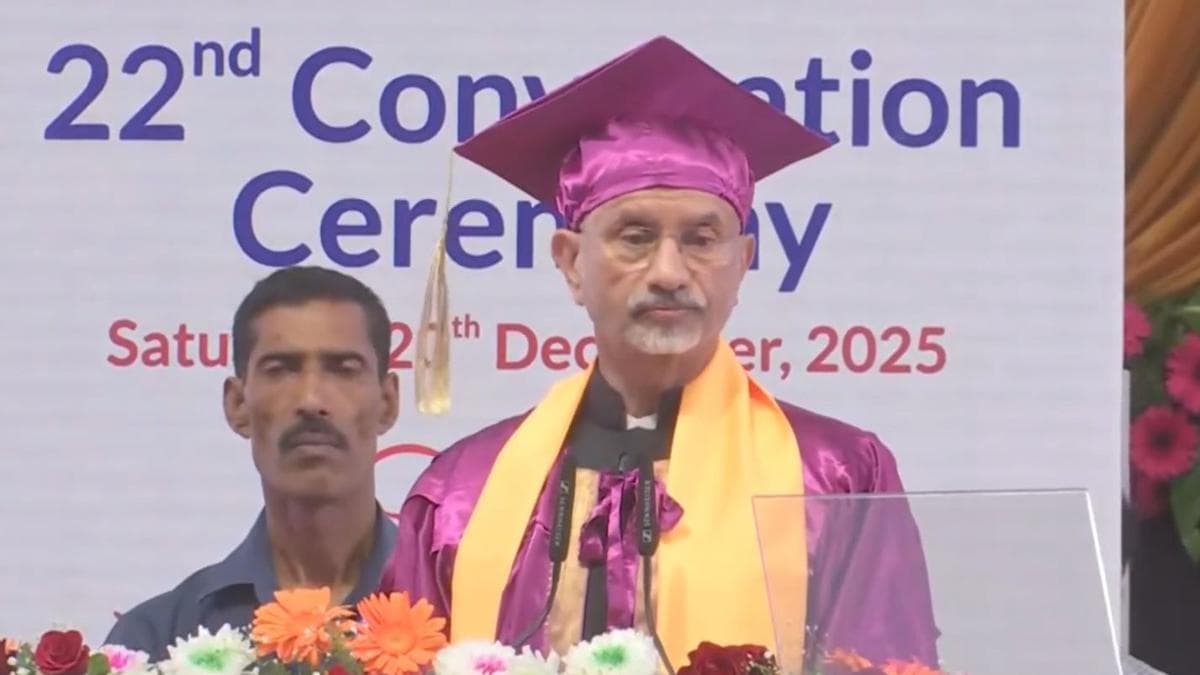
External Affairs Minister S. Jaishankar stated that the global pecking order has undergone a significant change, emphasizing that no single country, regardless of its power, can impose its will on all issues. This statement, made at the 22nd convocation of Symbiosis International (Deemed University) in Pune, highlights India's perspective on the evolving multipolar world order. It is crucial for understanding contemporary international relations and India's foreign policy stance for competitive exams.
Key Points
- 1External Affairs Minister S. Jaishankar made the statement regarding the global pecking order.
- 2He asserted that "No country, however powerful, can impose its will on all issues."
- 3The statement was delivered at the 22nd convocation of Symbiosis International (Deemed University).
- 4The event took place in Pune, Maharashtra.
- 5The core theme was the significant change in the global power dynamics and international relations.
In-Depth Analysis
External Affairs Minister S. Jaishankar's assertion that "No country, however powerful, can impose its will on all issues" signals a profound shift in India's understanding and articulation of the contemporary global order. This statement, delivered at the 22nd convocation of Symbiosis International (Deemed University) in Pune, encapsulates India's perspective on the transition from a unipolar world, dominated by a single superpower post-Cold War, to an increasingly multipolar and multi-conceptual international system.
**Background Context and What Happened:**
For decades following the collapse of the Soviet Union in 1991, the world largely operated under a unipolar framework, with the United States as the preeminent power. However, the 21st century has witnessed the rapid rise of new economic and military powers, particularly from Asia, such as China and India. This diffusion of power, coupled with the increasing interconnectedness of global challenges like climate change, pandemics, and economic crises, has made it evident that no single nation, regardless of its might, possesses the capacity or legitimacy to dictate global outcomes unilaterally. Jaishankar's statement is a direct acknowledgement of this evolving reality, reflecting a strategic assessment that the 'global pecking order' is no longer hierarchical but rather a complex web of interdependent actors.
**Key Stakeholders Involved:**
* **India:** As a rising global power, India is a crucial stakeholder in shaping this multipolar order. It advocates for a more equitable and representative global governance structure, seeking a permanent seat in the UN Security Council and greater influence in other multilateral forums. India’s stance is rooted in its long-held principle of strategic autonomy. Its participation in various groupings like BRICS, SCO, G20, Quad, and I2U2 demonstrates its intent to engage with diverse partners without being tied to a single bloc.
* **Traditional Powers (e.g., USA, EU):** These nations, accustomed to a dominant role, are grappling with the implications of diffused power. They are adjusting their foreign policies to engage with rising powers, seeking to maintain influence while navigating a more competitive landscape. For instance, the US's renewed focus on alliances and partnerships, such as the Quad, reflects this adaptation.
* **Rising Powers (e.g., China, Russia):** These nations are actively challenging the existing Western-centric order, seeking to establish alternative norms and institutions. China's Belt and Road Initiative and Russia's assertiveness on its periphery are examples of their efforts to reshape global dynamics.
* **Multilateral Institutions (UN, WTO, IMF):** These institutions, largely created in the post-WWII era, are under immense pressure to reform and reflect the current geopolitical realities. Their legitimacy and effectiveness are being questioned as they struggle to address global challenges in a fragmented world.
**Significance for India and Historical Context:**
This shift in the global pecking order holds immense significance for India. Historically, India's foreign policy, particularly during the Cold War, was characterized by Non-Alignment, a strategy aimed at maintaining autonomy from the two superpower blocs. Post-Cold War, while engaging more closely with the West, India never abandoned its commitment to strategic autonomy. Jaishankar's statement reaffirms this core principle, positioning India as a responsible global actor that seeks to build consensus rather than confrontational blocs. Economically, a multipolar world offers India diversified opportunities for trade, investment, and technology transfer, reducing over-reliance on any single market or partner. Politically, it enhances India's leverage in international negotiations and allows it to forge issue-based alliances. Socially, it promotes a more inclusive global discourse where diverse perspectives, including those from the Global South, gain greater prominence.
**Related Constitutional Articles, Acts, or Policies:**
India's foreign policy is guided by **Article 51** of the Constitution, a Directive Principle of State Policy, which mandates the state to "endeavour to promote international peace and security; maintain just and honourable relations between nations; foster respect for international law and treaty obligations... and encourage settlement of international disputes by arbitration." This constitutional directive underpins India's commitment to a rule-based international order and multilateralism. India's various foreign policy initiatives, such as the 'Neighbourhood First Policy,' 'Act East Policy,' and its active participation in forums like the G20, BRICS, and the Shanghai Cooperation Organisation (SCO), are all manifestations of its approach to navigating this complex multipolar world.
**Future Implications:**
The future implications of this evolving global order are multifaceted. We can expect increased strategic competition alongside greater cooperation on shared challenges. India's role is likely to expand, positioning it as a pivotal power that can bridge divides and foster collaboration. The emphasis will shift towards plurilateral groupings and flexible coalitions tailored to specific issues. The established international norms and institutions will face continuous pressure for reform. India's articulate advocacy for a 'reformed multilateralism' and its vision for the Indo-Pacific region will be crucial in shaping the trajectory of this new global order, ensuring that it is more inclusive, stable, and prosperous for all.
Exam Tips
This topic primarily falls under 'International Relations' (GS-II for UPSC Civil Services Exam, and General Awareness/Current Affairs for State PSCs, SSC, Banking, and Defence exams). Focus on India's foreign policy principles, its role in multilateral organizations, and its strategic partnerships.
Study related topics such as India's foreign policy doctrines (e.g., Strategic Autonomy, Panchsheel), key international organizations (UN, WTO, IMF, G20, BRICS, SCO), regional groupings (Quad, I2U2, ASEAN), and major geopolitical shifts (e.g., US-China rivalry, rise of Indo-Pacific concept).
Common question patterns include: essay questions on India's role in a multipolar world; objective questions testing knowledge of specific international forums, their members, and objectives; analysis of India's stance on global issues like climate change, terrorism, and trade; and questions on the significance of constitutional articles like Article 51 in shaping India's foreign policy.
Related Topics to Study
Full Article
"No country, however powerful, can impose its will on all issues,” Mr. Jaishankar said, addressing the 22nd convocation of the Symbiosis International (Deemed University) in Pune