



Relevant for Exams
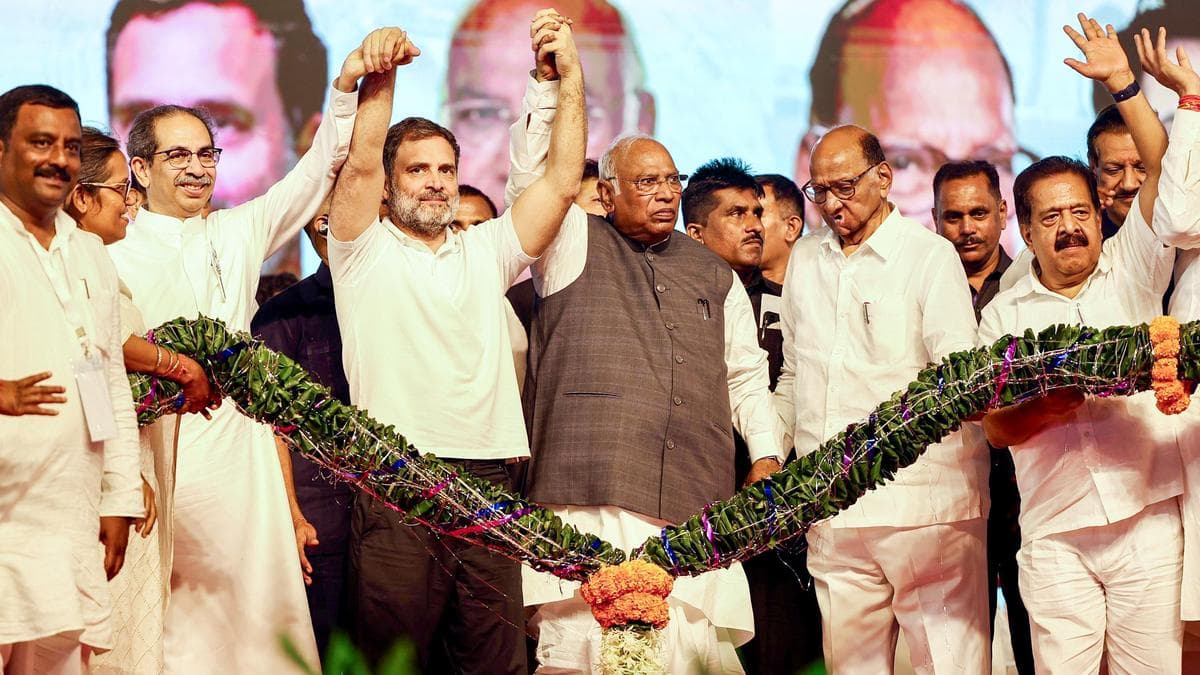
Congress exits MVA in Mumbai, reshaping the civic electoral contest.
Summary
The Congress party has exited the Maha Vikas Aghadi (MVA) alliance in Mumbai, a significant political development. This move fundamentally alters the electoral landscape for the upcoming civic body elections, transforming it into a multipolar contest. It is crucial for understanding state-level political dynamics and alliance formations for competitive exams.
Key Points
- 1The Congress party has walked out of the Maha Vikas Aghadi (MVA) alliance.
- 2The political development specifically concerns the civic contest in Mumbai.
- 3This move has significantly changed the existing electoral combinations.
- 4The nature of the contest is now described as a multipolar one.
- 5All parties involved are stated to have high stakes in the reshaped electoral scenario.
In-Depth Analysis
The recent decision by the Congress party to exit the Maha Vikas Aghadi (MVA) alliance for the upcoming Mumbai civic body elections marks a significant shift in Maharashtra's political landscape. This development, while seemingly localized to Mumbai, encapsulates broader themes of coalition politics, regional aspirations, and the challenges faced by national parties in maintaining their relevance in a multipolar electoral environment. For aspirants of competitive exams, understanding this event requires delving into its background, key players, constitutional underpinnings, and future ramifications.
The Maha Vikas Aghadi (MVA) was an unlikely alliance formed in 2019 after the Maharashtra Assembly elections. Comprising the ideologically disparate Shiv Sena (then undivided), Nationalist Congress Party (NCP), and Indian National Congress, its primary objective was to keep the Bharatiya Janata Party (BJP) out of power. This alliance successfully formed the state government, demonstrating a rare instance of political pragmatism overriding traditional rivalries. However, the MVA government's tenure was cut short in June 2022 following a split in the Shiv Sena, leading to the formation of a new government by Eknath Shinde's Shiv Sena faction and the BJP, later joined by Ajit Pawar's NCP faction. Despite these upheavals at the state level, the MVA partners (now Shiv Sena (Uddhav Balasaheb Thackeray) and NCP (Sharadchandra Pawar) and Congress) had largely maintained a united front against the ruling dispensation, particularly in the lead-up to the Lok Sabha and Assembly elections.
What happened specifically for the Mumbai civic contest is that the Congress, a constituent of the MVA, unilaterally decided to contest the Brihanmumbai Municipal Corporation (BMC) elections independently. This move effectively fractured the MVA's unity at the local level. The BMC, often referred to as India's richest civic body, controls an annual budget larger than that of several smaller states and plays a pivotal role in Mumbai's urban development, infrastructure, and financial health. Control over the BMC is therefore a highly coveted prize, offering significant political leverage and resources.
Several key stakeholders are deeply impacted by this decision. The **Congress party** itself aims to revitalize its organizational base in Mumbai, where it has seen a steady decline in influence. By contesting independently, it hopes to reclaim its traditional vote bank and assert its identity, rather than being seen as a junior partner within the MVA. For the **Shiv Sena (UBT) faction** and the **NCP (Sharadchandra Pawar faction)**, this decision means facing a fragmented opposition in Mumbai. While they might have preferred a united MVA to maximize their chances against the ruling BJP-Shiv Sena (Shinde)-NCP (Ajit Pawar) alliance, they now face a three-cornered or even four-cornered contest, which could benefit the dominant ruling alliance by splitting the opposition vote. The **BJP** and its allies are arguably the biggest beneficiaries, as a divided opposition generally makes it easier for a consolidated force to win. Their strategy would likely involve further exploiting these divisions.
This development holds significant implications for India's democratic fabric and political dynamics. Firstly, it underscores the inherent challenges of **coalition politics** in a diverse country like India, where local aspirations and state-level dynamics often conflict with national alliance strategies. The MVA's initial success was based on a common enemy (BJP), but sustaining that unity requires significant compromise, especially in seat-sharing for local elections. Secondly, it highlights the importance of **local self-government** and the constitutional provisions that empower it. The **74th Constitutional Amendment Act of 1992** gave constitutional status to urban local bodies (ULBs) like the BMC, making them a crucial tier of governance. Article 243ZA, for instance, mandates the State Election Commission to superintend, direct, and control the preparation of electoral rolls for, and the conduct of, all elections to the municipalities. The BMC itself operates under the specific provisions of the **Bombay Municipal Corporation Act, 1888**. The control of such a powerful civic body is not just about local administration but also about projecting political strength at the state and national levels.
Historically, Maharashtra has witnessed various alliance permutations, from the long-standing Shiv Sena-BJP partnership to the unprecedented MVA. The current scenario reflects a continuous churn in state politics, driven by regional parties' ambitions and national parties' struggle to maintain pan-India presence. The future implications are manifold: Will this local split affect the MVA's unity for the upcoming Lok Sabha and Assembly elections? It creates a precedent where constituents might prioritize individual growth over alliance strength, potentially weakening the broader opposition front. It also tests the Congress's strategy: if they perform poorly independently, it could further marginalize them; if they do well, it could embolden them to demand a larger share in future alliances. Ultimately, this move reshapes the civic contest into a multipolar battle, where every party has high stakes, and the outcome will be closely watched for its ripple effects across Maharashtra and beyond, influencing future alliance formations and electoral strategies.
This situation also indirectly touches upon the spirit of **cooperative federalism**, where different tiers of government (Union, State, Local) interact. While the 74th Amendment aimed to strengthen local governance, political interference and alliance dynamics often complicate its functioning, making the control of local bodies a matter of intense political contestation rather than purely administrative efficiency.
Exam Tips
This topic falls under the 'Indian Polity and Governance' section of UPSC, SSC, and State PSC syllabi, specifically focusing on Local Self-Government and Coalition Politics. Pay attention to the 73rd and 74th Constitutional Amendment Acts.
Study related topics like the structure, functions, and financial powers of Urban Local Bodies (ULBs) such as Municipal Corporations. Understand the role of the State Election Commission (Articles 243K and 243ZA).
Expect questions on the significance of local elections, challenges of coalition politics, the impact of party fragmentation on governance, and the constitutional provisions related to municipalities. Be prepared for both factual and analytical questions.
Analyze recent political developments in key states like Maharashtra, Uttar Pradesh, and West Bengal to understand current trends in alliance formations and electoral strategies. Connect these local events to broader national political dynamics.
Familiarize yourself with the key political parties in Maharashtra (BJP, Shiv Sena (Shinde), Shiv Sena (UBT), NCP (Ajit Pawar), NCP (Sharadchandra Pawar), Congress) and their historical performance in state and local elections.
Related Topics to Study
Full Article
The move has changed the electoral combinations in a multipolar contest where all parties have high stakes.