



Relevant for Exams
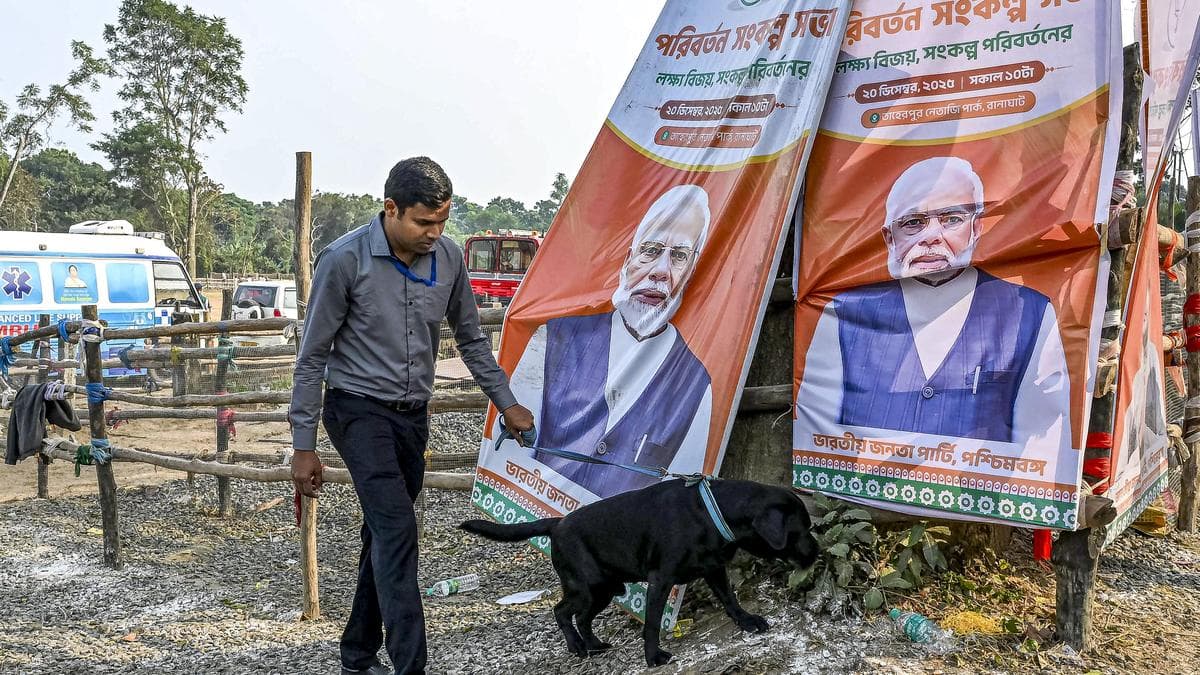
PM Modi seeks "double-engine govt" in Bengal by 2026; TMC alleges neglect of Matua citizenship.
Summary
Prime Minister Narendra Modi, during a rally in West Bengal, urged voters to support the BJP in the 2026 Assembly polls to establish a "double-engine government." The Trinamool Congress (TMC) criticized PM Modi for allegedly not addressing concerns regarding the citizenship of the Matua community in his speech. This highlights ongoing political dynamics in West Bengal, particularly concerning the Matua community's significance and the Citizenship Amendment Act (CAA), crucial for understanding state politics and citizenship issues.
Key Points
- 1Prime Minister Narendra Modi campaigned in West Bengal.
- 2PM Modi appealed for a "double-engine government" by the BJP in West Bengal.
- 3The appeal was made for the 2026 Assembly polls in the State.
- 4The Trinamool Congress (TMC) alleged PM Modi lacked concerns about the Matuas' citizenship.
- 5The Matua community's citizenship issue is a key political point in West Bengal.
In-Depth Analysis
The political landscape of West Bengal is a fascinating study of regionalism, identity politics, and the dynamic interplay between national and state-level parties. Prime Minister Narendra Modi's recent rally, where he appealed for a "double-engine government" by the BJP in the 2026 Assembly polls, and the Trinamool Congress (TMC)'s subsequent criticism regarding the Matua community's citizenship, encapsulate these complex dynamics perfectly.
**Background Context and What Happened:**
West Bengal has historically been a stronghold of regional parties and, for decades, the Left Front. However, in recent years, the Bharatiya Janata Party (BJP) has made significant inroads, emerging as the principal opposition to the ruling Trinamool Congress (TMC). The term "double-engine government" is a BJP coinage, referring to a state where the same party (or alliance) is in power both at the Centre and in the State. The BJP argues that this alignment facilitates better coordination, faster decision-making, and accelerated development, as state projects receive more robust central support. PM Modi's appeal for the 2026 Assembly polls indicates the BJP's long-term strategy and continued focus on expanding its footprint in states where it is not currently in power. The TMC, led by Chief Minister Mamata Banerjee, swiftly countered this narrative, alleging that the Prime Minister's speech lacked specific concerns about the citizenship of the Matua community, a crucial vote bank in several districts of West Bengal.
**Key Stakeholders Involved:**
1. **Bharatiya Janata Party (BJP):** The ruling party at the Centre, aiming to consolidate its position in West Bengal and eventually form a government. Their strategy involves highlighting development, nationalistic themes, and leveraging the popularity of PM Modi.
2. **Trinamool Congress (TMC):** The incumbent ruling party in West Bengal, fighting to retain its power. The TMC often positions itself as a protector of Bengali identity and a bulwark against what it perceives as the BJP's divisive politics. Their criticism aims to expose what they see as the BJP's unfulfilled promises, particularly concerning the Matuas.
3. **Matua Community:** A Scheduled Caste group comprising primarily of refugees who migrated from erstwhile East Pakistan (now Bangladesh) due to religious persecution. They hold significant electoral sway in at least 30-40 assembly constituencies, particularly in North 24 Parganas, Nadia, and other border districts. Their demand for citizenship has been a long-standing issue, and they were largely seen as supporters of the Citizenship Amendment Act (CAA) due to its promise of citizenship.
4. **Voters of West Bengal:** The ultimate arbiters, whose choices will be influenced by narratives of development, identity, citizenship, and governance put forth by both parties.
**Significance for India and Historical Context:**
This political exchange is highly significant for India for several reasons. Firstly, it underscores the persistent issue of **citizenship**, particularly for refugees and migrants from neighboring countries. The Matua community's origins trace back to the Partition of India in 1947, when East Bengal became East Pakistan, and later to the Bangladesh Liberation War in 1971. Waves of migration, often driven by religious persecution, brought millions into West Bengal. The Matua Mahasangha, a socio-religious sect, emerged as a powerful voice for these displaced people, advocating for their rights and, crucially, their citizenship status.
This issue gained renewed prominence with the enactment of the **Citizenship Amendment Act (CAA), 2019**. The CAA seeks to grant Indian citizenship to persecuted religious minorities (Hindus, Sikhs, Buddhists, Jains, Parsis, and Christians) from Pakistan, Bangladesh, and Afghanistan who entered India on or before December 31, 2014. The Matua community, being largely Hindu refugees from Bangladesh, expected swift implementation of the CAA to formalize their status. The delay in framing rules for the CAA, which were finally notified in March 2024, has been a major point of contention and political leverage.
**Constitutional Provisions and Policies:**
The legal framework for citizenship in India is primarily governed by the **Citizenship Act, 1955**. This Act has been amended multiple times, with the **Citizenship Amendment Act (CAA), 2019**, being the most recent and contentious. Article 11 of the Indian Constitution grants Parliament the power to regulate the right of citizenship by law. The CAA's provisions are rooted in this parliamentary power. The Matua issue also touches upon **Article 14 (Equality before law)**, **Article 21 (Protection of life and personal liberty)**, and the broader principles of **secularism** and **humanitarianism** within the Indian Constitution. The debate around CAA has raised questions about these fundamental rights, especially concerning the exclusion of certain groups.
**Future Implications:**
The political rhetoric surrounding the Matuas and the "double-engine government" will undoubtedly shape the upcoming electoral cycles in West Bengal, including the 2026 Assembly polls. For the Matuas, the full implementation of the CAA remains a critical concern, and their support will likely swing towards the party that they believe will best address their citizenship aspirations. The BJP hopes that the CAA will consolidate Matua votes in its favor, while the TMC's criticism aims to highlight the delay and potential pitfalls of the Act, potentially appealing to other communities wary of its implications. This ongoing political contestation also has implications for center-state relations, potentially leading to increased friction or, conversely, a more cooperative federal structure if the BJP gains power in the state. The long-term impact on West Bengal's social fabric and demographic politics, particularly regarding refugee rights and integration, will be closely watched.
This episode is a microcosm of larger challenges facing Indian democracy: balancing national security with humanitarian concerns, managing diverse populations, and navigating the complexities of identity politics in a federal structure. The outcome in West Bengal will not only define the state's future but also offer insights into the evolving nature of Indian politics and the role of citizenship in electoral strategies.
Exam Tips
This topic falls under GS Paper II (Polity & Governance, Social Justice) and GS Paper I (Indian History - Post-independence consolidation) for UPSC. For SSC, Banking, and State PSCs, it's crucial for Current Affairs and General Awareness, particularly on Indian Polity and Constitutional provisions.
Study the Citizenship Act, 1955, and the Citizenship Amendment Act (CAA), 2019, in detail. Understand their provisions, historical context, and the controversies surrounding them. Also, revise Articles 5-11 of the Indian Constitution related to citizenship.
Be prepared for questions on federalism (center-state relations), the role of regional parties, electoral strategies (like 'double-engine government'), and the impact of identity politics (e.g., Matua community) on elections. MCQs might ask about specific provisions of CAA or constitutional articles, while descriptive questions could focus on the socio-political implications of citizenship laws.
Familiarize yourself with key political terms like 'double-engine government', 'refugee', 'migrant', and their implications in the Indian context. Understand the difference between NRC and CAA.
Analyze the geopolitical context of migration from Bangladesh to India, including the events of 1947 and 1971, to fully grasp the historical roots of the Matua community's situation.
Related Topics to Study
Full Article
PM Modi urged the people to provide a chance to the BJP in the 2026 Assembly polls to form a “double-engine government” in the State