



Relevant for Exams
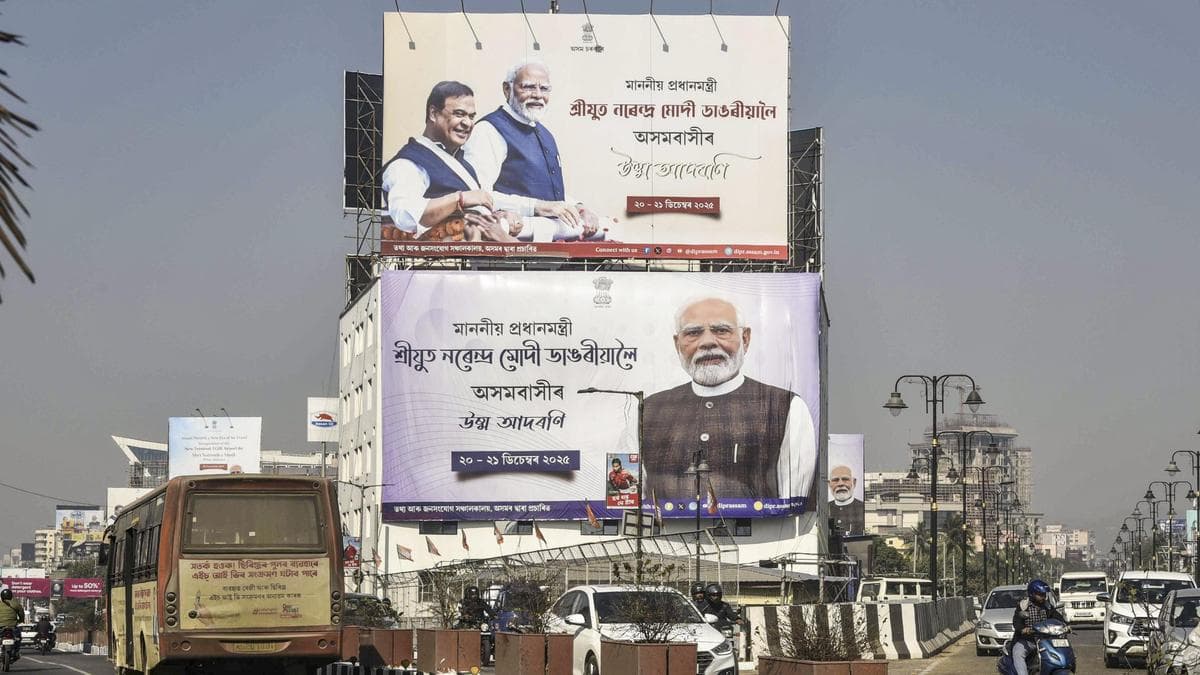
PM Modi on two-day Assam visit, unveils statue of state's first CM Gopinath Bordoloi.
Summary
Prime Minister Narendra Modi embarked on a two-day visit to Assam, where he unveiled a statue of Gopinath Bordoloi, the state's first Chief Minister. This visit underscores the government's focus on regional development and historical recognition. For competitive exams, this event is significant for general awareness, specifically regarding prominent political figures and state history.
Key Points
- 1Prime Minister Narendra Modi undertook a two-day official visit to Assam.
- 2PM Modi unveiled a statue of Gopinath Bordoloi, the first Chief Minister of Assam.
- 3The Prime Minister was received at the Lokapriya Gopinath Bordoloi International Airport.
- 4Assam Governor Laxman Prasad Acharya and Chief Minister Himanta Biswa Sarma received PM Modi.
- 5Gopinath Bordoloi is historically recognized as a pivotal figure in Assam's political landscape.
In-Depth Analysis
Prime Minister Narendra Modi's two-day visit to Assam, marked by the unveiling of a statue of Gopinath Bordoloi, the state's first Chief Minister, is a significant event with multiple layers of political, historical, and cultural importance for India. This gesture goes beyond mere ceremonial duties, reflecting the Central government's strategic focus on the North Eastern states and its efforts to integrate regional heroes into the national narrative.
**Background Context and Historical Significance:**
Gopinath Bordoloi, often revered as 'Lokapriya' (beloved by the people), was a towering figure in Assam's political landscape and a stalwart of the Indian freedom struggle. Born in 1890, Bordoloi was a Gandhian who actively participated in the Non-Cooperation Movement and the Quit India Movement. His most crucial contribution, however, came during the tumultuous period leading up to India's independence. In 1946, the British Cabinet Mission Plan proposed a 'Grouping' scheme, which would have grouped Assam with Bengal (Group C), effectively making it part of a Muslim-majority province that many feared would eventually accede to East Pakistan. Bordoloi, as the then Premier of Assam, vehemently opposed this plan, mobilizing public opinion and engaging in intense negotiations with the Congress high command and the British administration. His resolute stand, despite pressure from certain quarters, ultimately led to the Cabinet Mission's plan being dropped for Assam, thereby preserving its territorial integrity and distinct cultural identity within India. He served as the first Chief Minister of Assam from 1946 until his death in 1950, laying the administrative and developmental foundations for the newly independent state. Recognizing such a pivotal figure underscores the nation's gratitude and reinforces the idea of 'Ek Bharat Shreshtha Bharat' – One India, Great India – by acknowledging the diverse contributions of leaders from all regions.
**What Happened and Key Stakeholders:**
Prime Minister Narendra Modi arrived at the Lokapriya Gopinath Bordoloi International Airport, a symbolic entry point named after the very leader being honored. He was received by Governor Laxman Prasad Acharya and Chief Minister Himanta Biswa Sarma, along with other state cabinet colleagues. The primary event was the unveiling of Bordoloi's statue, a public acknowledgement of his legacy. Key stakeholders include the Prime Minister and the Central Government, who are keen on demonstrating their commitment to the North East; the Assam State Government, which benefits from increased central attention and infrastructure development; and the people of Assam, who see their history and heroes being recognized at the national level. The act of unveiling the statue is a powerful symbolic gesture, aimed at fostering regional pride while integrating it into the broader national consciousness.
**Significance for India and Broader Themes:**
The visit and the recognition of Gopinath Bordoloi are profoundly significant for India. Firstly, it highlights the Central government's continued focus on the North Eastern Region (NER), aligning with its 'Act East Policy' which seeks to enhance connectivity and economic ties with Southeast Asian nations. By honoring a regional icon, the government reinforces its commitment to the development and integration of the NER, often perceived as geographically peripheral but strategically vital. Secondly, it serves as a powerful message of federalism and national unity. Recognizing state leaders on a national platform strengthens the bond between the Centre and states, acknowledging the unique historical trajectories and contributions of each region to the Indian Union. This can help counter regional alienation and strengthen national cohesion. Politically, it also resonates with the electorate in Assam and the wider North East, demonstrating respect for local sentiments and historical figures.
**Constitutional and Policy References:**
While there isn't a direct constitutional article dictating the recognition of historical figures, the spirit of federalism is enshrined in the Indian Constitution, particularly through Articles 1, 245, 246, and 256, which define the distribution of powers and responsibilities between the Union and the states. The recognition of state-level leaders like Bordoloi strengthens the cooperative federalism ethos. Furthermore, Article 371B provides for special provisions with respect to the state of Assam, reflecting its unique historical and cultural context. The 'Act East Policy', though not a constitutional provision, is a significant foreign policy initiative that directly impacts the North East, aiming to transform it into a gateway for India's engagement with the ASEAN region and beyond. Such visits often precede or accompany announcements of developmental projects under various central schemes, reinforcing the Centre's commitment to Article 371B's underlying principle of ensuring equitable development.
**Future Implications:**
The future implications of such high-profile visits and symbolic gestures are manifold. They are likely to lead to increased focus on infrastructure development, connectivity projects (roads, railways, waterways), and economic initiatives in Assam and the surrounding North Eastern states. This could include further investment in sectors like tourism, agriculture, and manufacturing, leveraging the region's unique resources. Culturally, it can foster a stronger sense of identity and belonging among the people of Assam, ensuring that their historical contributions are not forgotten. Politically, it strengthens the ruling party's presence and influence in the region, potentially leading to greater political stability and integration. The recognition of regional heroes also sets a precedent for celebrating other unsung heroes from different parts of India, enriching the national tapestry and promoting a more inclusive understanding of Indian history.
Exam Tips
This topic falls under 'Indian History' (Modern India, Post-Independence Consolidation), 'Indian Polity and Governance' (Federalism, Centre-State Relations, Special Provisions for States), and 'Current Events of National Importance' in UPSC, SSC, and State PSC syllabi. Focus on factual details for preliminary exams (names, dates, key events) and analytical aspects for mains (significance, implications, constitutional linkages).
Study Gopinath Bordoloi's biography, his role in the freedom struggle, especially his opposition to the Cabinet Mission Plan's 'Grouping' scheme, and his contributions as the first CM of Assam. Relate this to the broader topic of state reorganization and integration of princely states/regions post-independence.
Pay attention to the 'Act East Policy' and other government initiatives for the North Eastern Region (e.g., North Eastern Council, various connectivity projects). Questions can be asked about the policy's objectives, its impact on the region, and India's relations with Southeast Asian countries.
Understand the concept of federalism in India and how gestures like honoring regional leaders contribute to cooperative federalism and national integration. Be prepared for questions on the roles of the President/Governor and Chief Minister in state governance, especially concerning centre-state interactions.
Practice both objective-type questions (e.g., 'Who was the first CM of Assam?', 'Which plan did Gopinath Bordoloi oppose?') and subjective/essay-type questions (e.g., 'Discuss the significance of recognizing regional leaders in promoting national unity and federalism in India').
Related Topics to Study
Full Article
PM Narendra Modi was received at the Lokapriya Gopinath Bordoloi International Airport by Governor Laxman Prasad Acharya, Chief Minister Himanta Biswa Sarma and his cabinet colleagues