



Relevant for Exams
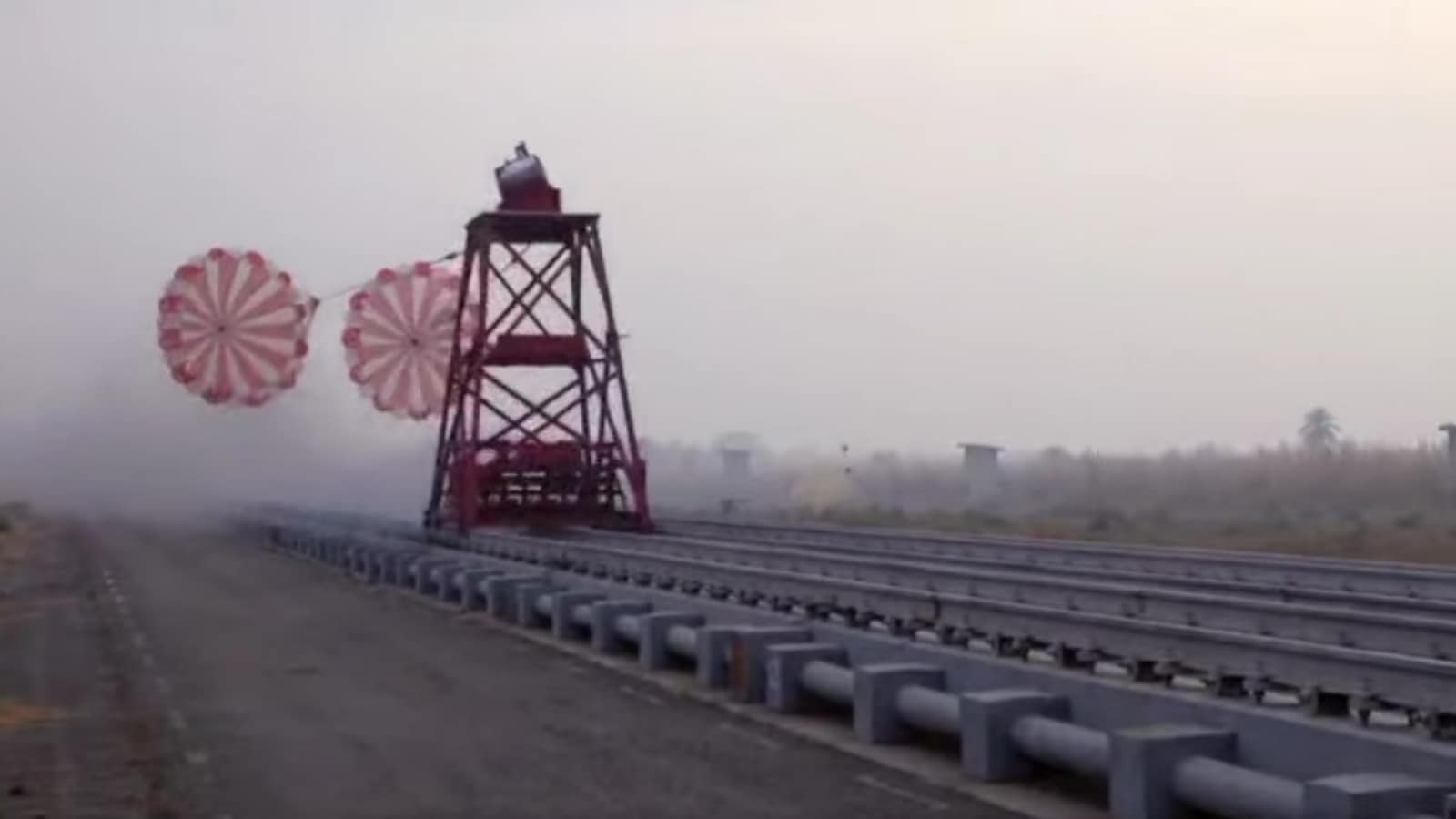
ISRO tests Gaganyaan parachute systems for safe astronaut re-entry and recovery.
Summary
ISRO is conducting fresh tests on parachute systems, a critical component for the Gaganyaan mission. These tests are vital to ensure the safe re-entry and recovery of the crew module and astronauts, marking a significant step in India's human spaceflight program. This development is crucial for understanding the progress and technical challenges of the Gaganyaan mission for competitive exams.
Key Points
- 1Gaganyaan Mission: India's ambitious human spaceflight program by ISRO, aiming to send astronauts to Low Earth Orbit (LEO).
- 2Executing Agency: Indian Space Research Organisation (ISRO) is the primary agency responsible for the Gaganyaan mission.
- 3Parachute Systems: These are crucial for the safe deceleration and controlled splashdown or landing of the crew module upon re-entry.
- 4Testing Phase: Fresh tests indicate ongoing validation and qualification of critical systems for astronaut safety and mission success.
- 5Re-entry & Recovery: The parachute systems are vital for the final stage of the mission, ensuring the safe recovery of the crew module and astronauts.
In-Depth Analysis
India's ambitious journey into human spaceflight, epitomized by the Gaganyaan mission, represents a monumental leap in the nation's technological prowess and strategic autonomy. The recent news of ISRO conducting fresh tests on parachute systems for the Gaganyaan mission underscores the meticulous and critical engineering efforts underway to ensure astronaut safety and mission success. These tests are not merely routine checks; they are a vital validation of a complex system designed to safely bring back the crew module and its precious human cargo from the harsh environment of space.
The Gaganyaan mission, announced by Prime Minister Narendra Modi on August 15, 2018, aims to send a three-member Indian crew to a Low Earth Orbit (LEO) for a duration of 3 to 7 days. This mission is a culmination of decades of incremental progress by the Indian Space Research Organisation (ISRO), which has evolved from launching its first satellite, Aryabhata, in 1975, to achieving feats like the Chandrayaan lunar missions and the Mangalyaan Mars Orbiter Mission. Each successful mission has built a foundation of expertise in launch vehicle technology, satellite deployment, deep-space communication, and complex orbital maneuvers, all of which are prerequisites for human spaceflight.
The re-entry and recovery phase is arguably one of the most hazardous parts of any human spaceflight mission. After completing its orbital operations, the Gaganyaan crew module will de-orbit and begin its fiery descent through the Earth's atmosphere. During this phase, the module experiences extreme temperatures due to atmospheric friction, requiring robust thermal protection systems. Once the module has decelerated sufficiently, the parachute system comes into play. These systems are incredibly complex, often involving a sequence of parachutes – starting with smaller drogue parachutes to stabilize and further slow down the module, followed by larger main parachutes that ensure a gentle splashdown in the designated recovery zone, likely in the Arabian Sea or the Bay of Bengal. The fresh tests being conducted by ISRO are crucial to qualify these multi-stage parachute deployment sequences under various simulated conditions, ensuring their reliability and redundancy.
Key stakeholders in this monumental endeavour include primarily ISRO, which is responsible for the design, development, and execution of the entire mission. However, the mission's scope extends far beyond ISRO's direct involvement. Various Indian industries, both public and private, are contributing significantly to manufacturing components, systems, and sub-systems, aligning perfectly with the 'Make in India' and 'Atmanirbhar Bharat' initiatives. Academic institutions are engaged in research and development, while international collaborations, notably with France (for astronaut medical support and training) and Russia (for astronaut training), provide critical expertise and facilities. The Indian government provides the necessary policy framework, strategic direction, and substantial financial backing, recognizing the mission's strategic importance.
The significance of Gaganyaan for India is multi-faceted. Technologically, it demonstrates India's self-reliance and advanced capabilities in areas like life support systems, crew escape systems, re-entry technology, and human-rated launch vehicles (GSLV Mk III). Strategically, joining the elite club of nations (USA, Russia, China) capable of independent human spaceflight elevates India's global standing and soft power. Economically, the mission is a catalyst for growth in the aerospace sector, fostering innovation, creating high-skilled jobs, and potentially leading to spin-off technologies beneficial to other sectors. From a scientific perspective, it opens avenues for microgravity experiments and studying human physiology in space, contributing to global scientific knowledge. Furthermore, it inspires a new generation towards science, technology, engineering, and mathematics (STEM) fields, fostering a scientific temper as enshrined in Article 51A(h) of the Indian Constitution, which mandates developing scientific temper, humanism, and the spirit of inquiry.
The historical context of India's space program underscores a consistent pursuit of self-reliance and peaceful applications of space technology. From the early days of building rockets on bicycle carts to launching commercial satellites for other nations, ISRO has always aimed for indigenous capability. Gaganyaan is a natural progression, aiming to achieve complete end-to-end capability in human spaceflight. Looking ahead, the successful completion of Gaganyaan will not be an endpoint but a stepping stone. It will pave the way for sustained human presence in space, potentially leading to an Indian space station (Bharatiya Antariksha Station) and more ambitious deep-space human exploration missions. It also strengthens India's position in international space cooperation and could open doors for future commercial space tourism or private sector involvement, further regulated by potential legislation like the proposed Space Activities Bill.
In essence, the ongoing parachute tests are a small yet critical piece of a much larger, ambitious puzzle. They symbolize India's commitment to meticulous engineering, astronaut safety, and its unwavering resolve to carve out a significant presence in the cosmos, truly embodying the spirit of scientific exploration and national aspiration.
Exam Tips
This topic primarily falls under the 'Science & Technology' section of the UPSC Civil Services Exam (GS Paper III) and General Awareness sections of SSC, Banking, Railway, and State PSC exams. Focus on understanding the mission's objectives, key technologies involved, and its strategic importance for India.
When studying, link Gaganyaan with India's broader space policy, previous ISRO missions (like Chandrayaan and Mangalyaan), and international human spaceflight programs. Questions often compare India's capabilities with other spacefaring nations or ask about the 'why' behind such missions.
Pay attention to specific facts: mission name, executing agency (ISRO), target orbit (LEO), number of crew members, and the launch vehicle (GSLV Mk III). Conceptual questions might ask about the challenges of re-entry, the purpose of specific systems like parachutes, or the social/economic benefits of space exploration.
Be prepared for questions on related government initiatives such as 'Atmanirbhar Bharat' and 'Make in India,' as Gaganyaan significantly leverages indigenous capabilities. Understand how the mission contributes to these broader national goals.
Familiarize yourself with the constitutional provisions like Article 51A(h) (Fundamental Duty to develop scientific temper) to provide a holistic answer, especially in descriptive exams, linking scientific advancements to national values.