



Relevant for Exams
1933: Mudd & Flosdorf develop dried blood serum, revolutionizing wartime medicine.
Summary
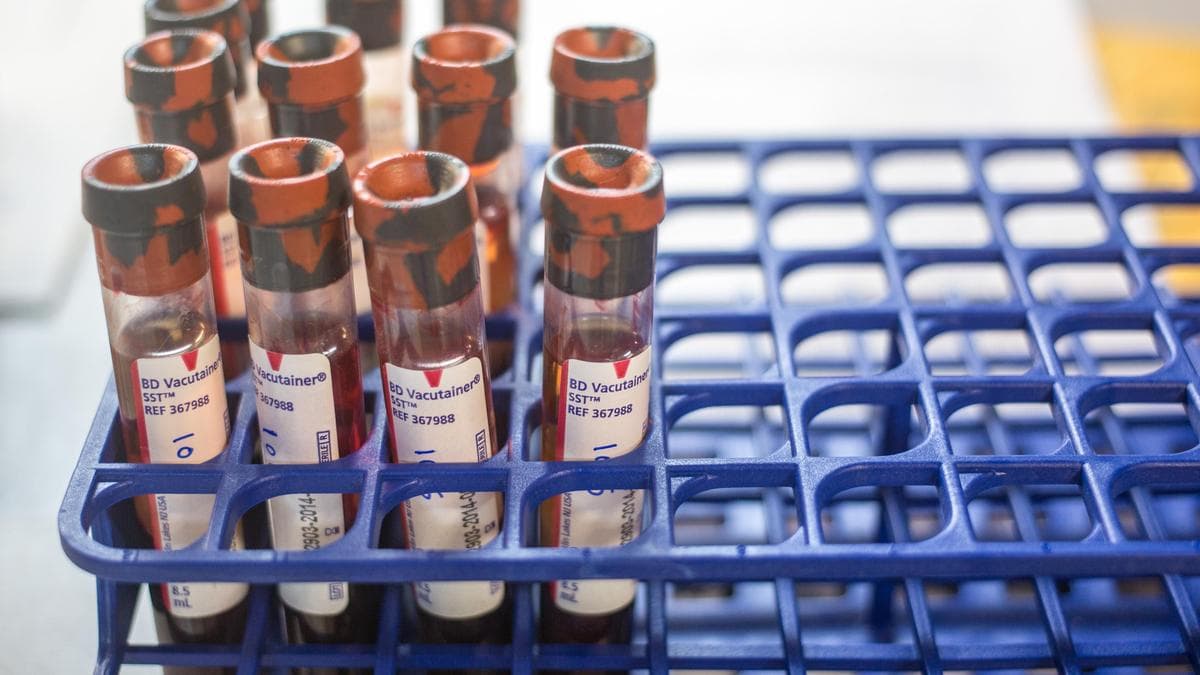
On December 21, 1933, biochemists Stuart Mudd and Earl Flosdorf successfully prepared dried human blood serum. This scientific breakthrough, initially a novelty, became crucial during World War II, saving countless lives by enabling easier storage and transport of blood products. For competitive exams, this highlights a significant historical development in medical science and its impact on warfare and public health.
Key Points
- 1On December 21, 1933, biochemists Stuart Mudd and Earl Flosdorf achieved the first successful preparation of dried human blood serum.
- 2The two biochemists responsible for this discovery were Stuart Mudd and Earl Flosdorf.
- 3Their innovation involved creating dried human blood serum, a method to preserve blood components.
- 4The process, initially a novelty, gained critical importance and widespread use with the onset of World War II.
- 5The primary significance of dried human blood serum was its ability to save countless lives during World War II and subsequent decades.
In-Depth Analysis
The discovery by biochemists Stuart Mudd and Earl Flosdorf on December 21, 1933, of a method to prepare dried human blood serum marks a pivotal moment in medical history, transforming battlefield medicine and civilian healthcare. Prior to this breakthrough, the challenges of blood preservation severely limited the efficacy of transfusions. Liquid blood has a very short shelf life, typically only a few weeks, and requires continuous refrigeration, making its transport and storage in remote or war-torn areas incredibly difficult. Early attempts at blood transfusions, though dating back centuries, were often hampered by issues of blood typing, coagulation, and contamination, alongside the logistical nightmare of maintaining viable blood supplies.
Mudd and Flosdorf's innovation involved lyophilization, or freeze-drying, which removes water from the blood serum while preserving its essential components. This process dramatically extended the shelf life of blood products, allowing them to be stored at room temperature for extended periods and easily reconstituted with sterile water when needed. Initially seen as a scientific novelty, its true potential was unleashed with the onset of World War II. The sheer scale of casualties and injuries on battlefields across the globe created an unprecedented demand for blood products. Dried plasma, a component of serum, could be rapidly deployed to provide immediate volume replacement for soldiers suffering from shock or severe blood loss, significantly reducing mortality rates before more comprehensive medical care could be administered.
Key stakeholders in this development included the pioneering scientists Stuart Mudd and Earl Flosdorf, whose intellectual curiosity and persistence led to the discovery. The medical community, particularly military doctors and researchers, quickly recognized and adopted the technique, scaling up production and distribution. Governments and military organizations became crucial facilitators, investing in research, manufacturing facilities, and logistical networks to deliver these life-saving products to the front lines. Ultimately, the countless soldiers and civilians who received these transfusions were the primary beneficiaries, their lives saved or significantly improved by this advancement.
For India, the impact of such global medical advancements, though not originating domestically, has been profound. Post-independence, as India began building its public health infrastructure, the principles and techniques of blood preservation, including those stemming from Mudd and Flosdorf's work, became foundational. The establishment of a robust network of blood banks across the country, regulated by bodies like the National Blood Transfusion Council and the Central Drugs Standard Control Organization (CDSCO), is a direct consequence of this global progression in transfusion medicine. Reliable access to safe blood and blood products is critical for a range of medical procedures, including major surgeries, treatment of trauma victims, management of anemia, and maternal healthcare, particularly in reducing maternal mortality rates. This aligns with India's constitutional commitment to public health. Article 47 of the Directive Principles of State Policy mandates that the State shall regard the raising of the level of nutrition and the standard of living of its people and the improvement of public health as among its primary duties. The availability of stored blood products directly contributes to fulfilling this constitutional obligation by ensuring essential healthcare services.
Furthermore, the regulatory framework governing blood banks in India, primarily under the Drugs and Cosmetics Act, 1940, and its subsequent rules (especially Part XB dealing with 'Blood Banks'), ensures the quality, safety, and efficacy of blood and its components. This Act, along with the National Blood Policy (2002), aims to achieve 100% voluntary blood donation and ensure a safe, adequate, and accessible blood supply. The ongoing efforts towards self-reliance in healthcare, encapsulated by initiatives like 'Atmanirbhar Bharat', also underscore the importance of indigenous capacity in blood processing, storage, and distribution, drawing lessons from global innovations.
The future implications of this discovery are vast. It laid the groundwork for modern transfusion medicine, leading to the development of specific blood components (red cells, platelets, cryoprecipitate), advanced cryopreservation techniques for long-term storage, and research into synthetic blood substitutes. Challenges remain, particularly in ensuring blood safety (screening for infectious diseases like HIV, Hepatitis B and C), promoting voluntary blood donation, and improving logistics for blood delivery in remote and underserved areas. Continued research in fields like regenerative medicine and gene therapy also draws upon the fundamental understanding of blood biology advanced by such early breakthroughs. The legacy of Mudd and Flosdorf's work continues to inspire efforts to make life-saving medical interventions more accessible and effective globally, including in India's journey towards universal healthcare.
Exam Tips
This topic falls under the 'General Science' (Biology: Human Physiology, Diseases, Health) and 'Science & Technology' (Biotechnology, Medical Advancements) sections of UPSC, SSC, Railway, State PSC, and Defence exams. It can also appear in 'History' (World History, Scientific Discoveries).
When studying, focus on the 'why' behind the discovery (challenges of liquid blood), the 'what' (dried human blood serum/plasma, freeze-drying), the 'when' (1933, critical during WWII), and the 'impact' (saved lives, revolutionized medicine, led to modern blood banking).
Common question patterns include direct factual questions (e.g., 'Who discovered dried blood serum?', 'When was it discovered?'), application-based questions (e.g., 'What was the significance of dried plasma during WWII?'), and questions linking scientific discoveries to public health policies or constitutional provisions in India (e.g., 'How do advancements in blood preservation relate to Article 47 of the Indian Constitution?').
Relate this historical discovery to current public health initiatives and legal frameworks in India, such as the Drugs and Cosmetics Act, 1940, and the National Blood Policy, to understand its contemporary relevance.
Be prepared to discuss the evolution of blood preservation techniques from this initial discovery to modern blood component therapy and cryopreservation methods.
Related Topics to Study
Full Article
On December 21, 1933, biochemists Stuart Mudd and Earl Flosdorf tasted success for the first time in their efforts to prepare dried human blood serum. While it remained a novelty until the onset of World War II, the process saved countless lives during the war and the decades since. A.S.Ganesh helps you draw first blood on this subject with this small primer…