



Relevant for Exams
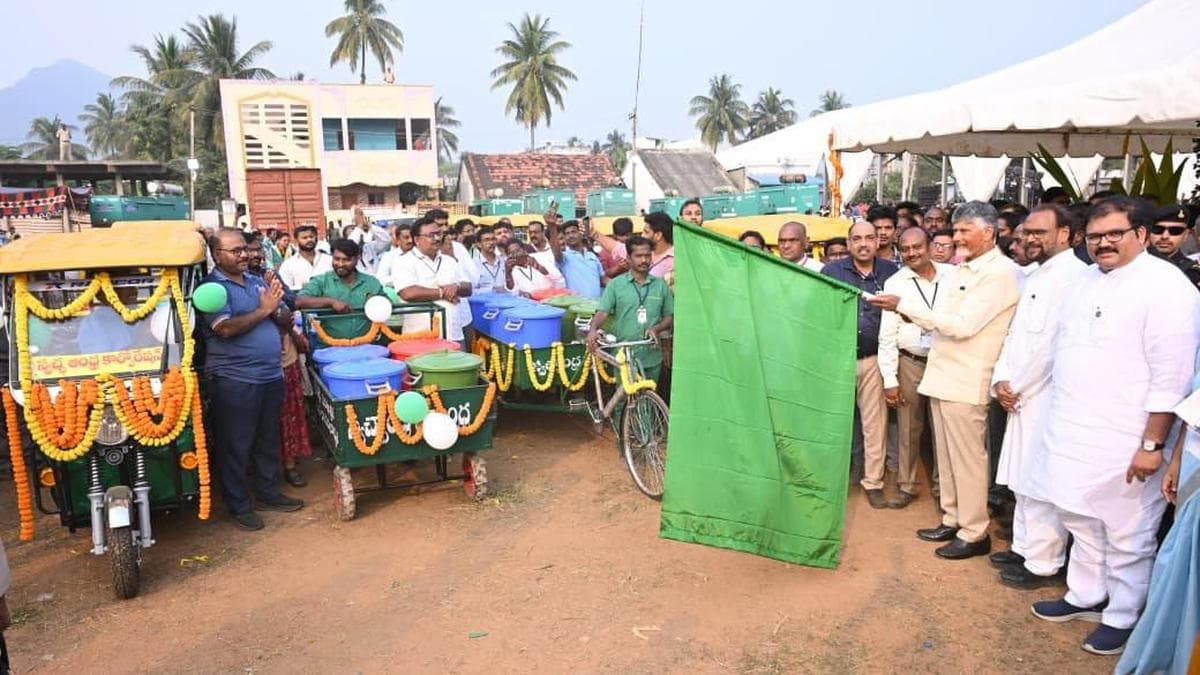
Andhra Pradesh CM Naidu targets plastic-free state by June 2025, garbage-free roads by Jan 26, 2025.
Summary
Andhra Pradesh Chief Minister Chandrababu Naidu has set ambitious Swachh targets for the state, aiming to make it plastic-free by June next year and its roads garbage-free by January 26 next year. This initiative emphasizes adopting a circular economy model for waste recycling, highlighting the state government's focus on environmental sustainability. For competitive exams, this showcases a state-level policy on cleanliness and waste management, relevant for questions on environmental initiatives and state-specific current affairs.
Key Points
- 1Andhra Pradesh Chief Minister Chandrababu Naidu announced Swachh targets for the state.
- 2Andhra Pradesh aims to become plastic-free by June 2025.
- 3Roads in Andhra Pradesh are targeted to be garbage-free by January 26, 2025.
- 4The initiative stresses the adoption of a circular economy model for waste recycling.
- 5The Chief Minister appealed to the people to participate for future generations' benefit.
In-Depth Analysis
The recent announcement by Andhra Pradesh Chief Minister Chandrababu Naidu to achieve ambitious Swachh targets – making the state plastic-free by June 2025 and its roads garbage-free by January 26, 2025 – marks a significant step towards environmental sustainability and effective waste management. This initiative is not merely a cleanliness drive but a strategic move emphasizing the adoption of a circular economy model for waste recycling, appealing to citizens for their active participation.
**Background Context and Historical Linkages:**
India has long grappled with the mammoth challenge of waste management, exacerbated by rapid urbanization, population growth, and changing consumption patterns. Mountains of waste in landfills, plastic pollution choking waterways, and unsegregated garbage on streets are common sights. Recognizing this, the Union Government launched the Swachh Bharat Abhiyan (SBA) on October 2, 2014, with the vision of a 'Clean India'. SBA, a nationwide campaign, aimed to achieve universal sanitation coverage and eliminate open defecation. It was later succeeded by Swachh Bharat Mission-Urban 2.0 and Swachh Bharat Mission (Gramin) Phase-II, focusing on sustainable solid waste management, wastewater treatment, and plastic waste management. Andhra Pradesh's new targets build upon this national momentum, translating the broader vision into concrete, time-bound state-level goals. The emphasis on a 'circular economy' moves beyond mere disposal to a model where resources are kept in use for as long as possible, extracting maximum value from them while in use, then recovering and regenerating products and materials at the end of each service life.
**What Happened and Key Stakeholders:**
Chief Minister Naidu's announcement sets a clear roadmap for Andhra Pradesh. The primary goal is to eliminate plastic waste by June 2025 and ensure roads are free of garbage by Republic Day, January 26, 2025. This involves a multi-pronged strategy: reducing plastic consumption, improving waste collection and segregation, enhancing recycling infrastructure, and promoting public awareness. The key stakeholders in this ambitious endeavor include:
1. **Andhra Pradesh State Government:** Through various departments (Urban Development, Panchayati Raj, Environment), it will formulate policies, allocate resources, and oversee implementation. Urban Local Bodies (ULBs) and Panchayati Raj Institutions (PRIs) at the grassroots level will be crucial for daily waste collection, segregation, and local enforcement.
2. **Citizens:** Their participation is paramount. Behavioral change, such as segregating waste at source, reducing single-use plastic, and responsible disposal, is critical for the success of the initiative. The Chief Minister's appeal underscores this need.
3. **Private Sector:** Waste management companies, recyclers, and innovators will play a vital role in developing and implementing efficient waste collection, processing, and recycling technologies, especially in a circular economy model.
4. **Non-Governmental Organizations (NGOs) and Self-Help Groups (SHGs):** These organizations can be instrumental in community mobilization, awareness campaigns, and even facilitating local waste collection and segregation efforts.
**Significance for India and Future Implications:**
This initiative holds significant importance for India. Environmentally, reducing plastic waste and achieving garbage-free roads will mitigate pollution, protect biodiversity, improve soil and water quality, and contribute to cleaner air. Public health will benefit immensely from reduced exposure to disease vectors thriving in unhygienic conditions. Economically, the circular economy approach can foster green jobs in waste collection, segregation, recycling, and product manufacturing from recycled materials. It can also reduce the state's reliance on virgin resources. If successful, Andhra Pradesh could serve as a model for other states, demonstrating how ambitious environmental targets can be achieved through concerted efforts.
**Constitutional and Policy Framework:**
Several constitutional provisions and legislative acts underpin such environmental initiatives:
* **Article 21 (Right to Life):** The Supreme Court has interpreted the right to life to include the right to a clean and healthy environment.
* **Article 48A (Directive Principle of State Policy):** It mandates that "the State shall endeavor to protect and improve the environment and to safeguard the forests and wild life of the country."
* **Article 51A(g) (Fundamental Duty):** It states that it shall be the duty of every citizen of India "to protect and improve the natural environment including forests, lakes, rivers and wild life, and to have compassion for living creatures."
* **73rd and 74th Constitutional Amendment Acts:** These acts empower Panchayats and Municipalities, respectively, to undertake functions related to public health, sanitation, and waste management at the local level.
* **Plastic Waste Management Rules, 2016 (and subsequent amendments):** These rules provide the legal framework for managing plastic waste, including the ban on single-use plastic items effective from July 1, 2022.
* **Solid Waste Management Rules, 2016:** These rules define responsibilities for waste generators, local authorities, and state pollution control boards, emphasizing segregation at source and scientific disposal.
The future implications are profound. Successful implementation would not only transform Andhra Pradesh's environmental landscape but also boost its image as a progressive state committed to sustainable development. However, challenges such as ensuring sustained public participation, adequate funding, technological adoption, and robust enforcement mechanisms will need to be meticulously addressed. The transition to a circular economy requires significant investment in infrastructure and a fundamental shift in consumption and production patterns, making this a long-term commitment that extends beyond the immediate targets.
Exam Tips
This topic falls under GS Paper 2 (Governance, Policies, Social Justice) and GS Paper 3 (Environment, Economy, Science & Technology) for UPSC. For State PSCs, it's relevant for General Studies on State-specific policies and Environment.
Study related topics like Swachh Bharat Abhiyan (Urban and Gramin), Plastic Waste Management Rules (2016, 2021, 2022), Solid Waste Management Rules (2016), and the concept of a Circular Economy. Understand the differences between linear and circular economies.
Common question patterns include: Direct questions on government schemes (e.g., 'Discuss the objectives and challenges of Swachh Bharat Abhiyan.'), analytical questions on the role of citizens and local bodies in environmental governance, and questions linking constitutional provisions (Article 21, 48A, 51A(g)) to environmental protection.
Be prepared to analyze the 'pros and cons' or 'challenges and opportunities' of such environmental initiatives, including financial, technological, and behavioral aspects.
For preliminary exams, focus on specific targets, dates, and the name of the state/CM. For mains, focus on integrated analysis, constitutional linkages, and policy implications.
Related Topics to Study
Full Article
Stressing the need for adopting a circular economy through which waste is recycled, the Chief Minister has appealed to the people to be a part of it for the benefit of the future generations