


Relevant for Exams
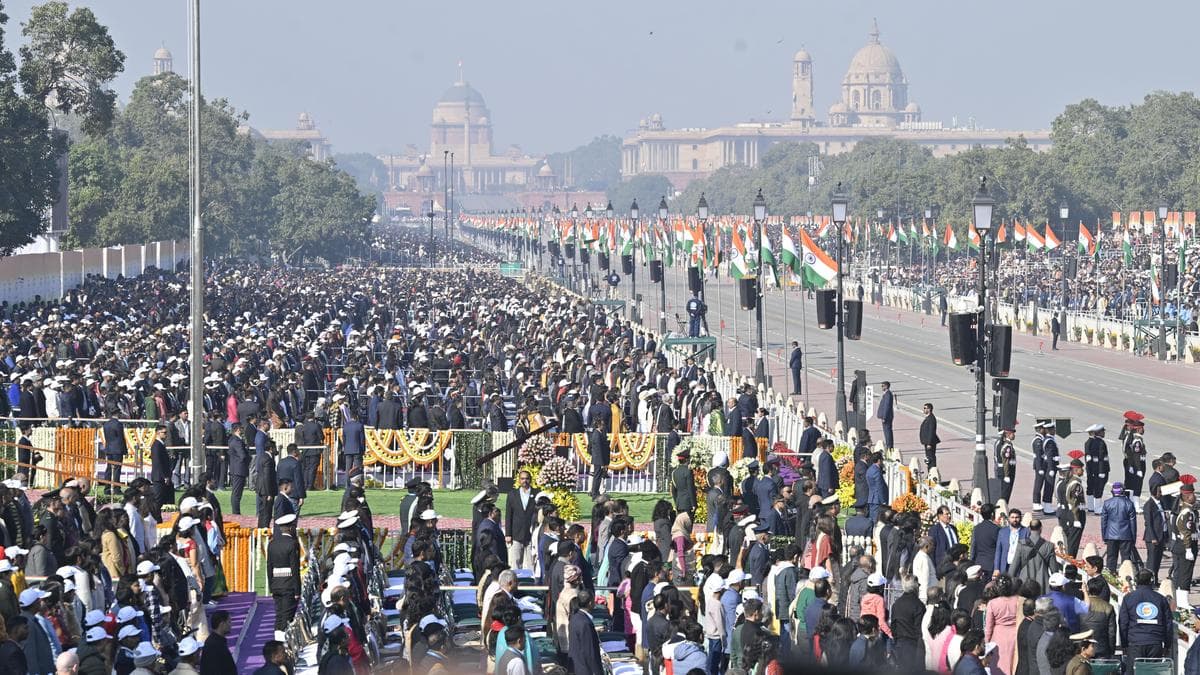
EU leaders invited for 77th Republic Day; EU-India Summit to finalize FTA.
Summary
India plans a Vande Mataram-themed 77th Republic Day celebration, inviting top EU leaders as chief guests. This move is significant as an EU-India Summit is scheduled alongside the festivities to finalize the long-pending Free Trade Agreement (FTA). This event underscores India's diplomatic efforts, boosts international relations, and holds economic importance for exam preparation, especially regarding international trade and national events.
Key Points
- 1Top EU leaders have been invited as chief guests for India's 77th Republic Day celebrations.
- 2The Republic Day fete is planned with a 'Vande Mataram' theme.
- 3An EU-India Summit is scheduled to be held on the sidelines of the Republic Day events.
- 4The primary agenda of the EU-India Summit is to finalize the much-delayed Free Trade Agreement (FTA).
- 5Multiple Ministries have been tasked with promotion and rebranding efforts for the event.
In-Depth Analysis
India's plan to host top European Union (EU) leaders as chief guests for the 77th Republic Day celebrations, coupled with a 'Vande Mataram' theme and an EU-India Summit aimed at finalizing a Free Trade Agreement (FTA), marks a significant moment in India's diplomatic calendar and economic strategy. This convergence of national celebration, cultural pride, and high-stakes economic diplomacy underscores India's growing global stature and its proactive approach to international relations.
The Republic Day, celebrated annually on January 26, commemorates the adoption of the Constitution of India in 1950. It is a grand display of India's military might, cultural diversity, and democratic ethos. The tradition of inviting a foreign Head of State or Government as the chief guest dates back to 1950, when Indonesian President Sukarno graced the occasion. This practice is a crucial tool of India's foreign policy, used to strengthen bilateral relations, signal strategic partnerships, and enhance India's soft power. The invitation to top EU leaders collectively, rather than a single head of state, highlights the strategic importance India places on its relationship with the EU as a bloc.
The 'Vande Mataram' theme adds a profound layer of nationalistic and cultural significance to the event. 'Vande Mataram', a poem written by Bankim Chandra Chattopadhyay in 1870s, was an integral part of India's freedom struggle and serves as the national song. Incorporating this theme into the Republic Day celebrations aims to evoke patriotic fervor and showcase India's rich cultural heritage to international dignitaries, reinforcing national identity and unity. This cultural projection, alongside economic and political engagements, forms a holistic approach to diplomacy.
At the heart of this diplomatic initiative is the EU-India Summit, specifically designed to finalize the long-pending Free Trade Agreement. Negotiations for a comprehensive FTA, officially known as the Broad-based Trade and Investment Agreement (BTIA), began in 2007 but were suspended in 2013 due to significant differences on issues such as data security, tariffs on automobiles, and market access for services. After an eight-year hiatus, talks resumed in June 2022, signaling renewed commitment from both sides. The EU is India's third-largest trading partner, and India is the EU's tenth-largest trading partner, making this agreement economically crucial.
Key stakeholders involved in this monumental exercise include the Indian Government, particularly the Ministry of External Affairs (MEA), the Ministry of Commerce and Industry, and the Prime Minister's Office. Various other ministries are tasked with promotion and rebranding, indicating a whole-of-government approach. On the European side, the European Commission, which negotiates trade agreements on behalf of the EU, and the European Council, comprising leaders of EU member states, are primary stakeholders. Businesses and industries in both India and the EU also stand as significant stakeholders, eagerly awaiting the potential benefits and challenges posed by the FTA.
This initiative holds immense significance for India. Economically, an FTA with the EU, a market of over 450 million people and a GDP of over $16 trillion, promises substantial gains. It could significantly boost India's exports of goods and services, attract foreign direct investment, and create employment opportunities. Reduced tariffs and non-tariff barriers would make Indian products more competitive in the European market, supporting the 'Make in India' and 'Atmanirbhar Bharat' initiatives. Politically and strategically, a robust partnership with the EU, a bloc of democratic nations, diversifies India's strategic alliances and provides a counterweight in an increasingly multipolar world. It also strengthens India's voice on global issues such as climate change, digital governance, and multilateralism.
From a constitutional perspective, while there isn't a direct constitutional article dictating Republic Day celebrations or chief guests, India's foreign policy objectives are guided by the Directive Principles of State Policy (DPSP), particularly Article 51. This article mandates the state to promote international peace and security, maintain just and honourable relations between nations, foster respect for international law and treaty obligations, and encourage settlement of international disputes by arbitration. The pursuit of an FTA and strengthening ties with the EU aligns perfectly with these principles. Furthermore, the implementation of any international treaty or agreement, such as an FTA, falls under the legislative powers of Parliament as per Article 253, which allows Parliament to make laws for implementing international agreements.
The future implications of this event are far-reaching. A successful conclusion of the FTA would not only unlock significant economic opportunities but also set a precedent for India's other ongoing FTA negotiations, such as with the UK. It would solidify India's position as a reliable and attractive destination for trade and investment. The strengthened strategic partnership with the EU could lead to deeper collaboration in areas like green energy transition, digital transformation, research and innovation, and defense. This event could mark a new chapter in India-EU relations, enhancing India's geopolitical influence and contributing to a more balanced and prosperous global order.
Exam Tips
This topic falls under GS Paper II (International Relations, Indian Polity - particularly foreign policy and constitutional provisions related to international agreements) and GS Paper III (Indian Economy - International Trade, Investment).
Study related topics such as the history of India-EU relations, the structure and functioning of the European Union, different types of Free Trade Agreements (FTAs) and their implications, India's current Foreign Trade Policy, and the significance of national symbols like 'Vande Mataram'.
Common question patterns include: MCQs on the year of Republic Day, chief guests, objectives of the EU-India Summit, or specific constitutional articles (e.g., Article 51, Article 253). Descriptive questions could ask about the economic and strategic significance of the India-EU FTA, India's foreign policy priorities, or the role of economic diplomacy in contemporary international relations.
Pay attention to specific dates (e.g., when FTA talks resumed, Republic Day date) and key figures/organizations (e.g., European Commission, Ministry of External Affairs) as these are often tested in factual questions.
Understand the 'why' behind the events – why EU leaders, why 'Vande Mataram' theme, why now for FTA finalization – to grasp the broader strategic context, which is crucial for analytical questions.
Related Topics to Study
Full Article
Top EU leaders have been invited for the 77th Republic Day celebrations; EU-India Summit planned on the sidelines to finalise the much-delayed Free Trade Agreement (FTA); multiple Ministries tasked with promotion and rebranding push